
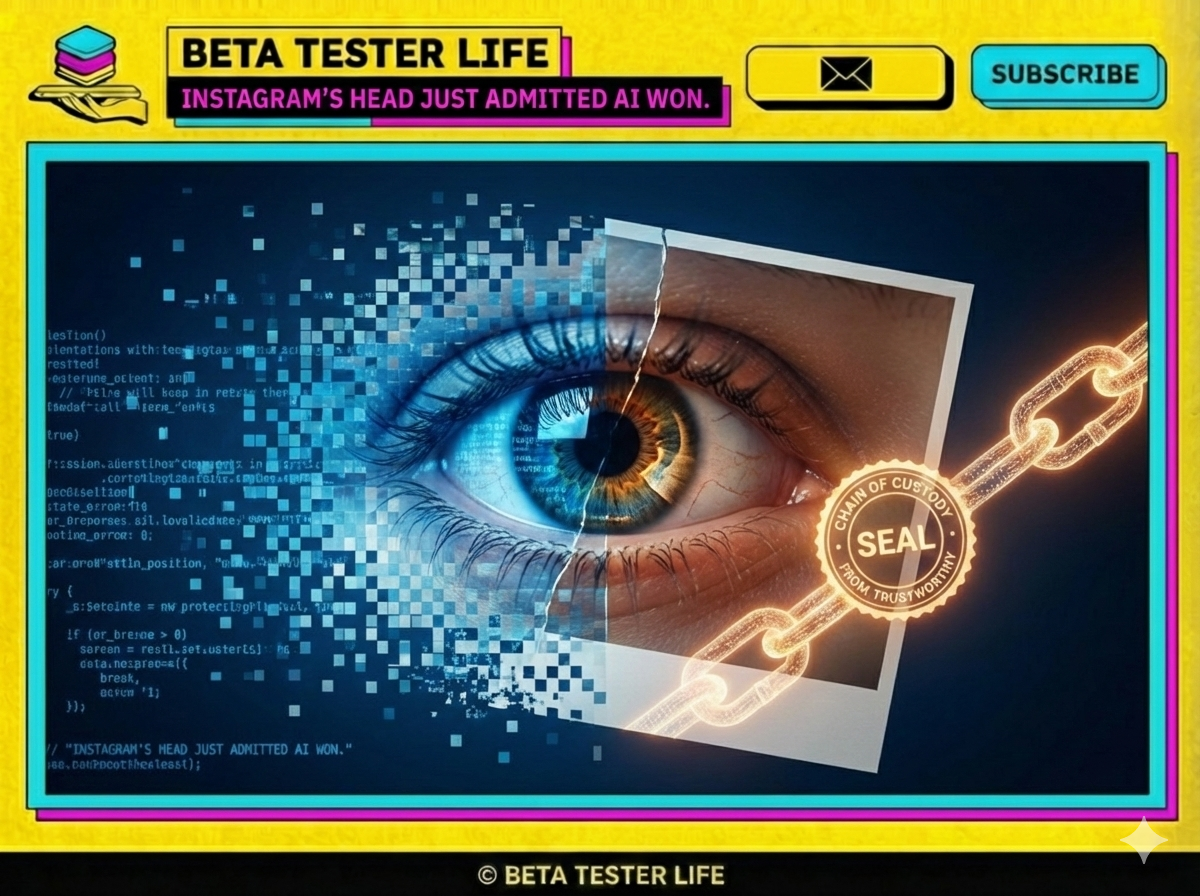
Adam Mosseri dropped a bomb on New Year’s Eve. In a 20-slide memo, Instagram’s head basically admitted defeat AI Generated content has won. AI-generated content has won. The photos you see? You can’t trust them anymore.
“For most of my life I could safely assume photographs or videos were largely accurate captures of moments that happened,” Mosseri wrote. “This is clearly no longer the case.”
He’s not wrong. Deepfakes jumped from 500,000 in 2023 to about 8 million in 2025. That’s 900% growth. The synthetic media flooding our feeds is getting harder to spot. Even experts get fooled. AI Generated content has won
The Problem With Detection
Current detection approaches are failing. AI learns to mimic imperfections. Those weird fingers and off-kilter shadows that used to give away fakes? AI is fixing them. The tools we built to catch synthetic media are losing the arms race.
Mosseri’s solution flips the script entirely. Instead of trying to detect what’s fake, verify what’s real. “It will be more practical to fingerprint real media than fake media,” he said.
Enter C2PA: Cryptographic Verification
The technology already exists. It’s called C2PA (Coalition for Content Provenance and Authenticity). Think of it like a digital signature baked into media at the moment of capture. Sony cameras are already shipping with it. Leica too. The idea is simple: sign photos cryptographically the instant they’re taken.
Here’s how it works. Your camera creates a manifest containing information about the device, a timestamp, and cryptographic hashes that bind the image to its metadata. Any modification breaks the signature. You can verify the entire chain of custody.
The Catch
There are gaps. Someone could photograph a printed AI image and sign that. C2PA can be stripped from images entirely. And we’ll have a two-tier system for years: verified new content versus unverified legacy media. The transition will be messy.
Plus, this puts a lot of power in Meta’s hands. They become arbiters of what’s “real.” That should make you uncomfortable.
What It Means For You
Mosseri predicts a mental shift: “We’re going to move from assuming what we see is real by default, to starting with skepticism.” That’s a massive rewiring of human behavior. We evolved to trust our eyes. Now we can’t.
For creators, “raw” and “imperfect” become authenticity signals. But even that’s temporary. Once AI can fake imperfection convincingly, we’re back to square one.
The real shift is from “what is being said” to “who is saying it.” Trust the source, not the pixels.
My Take
I agree with Mosseri’s diagnosis. Detection is a losing game. Verification from the source is smarter. AI Generated content has won
But I’m skeptical about execution. Camera manufacturers adopting standards is one thing. Getting phone makers, app developers, and social platforms to coordinate? That’s a decade-long project. And Meta has obvious self-interest here.
The uncomfortable truth: we’re entering an era where seeing is no longer believing. Cryptographic verification is a partial fix, not a solution. The deeper problem is cultural. We need to relearn how to evaluate information.
What do you think? Is cryptographic verification the answer, or are we just rearranging deck chairs?
