
The Compression Economy in Action: Text-to-AI video for proof of concept
How AI video generation is reshaping the economics of concept validation—and what it means for your AI video for proof of concept.
The Three-Week Problem
Enterprise product teams have a dirty secret: most proof-of-concept visualisations cost more to produce than the concepts themselves are worth.
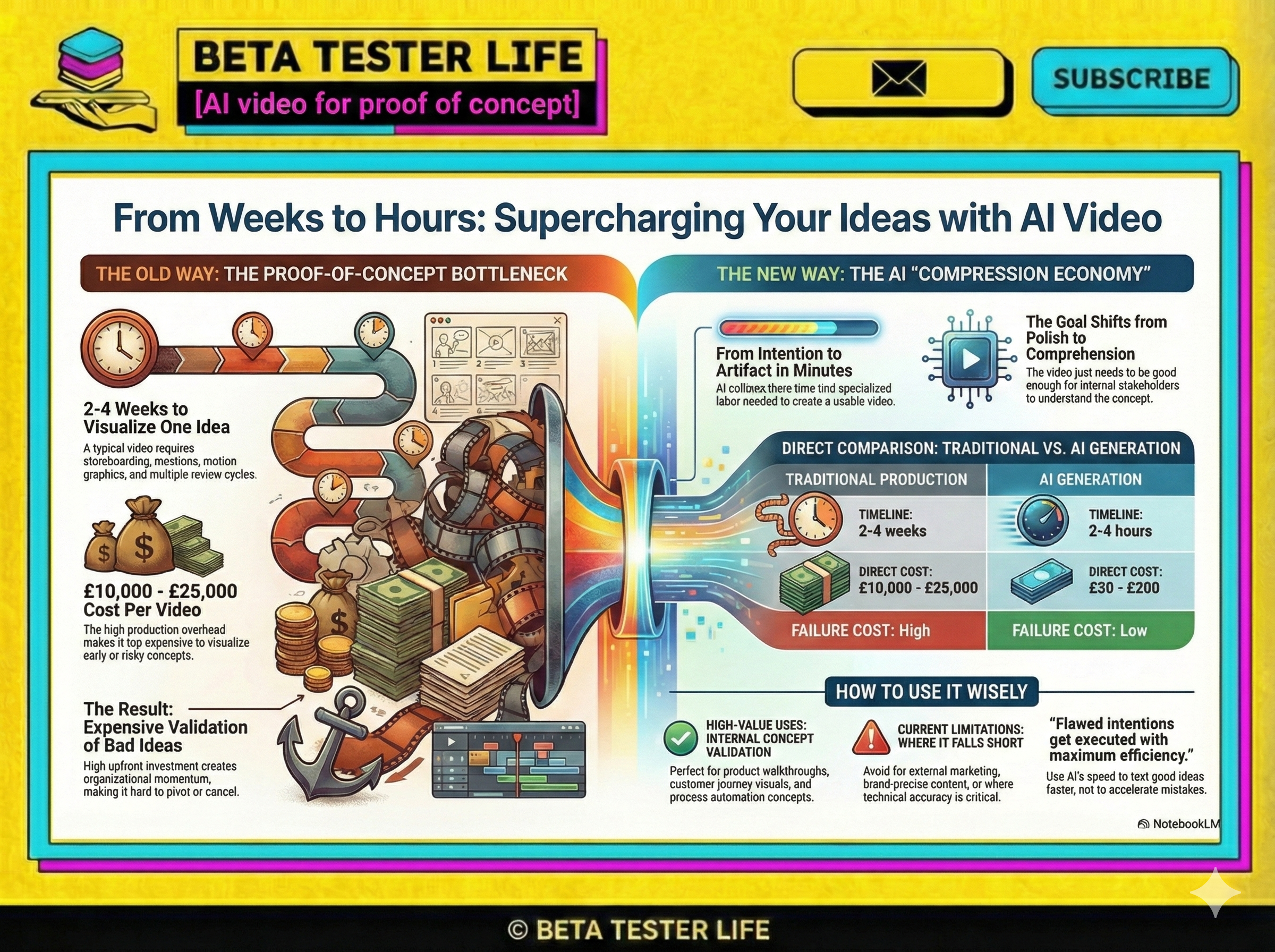
A typical POC video requires coordination across storyboarding, design mockups, motion graphics, and multiple stakeholder review cycles. The process consumes 2-4 weeks and £10-25K before anyone can evaluate whether the underlying concept merits further investment.
This creates a perverse incentive structure. Teams become reluctant to visualise early-stage ideas because the production overhead is prohibitive. By the time a concept gets visualised, organisational momentum has already built behind it—making objective evaluation politically difficult.
The result: expensive validation of ideas that should have been killed earlier.
Enter the Compression Economy
The compression economy describes a structural shift in how value gets created. AI tools are collapsing the distance between intention and artifact—reducing the time, specialised labour, and cognitive load required to transform a concept into a deployable output.
Text-to-video represents one of the purest expressions of this compression. What previously required a production team and weeks of calendar time can now be generated from a text prompt in minutes.
The strategic question isn’t whether these tools produce broadcast-quality output. They don’t.
The question is whether output quality is sufficient to achieve the POC’s actual purpose: stakeholder alignment, concept validation, and early failure detection.
For internal proof-of-concept work, the quality threshold is radically different from external publication. You need stakeholder comprehension, not production polish.
The Enterprise Use Cases
After extensive testing, clear patterns emerge around where text-to-video delivers legitimate enterprise value:
✅ High-Value Applications
| Use Case | Why It Works |
|---|---|
| Product Feature Walkthroughs | Stakeholders need to understand interaction patterns, not pixel-perfect UI. Motion conveys intent faster than static mockups. |
| Customer Journey Visualisation | Emotional narrative communicates value proposition. Exact interface accuracy is secondary to the story arc. |
| Process Automation Concepts | Before/after contrast is inherently visual. The transformation from manual to automated workflow lands instantly. |
| Training Module Previews | Demonstrating instructional style helps secure budget approval before committing to full production. |
⚠️ Current Limitations
| Use Case | Why It Falls Short |
|---|---|
| External-Facing Materials | Quality expectations from customers, investors, and partners exceed current AI capabilities. |
| Brand-Precise Content | Consistent brand rendering (logos, colours, typography) remains unreliable. |
| Complex Human Interaction | Uncanny valley artifacts in human faces and hands distract from the message. |
| Technical Accuracy Requirements | When the specific details matter more than the general concept, AI introduces unacceptable error rates. |
The Evaluation Framework – AI video for proof of concept
Selecting the right tool requires structured comparison across metrics that actually matter for enterprise deployment. I’ve developed a testing framework built around five core dimensions:
📊 Metric 1: Time-to-Usable Output
Total elapsed time from prompt submission to stakeholder-ready artifact. This includes queue time, generation time, and any necessary re-prompting iterations.
Critical distinction: “Usable” means sufficient for internal stakeholder review, not external publication. Over-indexing on polish defeats the purpose of rapid concept validation.
📊 Metric 2: Prompt Fidelity
How accurately the output reflects the input prompt’s intent. Score separately for visual elements, motion/action, timing, and overall composition.
Document which prompt elements are consistently ignored or misinterpreted. This reveals tool-specific limitations that affect use case suitability.
📊 Metric 3: Motion Coherence
Physical plausibility and temporal consistency of movement. Key factors include object permanence (do elements maintain consistent form?), physics adherence (does movement follow expected physical laws?), and human rendering quality.
📊 Metric 4: Stakeholder Comprehension
The only metric that ultimately matters: does the video achieve its communication purpose?
Testing protocol: Present outputs to stakeholders unfamiliar with the concept. Ask “What is this video trying to show?” before any explanation. Track whether visual artifacts distract from the core message.
📊 Metric 5: Cost Efficiency
Total cost per usable output, including failed attempts. Calculate cost per second of final output and compare against estimated traditional production cost for equivalent communication value.
The Tools Under Evaluation – AI video for proof of concept
Current market leaders for enterprise consideration:
| Tool | Key Strength | Enterprise Consideration |
|---|---|---|
| Runway Gen-3 Alpha | Strong motion coherence | Established enterprise relationships, API access |
| Kling AI 1.6 | Extended duration (up to 2 min) | Competitive quality at lower price point |
| Pika Labs 2.0 | Scene modification features | Accessible entry-level pricing |
| Luma Dream Machine | Realistic motion physics | Strong for product visualisation |
| OpenAI Sora | Quality ceiling benchmark | Limited availability, include if accessible |
The Strategic Risk: Accelerated Error Propagation
Here’s the governance consideration that tool vendors won’t emphasise:
In the compression economy, flawed intentions get executed with maximum efficiency.
If your POC concept is strategically misaligned, text-to-video lets you build organisational consensus around the wrong idea faster than ever before.
The compression economy rewards clarity of intention. Muddy strategy combined with rapid execution equals accelerated failure at scale.
This has direct implications for how organisations should deploy these capabilities:
🎯 Invest upstream in problem framing. The quality of your prompt reflects the quality of your strategic thinking. Vague intentions produce vague outputs—rapidly.
🎯 Establish review gates before distribution. Speed of creation shouldn’t bypass evaluation rigour. Build lightweight approval workflows that match the compressed creation timeline.
🎯 Track net productivity, not gross output. Include the human labour required for revision, correction, and governance in your ROI calculations.
The ROI Calculation – AI video for proof of concept
Conservative comparison for a typical enterprise POC visualisation:
| Factor | Traditional Production | AI Generation |
|---|---|---|
| Timeline | 2-4 weeks | 2-4 hours |
| Direct Cost | £10,000-25,000 | £50-200 |
| Iterations Possible | 1-2 | 10-20 |
| Failure Cost | High (sunk cost + momentum) | Low (minimal investment) |
Even accounting for lower production quality, the strategic value of faster iteration cycles compounds significantly.
The real calculation: How many concepts can you test in the time it previously took to produce one polished video?
If you can validate (or kill) five ideas in the same timeframe and budget, you’re not just saving money—you’re fundamentally changing your organisation’s capacity for strategic experimentation.
What Comes Next
I’m running a full structured evaluation across the major platforms using identical enterprise scenarios. The framework includes blind stakeholder comprehension testing—the metric that separates legitimate enterprise tools from impressive demos.
Results and the complete testing methodology will follow.
The Bottom Line
Text-to-video for POC work isn’t about replacing your production capabilities. It’s about changing when and how you invest in visualisation.
The organisations that will benefit most are those that:
→ Recognise the difference between “stakeholder alignment” and “external publication” quality thresholds
→ Build rapid iteration into their concept development workflows
→ Maintain governance discipline even as creation timelines compress
→ Invest in problem framing and strategic clarity upstream
The compression economy is here. The question is whether you’ll use it to make faster decisions—or just faster mistakes.
🔬 Test. Learn. Deploy.