
Walk into any classroom in 2026 and you’ll find something weirdly familiar. Thirty kids. One teacher. Fixed schedule. Standardized tests. The core model hasn’t fundamentally changed since 1926.

Meanwhile, AI has quietly been proving it can do things this century-old system cannot. And the evidence is now too strong to ignore.
The Harvard Study That Changes Everything

A randomized controlled trial at Harvard, published in Nature Scientific Reports in June 2025, compared students learning physics through an AI tutor versus an active learning classroom. The results weren’t subtle.
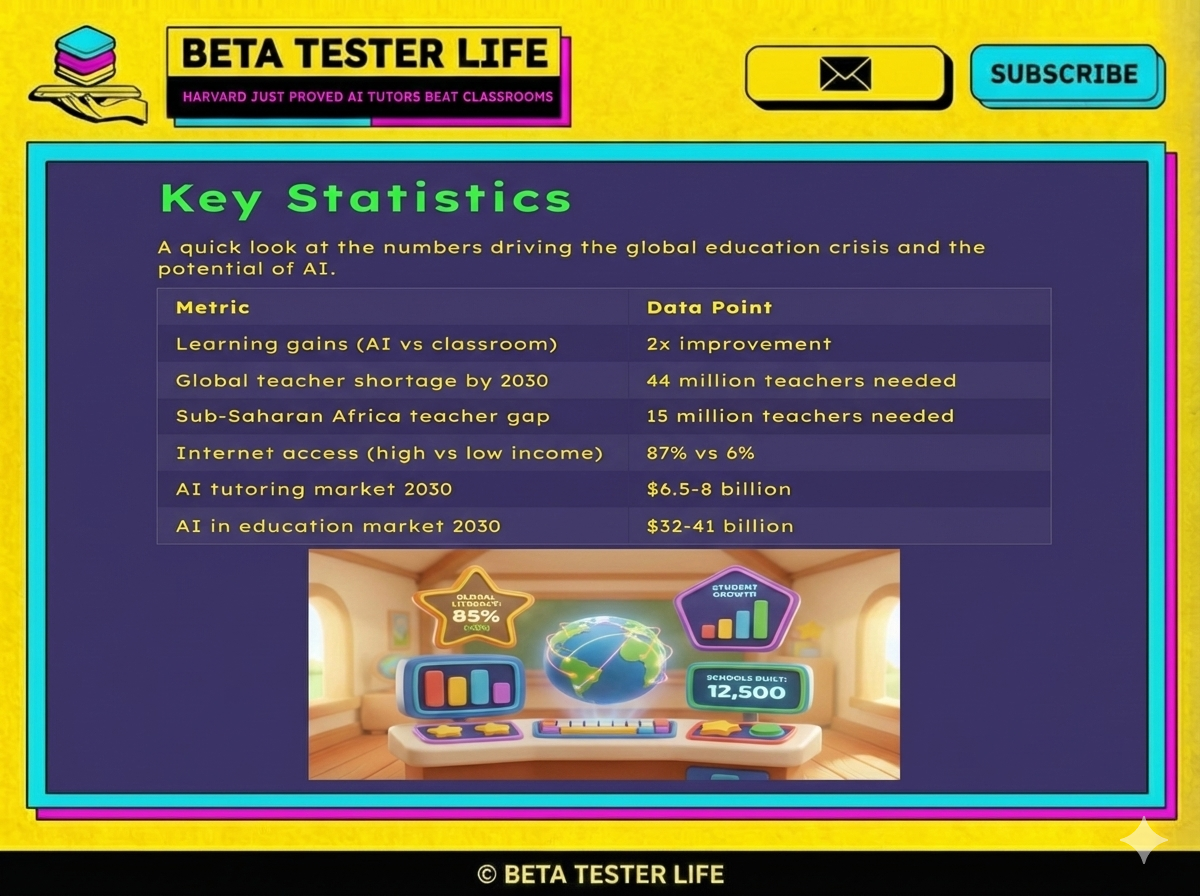
Students using the AI tutor learned significantly more. Their median learning gains were more than double those of students in the traditional active learning classroom. They also felt more engaged and more motivated. And here’s the kicker – they spent less time doing it.

This wasn’t some generic chatbot. The researchers carefully engineered the AI tutor to follow pedagogical best practices: facilitating active learning, managing cognitive load, promoting growth mindset, scaffolding content, and providing immediate personalized feedback.
The implications are massive. What if every student on Earth could access this kind of personalized instruction?
The 44 Million Teacher Problem

UNESCO’s Global Report on Teachers paints a stark picture. The world needs 44 million additional primary and secondary teachers by 2030 to meet education goals. Sub-Saharan Africa alone needs 15 million.
These aren’t abstract numbers. In some Nigerian schools, one qualified teacher is responsible for 150+ students. In many developing regions, pupil-to-teacher ratios run 40:1, 60:1, even 100:1.
The traditional solution – train more teachers – simply can’t scale fast enough. UNESCO estimates it would cost $120 billion annually in salaries just to close the gap. Global education funding is actually expected to fall 25% by 2027.
This is where AI’s promise becomes tantalizing. An AI tutor has infinite patience, can adapt to each learner’s pace, provides immediate feedback, and operates at near-zero marginal cost per additional student.
The Uncomfortable Truth About Access
Here’s where it gets complicated. The same UNESCO reports show that 87% of students in high-income countries have home internet access. In low-income countries? Just 6%.
2.6 billion people globally remain offline. In sub-Saharan Africa, internet access has stagnated at 36%. Only 43% of Africa’s population has reliable electricity.
The AI tutoring market is projected to grow from roughly $1.6 billion to $8 billion by 2030, with the highest growth in North America, Europe, and Asia-Pacific. The regions that need educational transformation most urgently are precisely the regions least equipped to access it.

Two Possible Futures
We’re standing at a fork in the road. One path leads to a world where every child has a persistent AI tutor that adapts to their learning style, available 24/7 in any language. Teachers evolve into mentors and coaches, orchestrating projects and social learning while AI handles the micro-level instruction.
The other path leads to a bifurcated system. ‘Sentient campus’ AI environments for wealthy students. Overcrowded, under-resourced classrooms for everyone else. AI making the privileged more educated while the disadvantaged fall further behind.
The technology can go either way. The question is whether we choose to invest in infrastructure, devices, and teacher training for the communities that need it most – or whether we let AI become another driver of inequality.
What Needs to Happen Now
The research is clear. Well-designed AI tutoring works. It can outperform even active learning classrooms when built on sound pedagogy.
But technology alone isn’t enough. We need deliberate policy focus on broadband infrastructure, device access, and training educators to work alongside AI tools. We need development finance that prioritizes digital public goods.
The classroom of 2100 doesn’t have to look like 1926. But whether it looks equitable depends on choices we make now.
Subscribe for more analysis on how AI is reshaping industries – and what it means for the rest of us.

Primary Sources:
- Kestin et al., Nature Scientific Reports (June 2025) – Harvard RCT
- UNESCO Global Report on Teachers (2024) – 44M teacher shortage
- UNESCO Global Education Monitoring Report (2023) – Digital divide data
- Mordor Intelligence, Grand View Research – Market projections
#EdTech #AItutors #Learningsystems #SkilldevelopmentTraining #Knowledge #workUpskilling