
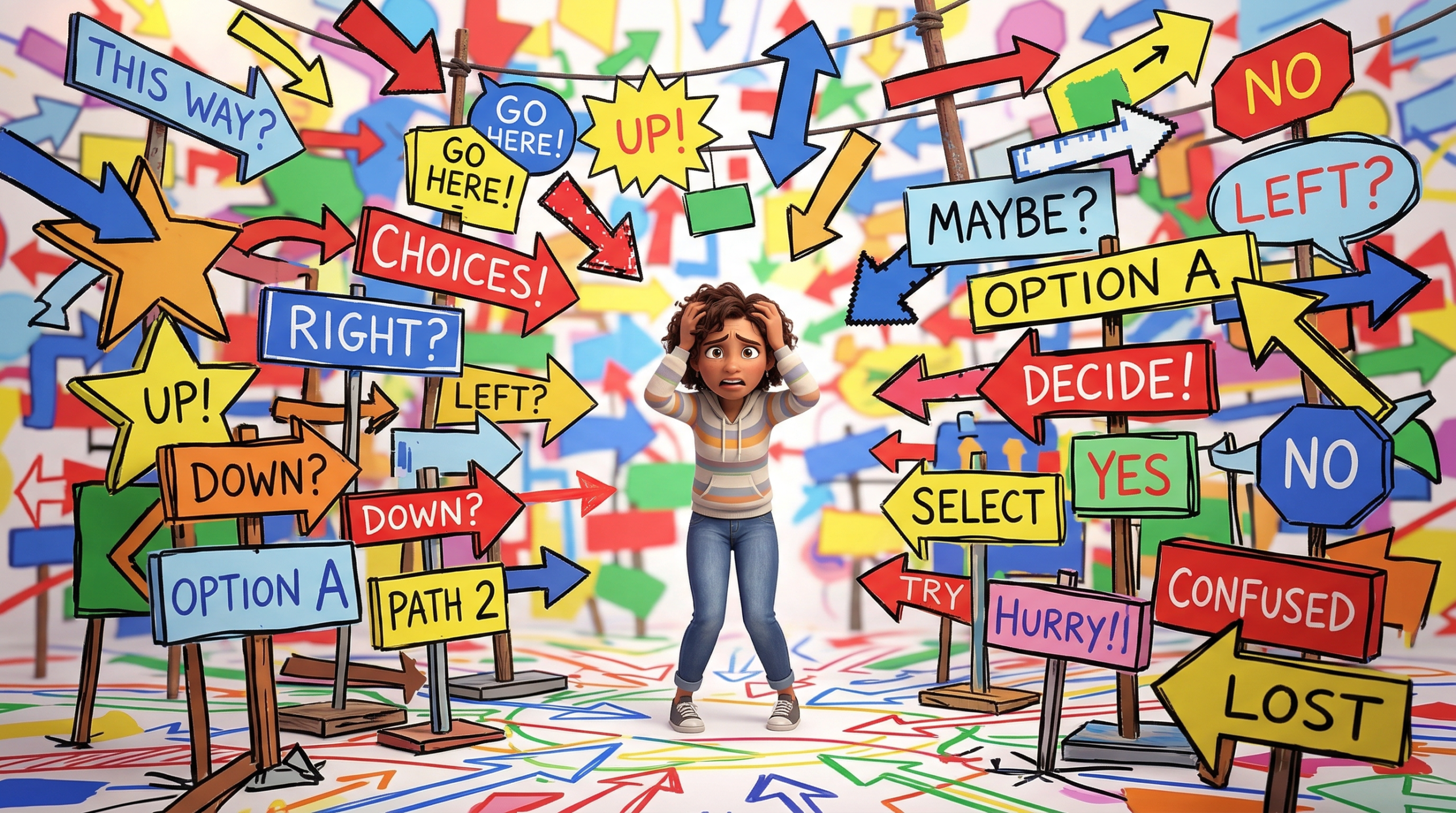
You know that feeling—the nagging sense that you took a wrong turn somewhere?
It’s the feeling that your career choice, the relationship you stayed in, or the city you moved to was somehow not right.
It’s as if there’s a better version of your life running in parallel, while you’re stuck with a rough draft.
Recognising this feeling can help you feel understood and less alone in your doubts.

I’ve experienced it, and most of the people I talk to have, too. However, here’s what research really says: that feeling is primarily your brain playing tricks on you. You know that feeling—the nagging sense that you took a wrong turn somewhere? It’s the feeling that your career choice, the relationship you stayed in, or the city you moved to was somehow not right. It’s as if there’s a better version of your life running in parallel, while you’re stuck with a rough draft. Recognising this feeling can help you feel understood and less alone in your doubts.
Your Brain Has a Built-In “Wrong Path” Alarm

There’s a network in your brain called the default mode network (DMN). It activates when you’re not focused on anything specific. Commuting. Showering and lying in bed at 2 am. The DMN handles self-referential thinking. It replays the past and simulates the future.
Useful in small doses. Destructive on a loop.
A 2023 study from Harvard and Massachusetts General Hospital found that people prone to negative thinking showed significantly more DMN activation when hearing criticism. And that activation directly correlated with rumination — the obsessive replay of negative thoughts. A 2025 review in MDPI Biology confirmed the DMN’s role in self-referential cognition and its link to anxiety and depression when the system becomes overactive.
Here’s the practical takeaway. That voice telling you that you’re on the wrong path? It’s a neural pattern, but remember, its intensity can vary based on individual experiences and circumstances. Recognising this helps you see it as a pattern, not an absolute truth, making it easier to challenge and reframe.
Your Worst Detours Might Be Your Best Material
Psychologists Richard Tedeschi and Lawrence Calhoun spent decades studying what happens after trauma. They found that many people don’t just recover. They grow. They identified five areas of post-traumatic growth: stronger relationships, new possibilities, personal strength, spiritual deepening, and a greater appreciation for life. This can help you feel hopeful about your own setbacks as opportunities for growth.

A 2024 paper in the Journal of Positive Psychology examined how existentialist meaning-making models — think Nietzsche, Frankl, even Schopenhauer — explain this growth.
The conclusion: meaning doesn’t come from avoiding adversity. It comes from engaging with it.
A 2025 scoping review of 109 cancer studies found something even more specific. The severity of the trauma didn’t predict who experienced growth. What mattered was whether people actively processed what happened. Deliberate reflection. Reframing. Sense-making. The people who grew weren’t the ones who had easier experiences. They were the ones who wrestled with hard ones.
Your detours aren’t deviations from the plan. They’re where the plan actually gets written. For example, viewing a career setback as a learning opportunity or a chance to explore new passions can transform regret into growth, making your journey more meaningful.
The “Correct” Life Is a Trap
Barry Schwartz at Swarthmore College has spent two decades studying what he calls the “paradox of choice.” His research found that people who obsessively seek the best possible option — maximisers — are consistently less happy than people who go for “good enough” — satisficers.

Maximisers report more depression. More regret. More comparison with others. And here’s the kicker: even when they get objectively better outcomes, they’re still less satisfied.
A 2024 study published in the SSRG International Journal found that choice overload leads to measurable decision paralysis, especially among people under 40. We’re not imagining it. The constant pressure to optimise every life decision is making us freeze.
A 2025 systematic review and meta-analysis found that mindfulness-based interventions can significantly promote flow — the state of being absorbed in the present. Not because mindfulness stops you from thinking. But because it trains you to stop treating every thought as an emergency.
What Actually Works
The research points in a clear direction. Stop trying to find the “right” path. Start engaging with the one you’re on.

Quieting the DMN: Meditation and mindfulness reduce overactivity in the default mode network. Even a few minutes of guided meditation or mindful breathing each day can have measurable effects, helping you stay present and less caught up in negative loops.
Deliberate reflection over passive rumination: Post-traumatic growth research distinguishes between intrusive rumination (looping on pain) and deliberate rumination (actively making sense of what happened). One destroys. The other builds.
Satisfying over maximising: Pick a direction. Commit. Stop looking over your shoulder at the road not taken. Schwartz’s research is detailed: the pursuit of the “best” is the enemy of the good.

The anxiety over the “wrong turn” isn’t a signal that you’re lost. It’s a signal that you’re human. And if the research tells us anything, it’s that the detours, the mistakes, the unplanned chapters — those are the actual path.
Research Sources
1. Chou, T., Deckersbach, T., Dougherty, D.D., & Hooley, J.M. (2023). The default mode network and rumination in individuals at risk for depression. Social Cognitive and Affective Neuroscience, 18(1). https://academic.oup.com/scan/article/18/1/nsad032/7188150
2. MDPI Biology (2025). The Journey of the Default Mode Network: Development, Function, and Impact on Mental Health. Biology, 14(4), 395. https://www.mdpi.com/2079-7737/14/4/395
3. Hamilton, J.P., Farmer, M., Fogelman, P., & Gotlib, I.H. (2015). Depressive Rumination, the Default-Mode Network, and the Dark Matter of Clinical Neuroscience. Biological Psychiatry, 78(4). https://pmc.ncbi.nlm.nih.gov/articles/PMC4524294/
4. Acuña, A. et al. (2025). Increased default mode network activation in depression and social anxiety during upward social comparison. Social Cognitive and Affective Neuroscience, 20(1). https://academic.oup.com/scan/article/20/1/nsaf012/7989924
5. Tedeschi, R.G. & Calhoun, L.G. (1996, 2004). Post-traumatic growth: Conceptual foundations. Psychology Today overview: https://www.psychologytoday.com/us/basics/post-traumatic-growth
6. Tandfonline (2025). Can existentialist thinking about the meaning of adversity lead to post-traumatic growth? Journal of Positive Psychology. https://www.tandfonline.com/doi/full/10.1080/17439760.2025.2505552
7. PMC (2025). Post-Traumatic Growth in Adult Cancer Survivors: A Scoping Review. International Journal of Psychology. https://pmc.ncbi.nlm.nih.gov/articles/PMC12392248/
8. Kaufman, S.B. (2024). Post-Traumatic Growth: Finding Meaning and Creativity in Adversity. Scientific American. https://www.scientificamerican.com/blog/beautiful-minds/post-traumatic-growth-finding-meaning-and-creativity-in-adversity/
9. Schwartz, B., Ward, A., Monterosso, J., Lyubomirsky, S., et al. (2002). Maximizing versus satisficing: Happiness is a matter of choice. Journal of Personality and Social Psychology, 83(5), 1178–1197. https://pubmed.ncbi.nlm.nih.gov/12416921/
10. Boby, A. (2024). An Analysis of the Impact of Choice Overload on Inducing Decision Paralysis. SSRG International Journal of Economics and Management Studies, 11(6). https://www.internationaljournalssrg.org/IJEMS/2024/Volume11-Issue6/IJEMS-V11I6P101.pdf
11. Iyengar, S.S. & Lepper, M.R. (2000). When choice is demotivating: Can one desire too much of a good thing? Journal of Personality and Social Psychology, 79(6), 300–322.
12. Longaretti, Y., Cheron, G., & Zarka, D. (2025). Unlocking Flow Through Mindfulness: A Systematic Review and Meta-Analysis of Randomized Controlled Trials. The Journal of Psychology. https://pubmed.ncbi.nlm.nih.gov/41165041/
13. PMC (2024). Neurobiological Changes Induced by Mindfulness and Meditation: A Systematic Review. https://pmc.ncbi.nlm.nih.gov/articles/PMC11591838/
14. Frontiers in Human Neuroscience (2025). Long-term mindfulness meditation. https://www.frontiersin.org/journals/human-neuroscience/articles/10.3389/fnhum.2024.1482353/pdf
#personaldevelopment #neuroscience #mindfulness #psychology #selfimprovement #posttraumaticgrowth #decisionmaking #mentalhealth #overthinking #paralysisbyanalysis #defaultmodenetwork #growthmindset #paradoxofchoice #mindfulnesspractice #betatesterlife
Leave a Reply