
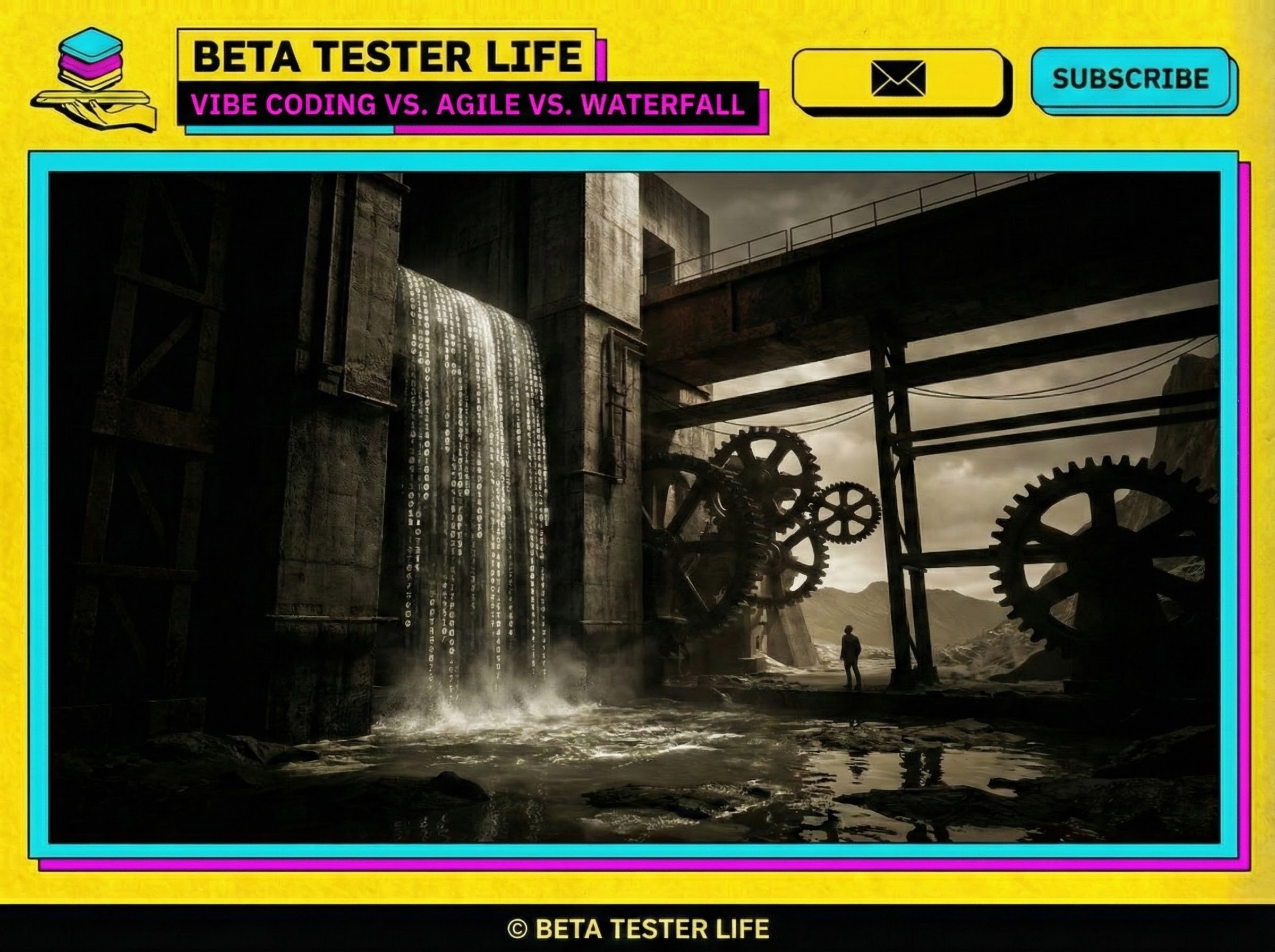
Vibe Coding vs. Agile vs. Waterfall: The Rise of Intent-Driven Delivery
The software delivery landscape is shifting under our feet. For decades, the industry has oscillated between the rigidity of Waterfall and the iterative rituals of Agile. But the explosion of Generative AI has introduced a new player: “Vibe Coding.”
As developers embrace AI tools like Cursor and Replit to code at the speed of thought, traditional frameworks are struggling to keep up. How do engineering leaders balance the raw speed of AI with the need for enterprise-grade reliability?
Based on a synthesis of pragmatic governance, human-centric adaptability, and AI-native strategy, this post outlines the future of software delivery: Intent-Driven Delivery (IDD).
🚀 Key Takeaways
- Agile is hitting a wall: Traditional “Story Points” based on complexity are becoming obsolete in an era where AI handles the syntax.
- Vibe Coding brings speed and risk: While AI enables “flow state” development, it risks creating technical debt without strict guardrails.
- The Solution is “Intent-Driven Delivery”: A new hybrid model that uses AI to automate the bureaucracy (“Wagile”) while unleashing developers to focus on auditing and logic.
- Shift Left on QA: The developer’s role is shifting from “writer of syntax” to “auditor of system intent.”
The Current State: Friction in the Frameworks
Before defining the solution, we must agree on the problem. Current research highlights a friction point between three distinct methodologies:
- Waterfall: Often criticized as rigid and slow, but acknowledged as necessary for high-stakes compliance and embedded systems where hardware constraints exist.
- Agile: The industry standard. However, it is increasingly bogged down by ritualism, meetings, and manual estimation.
- Wagile: The “Dark Matter” of enterprise delivery. This is Agile execution trapped inside Waterfall funding and reporting cycles. It is universally disliked but prevalent.
Enter “Vibe Coding”
Vibe Coding is the emerging practice of intuitive, flow-state, ad-hoc development powered by LLMs. It offers immense speed but poses severe risks regarding technical debt, maintainability, and onboarding if left unchecked. The challenge is not choosing one framework, but harmonizing them.
Three Perspectives on the AI Shift
To build a master strategy, we synthesized insights from three distinct AI archetypes regarding the state of modern development:
1. The Pragmatic Guardian (Governance Focus)
From a governance perspective, Vibe Coding is effectively “Cowboy Coding” rebranded. While the speed is undeniable, it requires “right-sizing.” Unchecked AI coding should be restricted to “Spikes” (experimental tasks) or prototypes. To prevent the collapse of quality assurance, these bursts of speed must be contained within a structured container.
2. The Paradigm Shifter (Strategic Focus)
From a futuristic perspective, Vibe Coding represents a shift from “Deterministic Assembly” (manual typing) to “Probabilistic Creation” (managing AI intent). This leads to a controversial conclusion: The Death of Story Points. Because AI decouples human effort from code output, estimating time based on complexity is obsolete. We must move toward estimating based on intent.
3. The Agile Scout (Human Focus)
From a human-centric view, the value of AI is the “Flow State.” To harness this without chaos, teams should utilize tactical guardrails like Time-boxing (e.g., internal hackathons) and immediate refactoring loops to solidify the code generated during these high-velocity sessions.
The Unified Strategy: Intent-Driven Delivery (IDD)
The industry is pivoting from a constraint of typing speed (Agile) to a constraint of verification speed (AI). To succeed, organizations must adopt Intent-Driven Delivery.
The Philosophy: Stop managing how code is written and start managing what the system does. Developers provide the Intent and the Audit; AI provides the Syntax.
The Architecture: “The Iron Sandwich”
To satisfy stakeholders while unleashing developers, you must construct a hybrid model dubbed “The Iron Sandwich.”
- The Outer Shell (Automated Wagile): Use LLMs to generate the heavy documentation, requirements traceability, and status reports required by the PMO. This keeps the “Enterprise Beast” calm without slowing down engineers.
- The Inner Core (Protected Vibe): Allow developers to use AI tools to generate features rapidly. Measure their velocity in Features Shipped, not Story Points.
- The Gatekeeper (The Audit): Since code generation is fast and probabilistic, the bottleneck moves to QA. Senior Engineers must stop being “Code Reviewers” (checking syntax) and become “System Auditors” (checking for logic flaws and security hallucinations).
Tactical Implementation Guide
How does this look in practice? Here is the comparison between the old world and the unified AI approach.
| Feature | The Old Way (Agile/Scrum) | The New Way (IDD) |
|---|---|---|
| Estimation | Story Points (Complexity + Effort) | Milestones. Complexity no longer equals time. |
| Development | Sprints (2 weeks) | Continuous Flow with daily integration gates. |
| Code Review | “Fix this variable name.” | “Explain why the AI chose this pattern.” |
| Documentation | Written manually (often outdated). | Generated continuously by AI based on codebase. |
| Role of Junior | Writes simple code to learn. | “The Gardener”: Prunes AI code, writes tests, learns system architecture. |
Immediate Actions for Engineering Leaders
If you want to maintain velocity in an AI-native world without collapsing into technical debt, take these three steps today:
- Formalize “Vibe” Spikes: Allow teams 24-48 hour prototyping bursts to solve hard problems using AI, but enforce a strict “cleanup” phase where code is audited and integrated into the main branch with tests.
- Reskill for Auditing: Train your team to debug code they didn’t write. The most valuable skill in 2024 is not writing syntax, but reading and verifying AI-generated logic.
- Automate the Bureaucracy: If your organization demands Wagile artifacts, do not make humans write them. Use your AI context window to generate the compliance docs.
The Bottom Line: Do not choose between Waterfall, Agile, or Vibe. Automate the Waterfall, structure the Agile, and unleash the Vibe.