
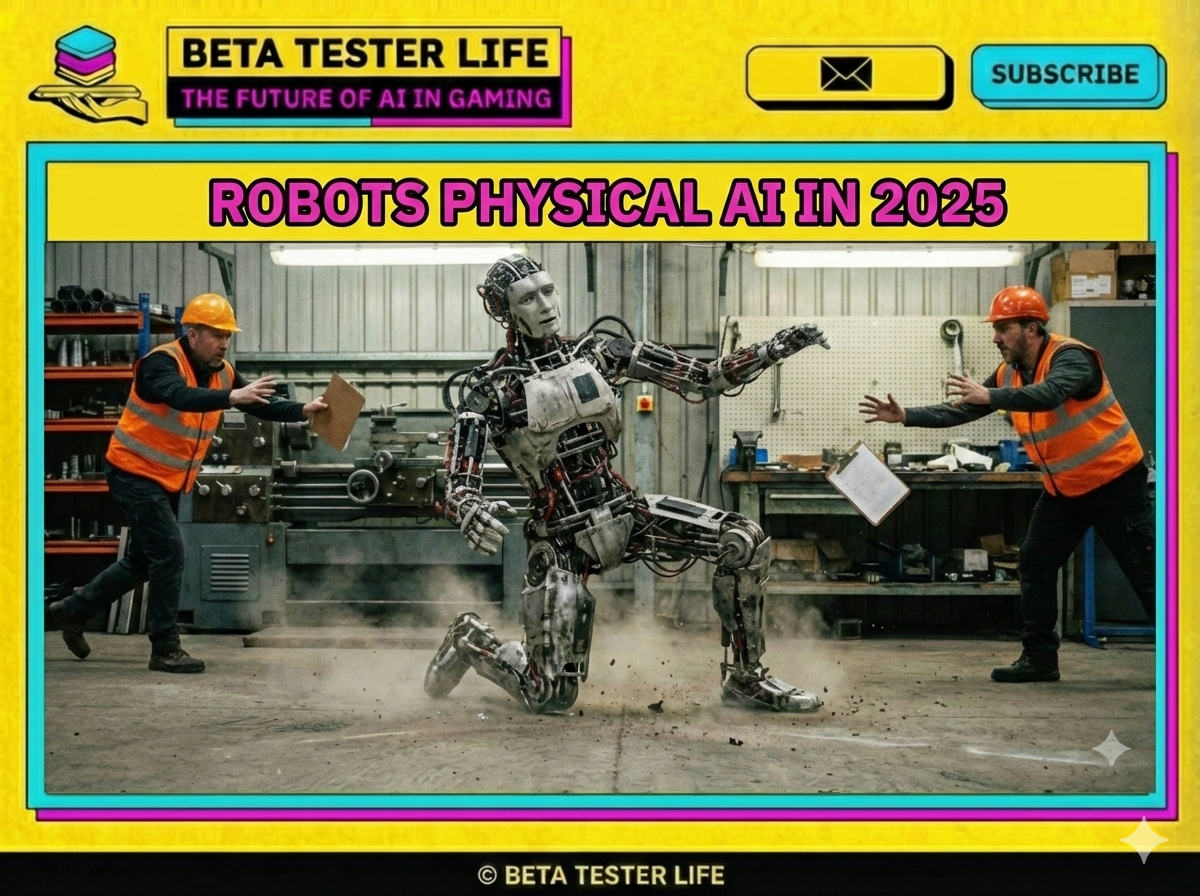
When Robots Learned to Fall—The Maturation of Physical AI in 2025
May 2025. A humanoid robot stumbles mid-movement. Handlers rush to check for damage. The robot gets up, dusts itself off, and continues working.
That wasn’t luck. Disney Research in Zurich had trained that machine through tens of thousands of Robots simulated falls, teaching it how to minimize injury using reinforcement learning. One viral video encapsulated 2025’s humanoid robotics revolution: after decades in labs, humanoid robots entered the real world in significant numbers.
By mid-December 2025, Mind1 Robotics demonstrated fully autonomous AI running on a $16,000 Unitree G1 humanoid—shifting practical household robots from science fiction to near-term reality.
The Market Reached Deployment Scale
2025 marked the transition from prototypes to production deployments across industrial operations.
Leading Platforms Reached Commercial Scale
| Platform | Deployment Type | Key Capability | Price Point |
|---|---|---|---|
| UBTECH Walker S2 | Large-scale industrial | Full production line integration | Enterprise pricing |
| Tesla Optimus Gen 2 | Manufacturing | Unprecedented dexterity/balance | Not disclosed |
| Figure AI Figure 03 | Manipulation tasks | Award-winning precision | Not disclosed |
| Unitree G1 + Mind1 | Research/household | Fully autonomous AI brain | $16,000 |
| Unitree R1 | Global research | Accessible platform | $5,500 |
The Technology Convergence That Enabled This
Three capabilities matured simultaneously:
1. Large Language Models
Robots gained natural language understanding and high-level reasoning—interpreting spoken instructions and adapting to novel situations without reprogramming.
2. Physical AI Systems
Virtual simulation environments let robots experience thousands of falls, collisions, and variations before encountering the real world. No physical wear, accelerated learning.
3. Cost Collapse Trajectory
Bill-of-materials costs projected to decline 50-70% by early 2030s—from current levels to $13,000–17,000 per robot.
💡 Critical Insight: The price point determined adoption velocity. Unitree’s $5,500 R1 dominated research demonstrations globally—not because it was technically superior, but because universities, startups, and labs could afford it.
The Geopolitical Race: China’s Strategic Play
China entered 2025 with clear intent: humanoid robots as the response to demographic collapse.
The Demographics Driving Strategy
| Challenge | Scale | Response |
|---|---|---|
| Population decline | Significant shrinkage projected through 2060 | Build manufacturing capacity for robotics |
| Labor supply threat | Economic output at risk | Subsidize component production domestically |
| Export positioning | Dominate global markets | Price domestic firms to win share |
China’s Manufacturing Bet:
- Years of capacity building in robotics components
- Government subsidies positioning domestic firms
- Export pricing that made ownership globally accessible
Market Share by Volume (Research Platforms)
Unitree’s R1 at ~$5,500 flooded international research demonstrations throughout 2025.
Result: Chinese humanoid models dominated not through technical superiority but through economic accessibility.
The Scale Is Staggering
Projections through 2060:
| Region | Projected Robot Population | Human Population Context |
|---|---|---|
| China | 300 million robots | Aging, shrinking workforce |
| United States | 77 million robots | Stable demographics |
| Global Total | 3+ billion robots | Coexisting with humans |
Historical Precedent: China’s electric vehicle dominance—an industry barely existing two decades ago—offers a cautionary parallel. The nation built infrastructure, Subsidised production, and captured market share while Western competitors debated strategy.
The Security Crisis Nobody Prepared For
Late 2025 exposed critical vulnerabilities that highlighted a fundamental truth: the robotics industry moved faster than its security posture could sustain.
Documented Vulnerabilities in Deployed Systems
| Vulnerability Type | Impact | Affected Platform |
|---|---|---|
| Bluetooth protocol flaws | Remote hijacking of deployed robots | Unitree Robotics |
| Hard-coded encryption keys | Leaked, enabling malware spread | Unitree Robotics |
| Botnet formation | One compromised robot infects others | Multiple platforms |
| Root-level control | Complete system access | Compromised units |
| Unauthorized data transmission | User data sent to Chinese servers | Specific models |
The Botnet Scenario
Attack vector: One compromised robot spreads malware to others nearby through hard-coded encryption keys.
Result: Networked robots with root-level control—essentially a physical botnet operating in warehouses, factories, and potentially homes.
What This Means for Infrastructure
A dedicated robotics cybersecurity industry will likely emerge within the decade—mirroring how IT security grew alongside personal computing.
The parallel is exact:
- Personal computing scaled faster than security practices
- Vulnerabilities materialized as adoption accelerated
- Specialized security industry emerged to protect deployed systems
- Regulatory frameworks followed security incidents
The Urgency: Unlike software vulnerabilities, compromised robots operate in physical spaces with humans. The security implications extend beyond data breaches to physical safety.
The Workforce Displacement Reality
2025 posed uncomfortable questions for policy makers: these robots didn’t supplement human workers—they replaced them.
The Economic Case for Replacement
Fully autonomous warehouse robot:
- Operates 24/7 without breaks
- Costs 5% of human labor annually
- Requires no benefits, training, or supervision
- Never calls in sick, takes vacation, or files complaints
The Transition Ahead
| Phase | Characteristics | Timeline |
|---|---|---|
| Labor shortage | What drove initial robotics investment | 2020-2024 |
| Transition zone | Robots deployed alongside humans | 2025-2027 |
| Labor displacement | Robots replace human roles at scale | 2028-2035 |
The paradox: Organizations invested in robotics to solve labor shortages. The robots’ actual impact is labor displacement.
Industries Most Exposed
Manufacturing
Precision tasks, repetitive operations, 24/7 production demands
Warehousing
Material handling, order fulfillment, inventory management
Retail
Stocking, customer assistance, checkout operations
Food Service
Preparation, delivery, cleaning operations
📊 Policy Gap: No major economy has comprehensive workforce transition frameworks addressing robotics displacement at the scale projected through 2035.
What Infrastructure Reliability Demands
Through an engineering lens, 2025’s humanoid robotics maturation teaches three critical lessons.
1. Simulation Before Deployment Reduces Real-World Failure Modes
Disney Research breakthrough: Tens of thousands of simulated falls taught robots to minimize injury in unpredictable environments.
Engineering principle: Virtual failure modes are cheaper than physical failures—massively cheaper when robots cost $16,000+ and operate among humans.
Application: Physical AI simulation should become standard practice before any deployment in shared human spaces.
2. Security Cannot Be an Afterthought in Physical Systems
The vulnerability timeline:
- Unitree deployed robots globally
- Security researchers discovered protocol flaws
- Hard-coded encryption keys leaked
- Data transmission to foreign servers confirmed
Engineering failure: Security architecture wasn’t integral to system design—it was added afterward, creating vulnerabilities that cannot be patched without hardware replacement.
Requirement: Security-by-design for physical AI systems operating at scale must become regulatory mandate.
3. Cost Curves Drive Adoption Faster Than Technical Superiority
Market reality: Unitree’s R1 at $5,500 dominated research demonstrations not because it was best-in-class technically, but because it was accessible.
Economic principle: When cost drops below threshold, adoption accelerates regardless of whether the technology is fully mature.
Infrastructure implication: Security frameworks, workforce policies, and regulatory oversight must scale ahead of adoption curves—not react to incidents after deployment.
The Questions We’re Not Asking
Are we prepared for the workforce implications?
No major economy has comprehensive transition frameworks addressing robotics displacement at projected 2035 scale.
Do security frameworks match deployment velocity?
Late 2025 vulnerabilities prove the answer is no—and the gap is widening.
Can Western manufacturers compete with subsidized Chinese robotics?
The EV precedent suggests price competition against state-subsidized production is nearly impossible without equivalent industrial policy.
What happens when 3+ billion robots operate alongside humans?
Safety standards, liability frameworks, and human-robot interaction protocols remain underdeveloped.
Conclusion: The Robots Learned to Fall—We Haven’t
2025’s breakthrough wasn’t just that robots could fall safely—it was that they learned to fall safely through simulation before encountering real-world unpredictability.
The contrast is stark:
- Robots trained through tens of thousands of virtual failures
- Organizations deploying without security-by-design
- Policymakers reacting to displacement after it occurs
- Industries scaling before governance frameworks exist
The infrastructure reliability lesson: Complex physical systems require frameworks before deployment, not policies after incidents.
The robots learned to fall. The question is whether our economic structures, security postures, and workforce policies can adapt before we do.
What’s your organisation’s robotics strategy? Are you preparing for workforce transition, or waiting for displacement to force the conversation?
Subscribe to betatesterlife for weekly analysis on AI, robotics, and emerging tech—frameworks over hype, infrastructure reliability lens, 30 years of context.