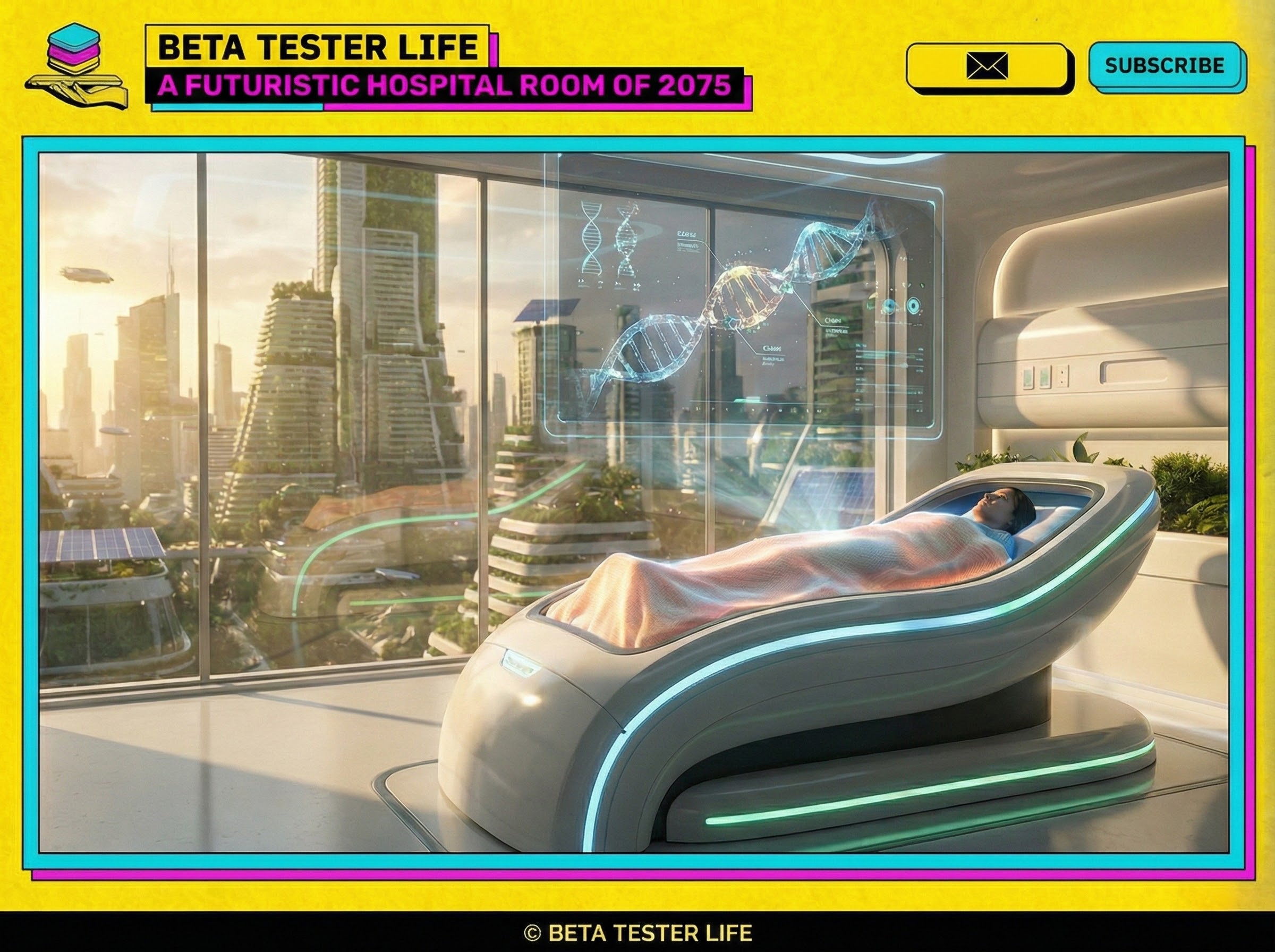
Imagine a world where cancer is detected years before symptoms appear. Where your doctor is an AI assistant available 24/7. And where aging itself becomes a treatable condition.
This is the healthcare landscape experts predict we’ll see within the next 30 to 50 years. Based on current research and breakthrough technologies already in development, medicine stands on the edge of dramatic changes. Changes more significant than anything we’ve seen in human history.
🧬 Personalized Medicine Becomes the Standard
By 2035, the concept of “one-size-fits-all” medicine will seem as outdated as bloodletting does today. Genomics, AI, and big data will combine to create truly personalized healthcare.
Genomic sequencing cost $100 million in 2001 and $1,000 in 2020. Soon, it will cost under $100. Every newborn will receive a complete genetic blueprint at birth. This data will follow patients throughout their lives.
Here’s what this enables:
- Custom medications tailored to your genetic markers. No more trial-and-error treatment.
- Early intervention based on genetic risks identified decades before disease starts.
- Personalized nutrition and lifestyle plans optimized for your unique biology.
- Targeted cancer treatments designed around specific mutations in your tumor. Success rates could exceed 80% compared to today’s 50%.
According to MIT’s Institute for Medical Engineering, by 2045 the average person will have continuous health monitoring. Tiny implantable or wearable sensors will detect biomarkers for over 500 different conditions.
🤖 AI Doctors and Robotic Surgeons Take Center Stage
The role of human physicians won’t disappear, but it will transform. By 2040, AI diagnostic systems will outperform human doctors in accuracy across virtually all specialties. Error rates will drop below 1% compared to the current 10-15% misdiagnosis rate.
These AI systems will have access to every medical journal, clinical trial, and patient case in existence—updated in real-time. When you describe symptoms, the AI will instantly cross-reference millions of similar cases. It will consider factors human doctors might miss due to cognitive limits or outdated training.
Robotic surgery will become the norm rather than the exception. By 2050, experts predict:
- 95% of surgical procedures will be performed by AI-guided robots with human oversight.
- Microsurgeries impossible with human hands will become routine, operating at the cellular level.
- Recovery times will decrease by 60-70% due to unprecedented precision.
- Surgical complications will drop to nearly zero in developed nations.
🧪 Regenerative Medicine and Age Reversal
Perhaps the most revolutionary development will happen in regenerative medicine and longevity research. Science that seems like fantasy today will become clinical reality within three decades.
Organ regeneration will eliminate transplant waiting lists entirely. By 2045, bioprinting technology will advance to where replacement organs can be grown from a patient’s own cells in about 30 days. Labs are already successfully printing simple organs like bladders. Complex organs like hearts and kidneys are projected for 2035-2040.
Even more remarkably, aging itself will shift from an inevitable process to a treatable condition. Research into drugs that clear “zombie” cells, telomere extension, and NAD+ boosters suggests that by 2055:
- The average human lifespan in developed nations could reach 100-120 years.
- The “healthspan”—years lived without chronic disease—will extend proportionally.
- Biological age reversal of 10-20 years may become possible through cellular reprogramming.
- Age-related conditions like Alzheimer’s, Parkinson’s, and osteoporosis could be largely prevented or reversed.
🌐 Healthcare Access and Global Equity Challenges
While these advances promise extraordinary benefits, they also raise critical questions about access and equity. The digital health divide could deepen if these technologies remain available only to wealthy nations and individuals.
However, there’s reason for optimism. Telemedicine and AI diagnostics have much lower infrastructure requirements than traditional healthcare systems. A smartphone with AI diagnostic capabilities could provide better medical advice than was available to billionaires just 50 years ago.
By 2050, the WHO projects that AI-powered basic healthcare could reach 95% of the global population, even in remote areas.
The cost of medical technology also trends toward accessibility. Just as genetic sequencing costs have dropped by a factor of one million in 20 years, many emerging technologies follow similar curves.
Looking Forward
The next 30-50 years will redefine what it means to be healthy, to age, and even to be human. We stand at the threshold of a medical revolution that will not only extend our lives but enhance their quality in ways previous generations could never imagine.
The question isn’t whether these changes will arrive—it’s whether we’ll build the ethical frameworks and equitable systems to ensure their benefits reach all of humanity.

Written by Kevin Campbell
Thirty years of technology, delivery and organisational change—translated into practical thinking for people doing the work.
Continue the journey
One thought leads to another.
Scroll to explore
 Field Notes
The CC List Is Not a Control
Field Notes
The CC List Is Not a Control
 Enterprise Delivery
Stop Owning People. Start Owning Outcomes
Enterprise Delivery
Stop Owning People. Start Owning Outcomes
 Field Notes
Self-Awareness Is Not Introspection. It Is System Monitoring.
Field Notes
Self-Awareness Is Not Introspection. It Is System Monitoring.
 Field Notes
The AI Creative Process: Why AI Should Enter Twice
Field Notes
The AI Creative Process: Why AI Should Enter Twice
 AI Governance
Most AI pilots fail not because the technology doesn’t work, but because nobody cleared space in people’s calendars to actually use it.
AI Governance
Most AI pilots fail not because the technology doesn’t work, but because nobody cleared space in people’s calendars to actually use it.
 Enterprise Delivery
Vibe Coding vs. Agile vs. Waterfall: The Rise of Intent-Driven Delivery
Enterprise Delivery
Vibe Coding vs. Agile vs. Waterfall: The Rise of Intent-Driven Delivery
Conversation
Add to the thinking
Questions, experience and thoughtful disagreement are welcome.