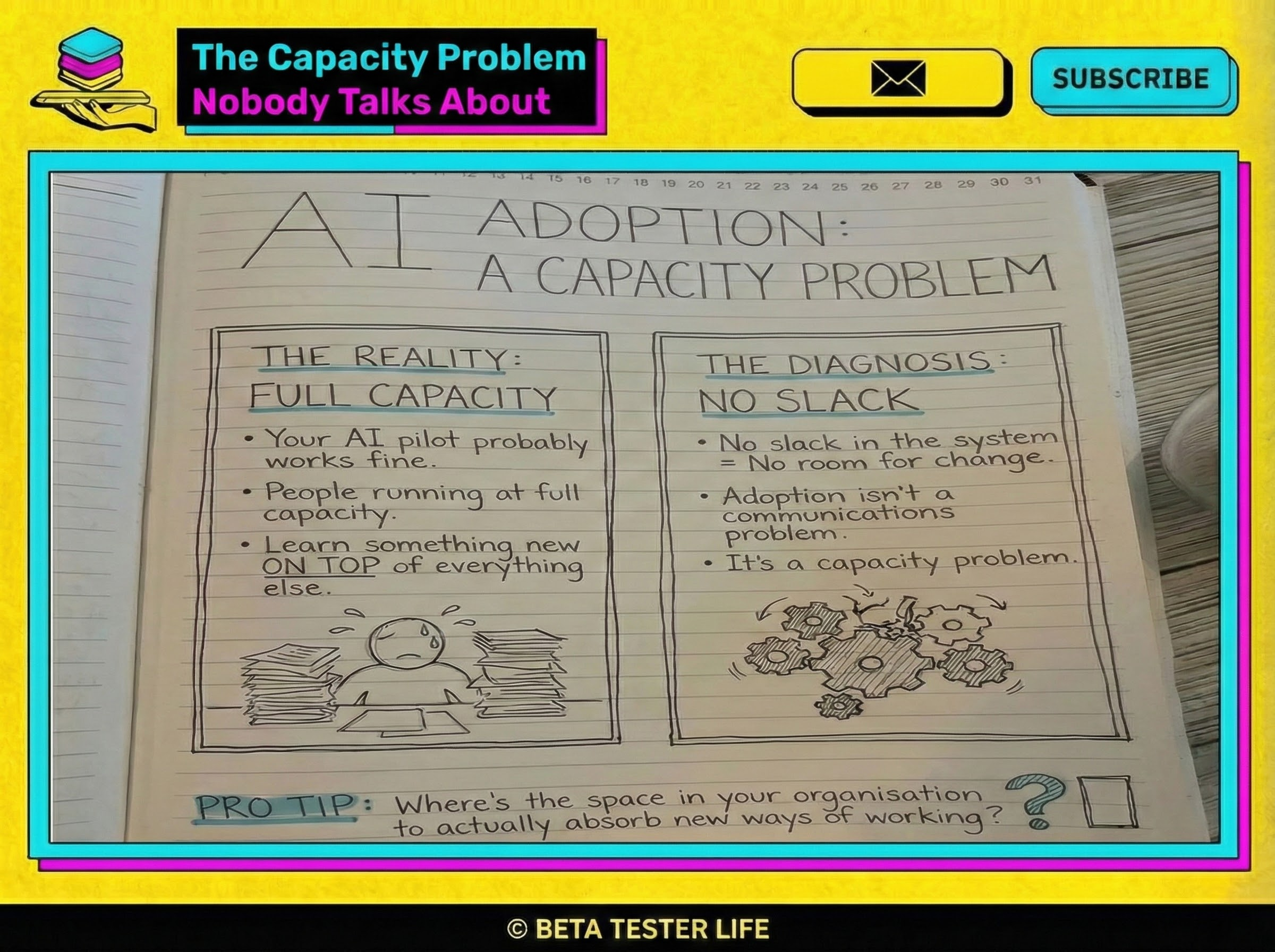
The Capacity Problem Nobody Talks About
Most AI pilots don’t fail because the technology is bad.
They fail because you launched a new tool into a calendar already running at 120%.
The Real Blocker Isn’t Resistance
When adoption stalls, the instinct is to blame culture. Or training. Or comms.
But ask anyone on the ground and they’ll tell you the truth: there’s no space.
No space to learn. No space to experiment. No space to fail safely and try again.
People aren’t resisting change. They’re drowning in the current workload.
Adoption Is a Capacity Problem
Here’s what I see repeatedly:
Leadership announces an exciting AI initiative → Teams nod along → Nothing changes → Leadership concludes “they’re not bought in”
The missing step? Nobody removed anything from the backlog.
You can’t pour water into a glass that’s already full. You just get spillage — and frustrated people mopping up the mess.
🧊 The Uncomfortable Question
Before your next AI rollout, ask this:
What are we going to stop doing to make room for this?
Not “deprioritise.” Not “park for later.” Actually stop.
If the answer is “nothing,” you’ve already predicted the outcome.
What Slack Actually Looks Like
Organisations that absorb change well have built-in margin:
- 10–20% time genuinely protected for learning
- Quarterly culls of reports and meetings that no longer serve
- Permission to say no to low-value work without career consequences
This isn’t soft culture stuff. It’s operational design.
The Honest Audit
Take your AI adoption plan and run it through this filter:
| Question | Honest Answer |
|---|---|
| How many hours per week does this require from users? | |
| Where do those hours come from? | |
| What existing work gets removed or reduced? | |
| Who has authority to make that call? |
If you can’t fill in column two, you don’t have a plan. You have a wish.
💡 One Thing to Try
Before launching anything new, run a “stop doing” workshop with the team who’ll use it.
Ask: “If we’re adding this, what should we subtract?”
Let them tell you. They know where the waste is. They’ve just never been asked.
Where’s the space in your organisation to actually absorb new ways of working?
More frameworks for AI adoption at betatesterlife.com

Written by Kevin Campbell
Thirty years of technology, delivery and organisational change—translated into practical thinking for people doing the work.
Continue the journey
One thought leads to another.
Scroll to explore
 AI Governance
Reliable AI Systems: A Practical Way to Control Risky Outputs
AI Governance
Reliable AI Systems: A Practical Way to Control Risky Outputs
 AI Governance
AI Job Design: How to Make Agents Earn Their Place
AI Governance
AI Job Design: How to Make Agents Earn Their Place
 AI Governance
AI Leadership Judgement: How to Make Better Decisions With AI
AI Governance
AI Leadership Judgement: How to Make Better Decisions With AI
 AI Governance
AI Build Versus Buy: How to Make Better Ownership Decisions
AI Governance
AI Build Versus Buy: How to Make Better Ownership Decisions
 Enterprise Delivery
Vibe Coding vs. Agile vs. Waterfall: The Rise of Intent-Driven Delivery
Enterprise Delivery
Vibe Coding vs. Agile vs. Waterfall: The Rise of Intent-Driven Delivery
 Field Notes
AI video for proof of concept
Field Notes
AI video for proof of concept
Conversation
Add to the thinking
Questions, experience and thoughtful disagreement are welcome.