In this article8 min read
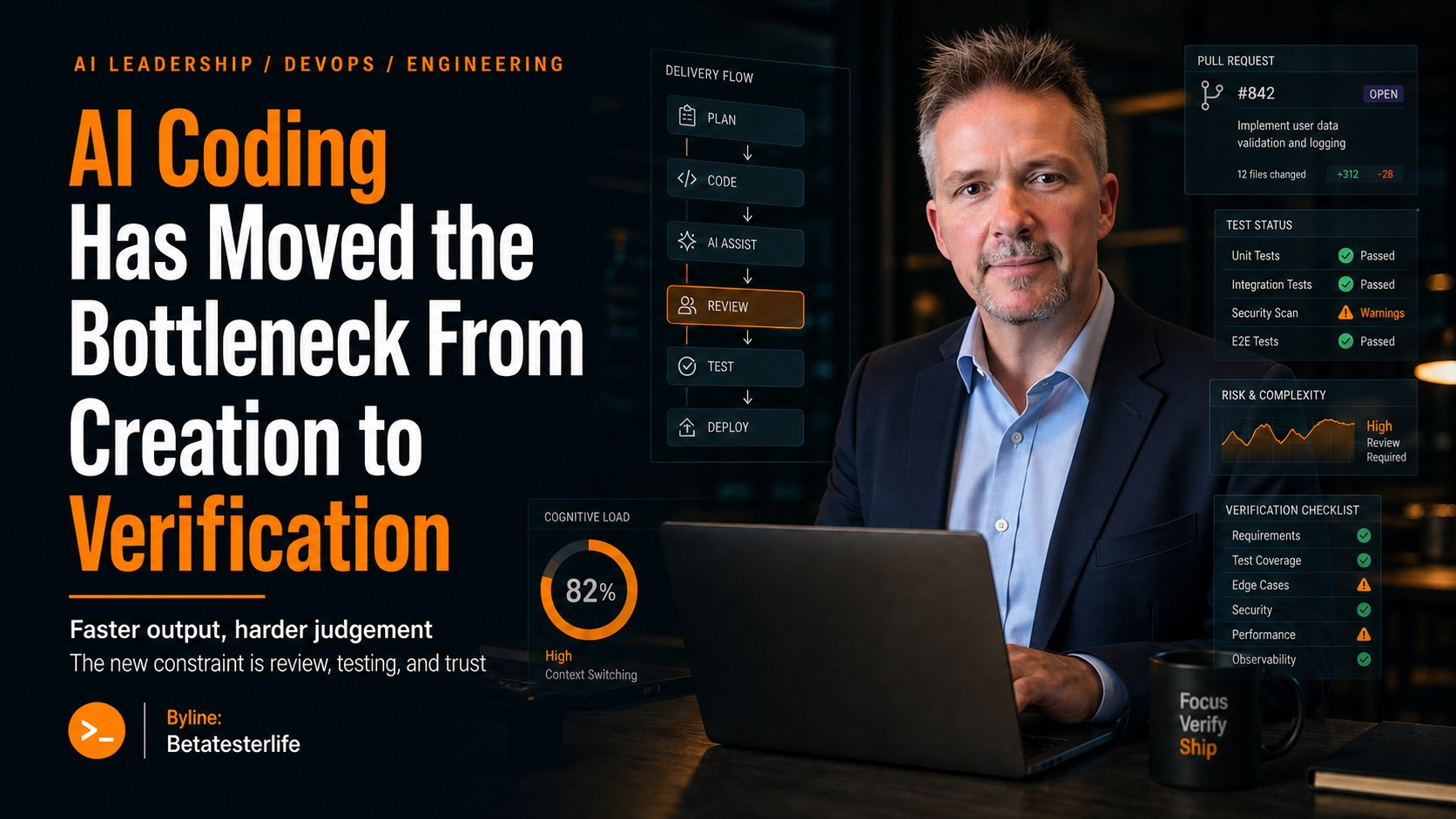
AI coding has changed the shape of software work. It has not removed the hard part. It has moved it.
The old bottleneck was often creation. Could someone write the boilerplate? Could they remember the API? Could they sketch the test, the migration, the parser, the React component, the Terraform module, the SQL query, the documentation page?
AI coding assistants have made that part dramatically easier. They are fast at producing plausible code. They are good at filling gaps. They are useful for first drafts, refactors, scaffolding, examples, tests, translation between frameworks, and the tedious connective tissue that used to consume quiet hours.
But speed at creation does not equal speed to trusted software. In many teams, the constraint is shifting from writing code to verifying it.
The new bottleneck
The new bottleneck is not whether code can be produced. It is whether the code should be believed.
That is a different kind of work. It asks engineers to inspect intent, architecture fit, edge cases, security implications, runtime behaviour, product assumptions, test quality, operational impact, accessibility, observability, rollback paths, and maintainability. The assistant can generate the patch. The team still owns the consequences.
This is why the simple productivity story feels incomplete. If a developer uses AI to produce twice as much code but the team spends twice as long reviewing, correcting, testing, and understanding it, the system has not automatically improved. The work has moved downstream.
The danger is that organisations count the visible acceleration and miss the hidden verification load.
Fluent code is not verified code
AI-generated code often looks more finished than it is. That is part of its power and part of its risk.
A rough human draft carries visible signs of incompleteness. There are TODOs, uneven naming, missing branches, awkward comments, and obvious gaps. AI output can arrive with clean formatting, confident structure, plausible tests, and a tone of completion. It can feel review-ready before it is reality-ready.
That creates a subtle cognitive trap. Reviewers may have to work harder because the code is syntactically tidy but semantically uncertain. The surface looks calm, so the reviewer must deliberately search for the hidden trouble: the wrong assumption, the missed boundary, the shallow test, the dependency that should not be there, the security weakness wrapped in reasonable-looking code.
The more polished the output, the more disciplined the verification has to be.
Typing was never the whole job
Software engineering has always involved more than typing. The valuable work is deciding what should exist, how it should behave, how it should fail, how it should be operated, and how it should change later without creating a mess.
AI coding assistants are strongest when the problem is local and well-bounded. Generate a helper. Convert a test style. Explain an unfamiliar API. Draft a migration. Produce a first pass at a component. These are useful gains.
They are weaker when the real issue is context. Why does this service exist? What are the invariants? What did the previous incident teach us? Which customer workflow matters most? What risk are we allowed to take? Which abstraction will survive the next three requirements?
Those questions live in the surrounding system. They are not always present in the prompt. They are rarely captured fully in code. They require memory, judgement, and accountability.
The review burden changes
AI changes code review in at least four ways.
First, volume can increase. If assistants make it easier to produce large patches, reviewers face more material to inspect. A pull request that was cheap to create may still be expensive to understand.
Second, authors may understand less of the code they submit. That is not inevitable, but it happens when generation outruns comprehension. A developer can accept a suggestion that works in the happy path without being able to explain the edge cases.
Third, tests can become performative. AI is good at writing tests that look like tests. It is also good at asserting the implementation rather than challenging the behaviour. A green test suite is less comforting if the tests were generated from the same shallow understanding as the code.
Fourth, review becomes more adversarial to the output. The reviewer has to ask: what would be wrong if this looked right? That is tiring work. It demands attention, scepticism, and domain knowledge.
Correction is part of the cost
The cost of AI-assisted development is not only the time spent prompting. It is the time spent correcting.
Corrections can be small: naming, style, imports, typing, null handling, accessibility attributes, test fixtures. They can also be structural: the wrong abstraction, the wrong data model, the wrong permission boundary, the wrong concurrency assumption, the wrong failure mode.
The problem is that correction often feels like progress because something already exists. But editing a plausible wrong answer can consume more attention than writing a smaller correct one. The team has to disentangle the assistant's confidence from the system's needs.
That is where cognitive load rises. Engineers are not just creating. They are supervising, interrogating, comparing, pruning, and repairing.
Testing becomes more important, not less
AI does not reduce the need for testing. It raises the value of good testing.
A team using AI coding tools needs sharper test strategy, not a larger pile of generated tests. The question is not whether the assistant can produce unit tests. It can. The question is whether the tests protect the behaviours that matter.
That means more attention to acceptance criteria, contract tests, property-based tests where appropriate, security checks, performance boundaries, observability, and production feedback. It means testing the edges the model is likely to smooth over.
It also means being honest about what tests cannot prove. A generated test suite can create a comforting theatre of assurance. Verification has to include human reasoning about risk, not just automated confirmation.
The productivity metric is too narrow
Many AI coding conversations still use a narrow productivity lens: lines of code, tasks completed, time to first draft, number of pull requests, or developer satisfaction.
Those are not useless measures, but they are incomplete. The better question is system throughput to trusted change.
How long does it take for an idea to become reliable software in production? How much rework appears after review? How often do AI-assisted patches require architectural correction? Are incidents increasing? Are tests meaningful? Are senior engineers becoming review bottlenecks? Are junior engineers learning faster or outsourcing the struggle that builds judgement?
A team can become faster at producing changes while becoming slower at trusting them. That is not transformation. It is inventory growth.
The senior-engineer bottleneck
One predictable side effect is pressure on senior engineers.
If junior or mid-level developers can generate more code, the scarce resource becomes expert review. Senior engineers become the verification layer for a larger volume of plausible output. They are asked to catch design flaws, security problems, missing product nuance, and operational risks after the code already exists.
That can quietly damage a team. The senior people spend more time reviewing and less time designing, mentoring, simplifying, and removing systemic constraints. The organisation sees more activity but loses some of the deeper leverage it relies on.
Used well, AI can support learning. Used badly, it turns experts into quality gates for code they would rather have helped shape earlier.
Governance has to move closer to the work
AI coding governance cannot live only in policy documents. It has to show up in the delivery mechanics.
Teams need clear rules for where AI is appropriate, what must be reviewed, what cannot be pasted into tools, how generated code is attributed or disclosed internally, how dependencies are checked, how licences are handled, and how security-sensitive changes are verified.
But governance should not become theatre. The useful governance question is simple: what extra verification is required because AI was involved?
For a low-risk internal script, the answer may be lightweight. For authentication, payments, infrastructure, privacy, data migration, model evaluation, or customer-critical workflows, the answer should be much stricter.
What good teams will do differently
Good teams will not reject AI coding tools. They will redesign their engineering system around the new bottleneck.
They will keep patches smaller. They will require authors to explain AI-assisted code in their own words. They will treat generated tests as drafts, not evidence. They will strengthen code review checklists around behaviour, security, operations, and maintainability. They will add better static analysis, dependency scanning, and contract checks. They will invest in observability so production can verify assumptions faster.
They will also use AI before code exists, not only after. A good assistant can help explore trade-offs, generate test ideas, identify missing acceptance criteria, review design options, and produce threat-model prompts. That moves AI into the thinking process instead of letting it flood the review queue with finished-looking code.
What to do on Monday
Start by changing the team conversation.
Do not ask only: how much faster can we code with AI? Ask: where does verification now happen, who owns it, and what is getting squeezed?
Look at the last ten AI-assisted pull requests. How many needed substantial correction? Were the tests meaningful? Did reviewers understand the author’s reasoning? Did the patch size grow? Did senior engineers become the final safety net? Did anything escape into production that should have been caught earlier?
Then adjust the system. Set expectations for AI-assisted authorship. Keep reviews smaller. Make test intent explicit. Strengthen engineering standards. Add risk-based verification. Use AI to improve review preparation, not just code generation.
Final thought
AI coding assistants are real tools. They can save time, reduce friction, and make developers more capable in the right conditions. But they do not remove engineering judgement. They make judgement more important.
The bottleneck has moved from creation to verification. Leaders who understand that will get more value from AI because they will manage the whole system, not just the typing speed.
The future of AI-assisted software delivery will not belong to the teams that generate the most code. It will belong to the teams that can trust what they ship.
Source note
This article was informed by current AI software-development research and industry reporting, including METR's 2025 study of experienced open-source developers, DORA's AI-assisted software development research, Stack Overflow developer survey data, GitHub Copilot productivity studies, and GitClear's code-quality analysis. The argument and recommendations are Beta Tester Life editorial analysis.

Written by Kevin Campbell
Thirty years of technology, delivery and organisational change—translated into practical thinking for people doing the work.
Continue the journey
One thought leads to another.
Scroll to explore
 AI Governance
Reliable AI Systems: A Practical Way to Control Risky Outputs
AI Governance
Reliable AI Systems: A Practical Way to Control Risky Outputs
 AI Governance
AI Job Design: How to Make Agents Earn Their Place
AI Governance
AI Job Design: How to Make Agents Earn Their Place
 AI Governance
AI Leadership Judgement: How to Make Better Decisions With AI
AI Governance
AI Leadership Judgement: How to Make Better Decisions With AI
 AI Governance
AI Build Versus Buy: How to Make Better Ownership Decisions
AI Governance
AI Build Versus Buy: How to Make Better Ownership Decisions
 Leadership & Culture
Supercommunicators Is A Leadership Book About Alignment, Not Charisma
Leadership & Culture
Supercommunicators Is A Leadership Book About Alignment, Not Charisma
 Field Notes
How To Not Know Is A Leadership Book For The Age Of False Certainty
Field Notes
How To Not Know Is A Leadership Book For The Age Of False Certainty
Conversation
Add to the thinking
Questions, experience and thoughtful disagreement are welcome.