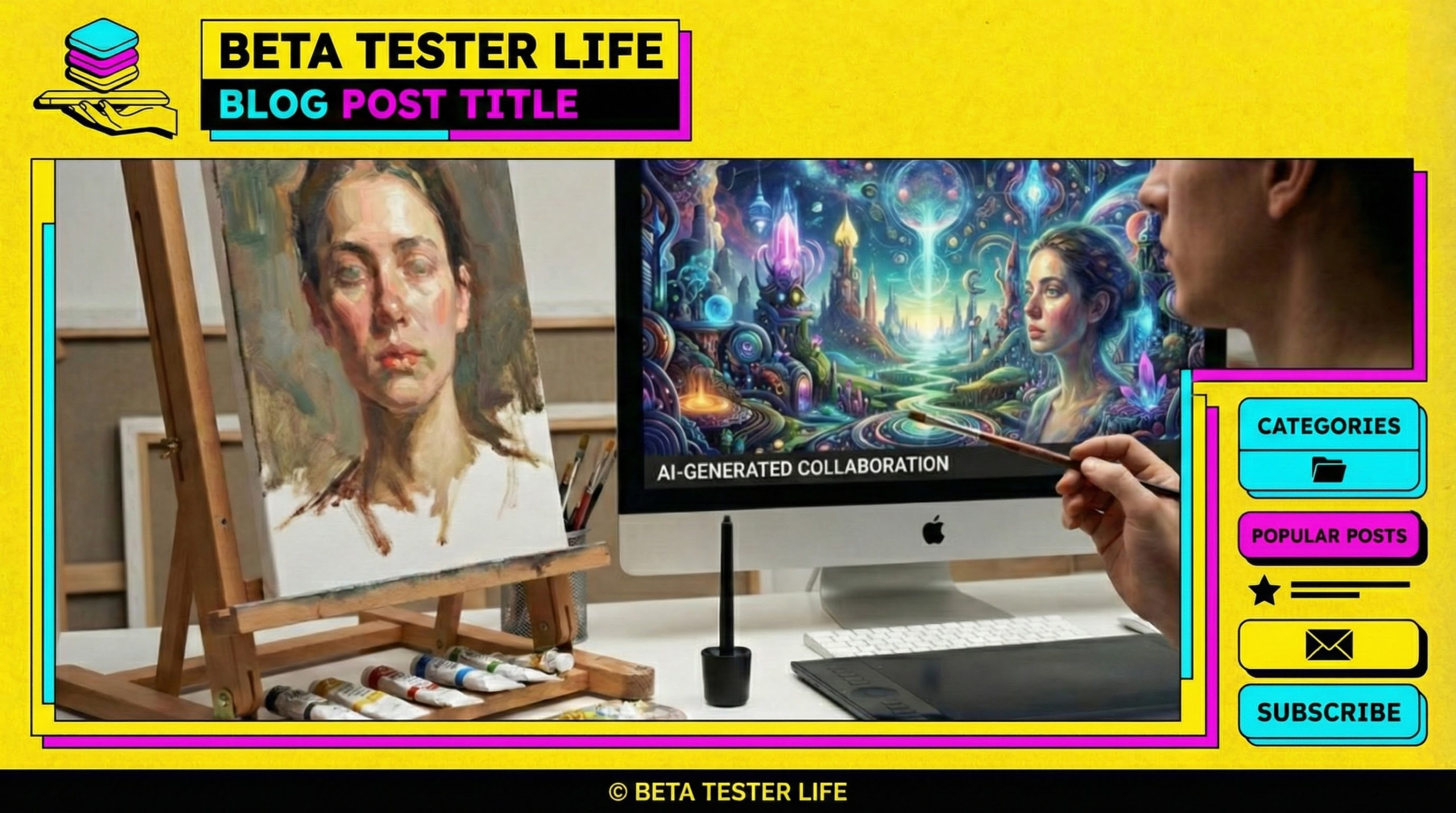
The AI Debate Isn’t About Replacement. It’s About Redefinition.
Your creativity is the prompt. The model is the exponential amplifier. Human-in-the-loop is the new mastery.
87% of U.S. creative professionals now use AI tools | 25% productivity boost with AI collaboration | 50% increase in perceived artwork value | $12.6B Gen AI in creative industries by 2029
The Core Thesis
“The best results now come from artists and writers who treat AI as a powerful digital collaborator—not a replacement for human imagination, but an exponential amplifier of it.”
Research from Oxford Academic’s PNAS Nexus confirms this: text-to-image AI significantly enhances human creative productivity while those who successfully explore novel ideas and filter model outputs for coherence benefit the most. The pivotal role of human ideation and artistic filtering determines success with generative AI tools.
🧠 Human Creativity × 🤖 AI Capability = 🚀 Exponential Output
The Data Behind the Revolution
The numbers paint a clear picture: we’re witnessing the fastest technology adoption in creative history. But what makes this different from previous automation waves is the collaborative nature of the results.
Generative AI Adoption Growth
| Year | 2017 | 2019 | 2021 | 2023 | 2024 | 2025 |
|---|---|---|---|---|---|---|
| Adoption Rate | 20% | 28% | 38% | 55% | 71% | 78% |
Percentage of organizations using AI in at least one business function (Source: McKinsey Global Survey)
Creative Industry AI Integration
| Sector | Adoption Rate |
|---|---|
| U.S. Creative Professionals | 87% |
| Visual Arts / Digital Design | 78% |
| Media & Entertainment | 69% |
| Music Production | 65% |
| Writing & Content | 63% |
AI adoption rates by creative sector, 2024-2025 (Sources: Adobe Creative Study, Industry Reports)
Market Growth Projection
| Year | 2024 | 2025 | 2027 | 2029 |
|---|---|---|---|---|
| Market Size | $4.8B | $6.3B | $9.8B | $12.6B |
Global Generative AI in Creative Industries market size in billions USD (Source: Business Research Company)
Research-Backed Insights
Peer-reviewed studies and industry reports reveal a consistent pattern: the most successful AI implementations are those that enhance rather than replace human creativity.
25% — Productivity Enhancement
Text-to-image AI significantly enhances human creative productivity by 25% according to research analyzing over 4 million artworks from 50,000 unique users.
Source: PNAS Nexus, Oxford Academic
50% — Value Perception Increase
AI-assisted artwork receives 50% more favorites per view, demonstrating that human-AI collaboration produces work that resonates more strongly with audiences.
Source: PNAS Nexus, Oxford Academic
Highest — Beauty Rating Achievement
AI-generated content with human intervention received the highest beauty ratings, outperforming both pure human and pure AI creation in poetry studies.
Source: Computers in Human Behavior, ScienceDirect
70% — Creative Professionals Believe
Over 70% of creative professionals believe AI will enhance and significantly transform their work according to Adobe research.
Source: Adobe Creative Study
Co-Creator — Role Matters
People must occupy the role of co-creator, not editor, to reap the benefits of generative AI. Creative self-efficacy is the key mechanism.
Source: Scientific Reports, Nature
11.4 hours — Weekly Time Savings
Content marketing teams using generative AI save around 11.4 hours per week per employee, freeing capacity for strategic work.
Source: Aristek Systems AI Report
The Human-in-the-Loop Framework
The most effective creative AI workflows follow a consistent pattern: humans provide direction, AI amplifies possibilities, and humans curate the final output. This isn’t automation—it’s augmentation.
💡 Ideation → ⚡ Amplification → ✨ Curation
- Ideation: Human creativity drives the vision and sets direction
- Amplification: AI generates variations and explores possibilities
- Curation: Human judgment filters and refines the output
This framework works because it leverages the unique strengths of both human and artificial intelligence. Humans excel at taste, judgment, emotional resonance, and novel conceptual leaps. AI excels at rapid iteration, pattern recognition, and exploring vast possibility spaces. Together, they achieve what neither could alone.
Where Human-AI Collaboration Thrives
Across creative industries, the pattern repeats: the most successful practitioners treat AI as a collaborative partner, not a replacement tool.
🎨 Visual Arts — 78% Using AI for Image Production
Visual content generation leads creative AI adoption, with artists using AI for concept exploration, style experiments, and production acceleration.
✍️ Writing & Content — Overcoming Creative Blocks
Writers use AI as a brainstorming partner, generating angles and narrative possibilities while maintaining their authentic voice and editorial control.
🎵 Music Production — Accelerated Composition
Musicians collaborate with AI to quickly generate beats, melodies, and rhythms as building blocks, then apply human creativity for the final arrangement.
🎬 Entertainment — 99% Planning AI Implementation
Nearly all entertainment executives plan to implement generative AI in content pipelines within three years, with 44% already using AI for 3D model generation.
📊 Marketing & Design — 76% Using AI for Copywriting
Marketing teams leverage AI for content creation, copywriting, and data analysis while human strategists drive campaign direction and brand voice.
🏢 Enterprise Creative — 69% Content Workflows Include AI
Media and entertainment report that over two-thirds of creative content workflows now incorporate generative AI tools at some stage.
The Critical Nuance
Research from Science Advances reveals an important tension: while AI enhances individual creativity, it may reduce collective diversity of novel content. Writers using AI produce more creative stories, but those stories become more similar to each other.
This finding underscores why human creative direction remains essential. The artists and writers who thrive with AI are those who bring strong personal vision, unique perspectives, and distinctive voices to the collaboration. AI amplifies what you bring to it.
The conclusion is clear: your creativity is the differentiator. AI is a powerful tool that rewards those who have something meaningful to say and the skill to guide the collaboration toward authentic expression.
The Future Belongs to Collaborators
The question isn’t whether AI will transform creative work—it already has. The question is whether you’ll be among those who master the new paradigm.
Data sources: St. Louis Fed, McKinsey Global Institute, PNAS Nexus (Oxford Academic), Science Advances, Scientific Reports (Nature), Adobe Creative Study, ScienceDirect, Business Research Company

Written by Kevin Campbell
Thirty years of technology, delivery and organisational change—translated into practical thinking for people doing the work.
Continue the journey
One thought leads to another.
Scroll to explore
 AI Governance
Reliable AI Systems: A Practical Way to Control Risky Outputs
AI Governance
Reliable AI Systems: A Practical Way to Control Risky Outputs
 AI Governance
AI Job Design: How to Make Agents Earn Their Place
AI Governance
AI Job Design: How to Make Agents Earn Their Place
 AI Governance
AI Leadership Judgement: How to Make Better Decisions With AI
AI Governance
AI Leadership Judgement: How to Make Better Decisions With AI
 AI Governance
AI Build Versus Buy: How to Make Better Ownership Decisions
AI Governance
AI Build Versus Buy: How to Make Better Ownership Decisions
 Enterprise Delivery
Speed is easy. Control is the strategic imperative.
Enterprise Delivery
Speed is easy. Control is the strategic imperative.
 Enterprise Delivery
The Technological Jerk of Software Development
Enterprise Delivery
The Technological Jerk of Software Development
Conversation
Add to the thinking
Questions, experience and thoughtful disagreement are welcome.