In this article8 min read
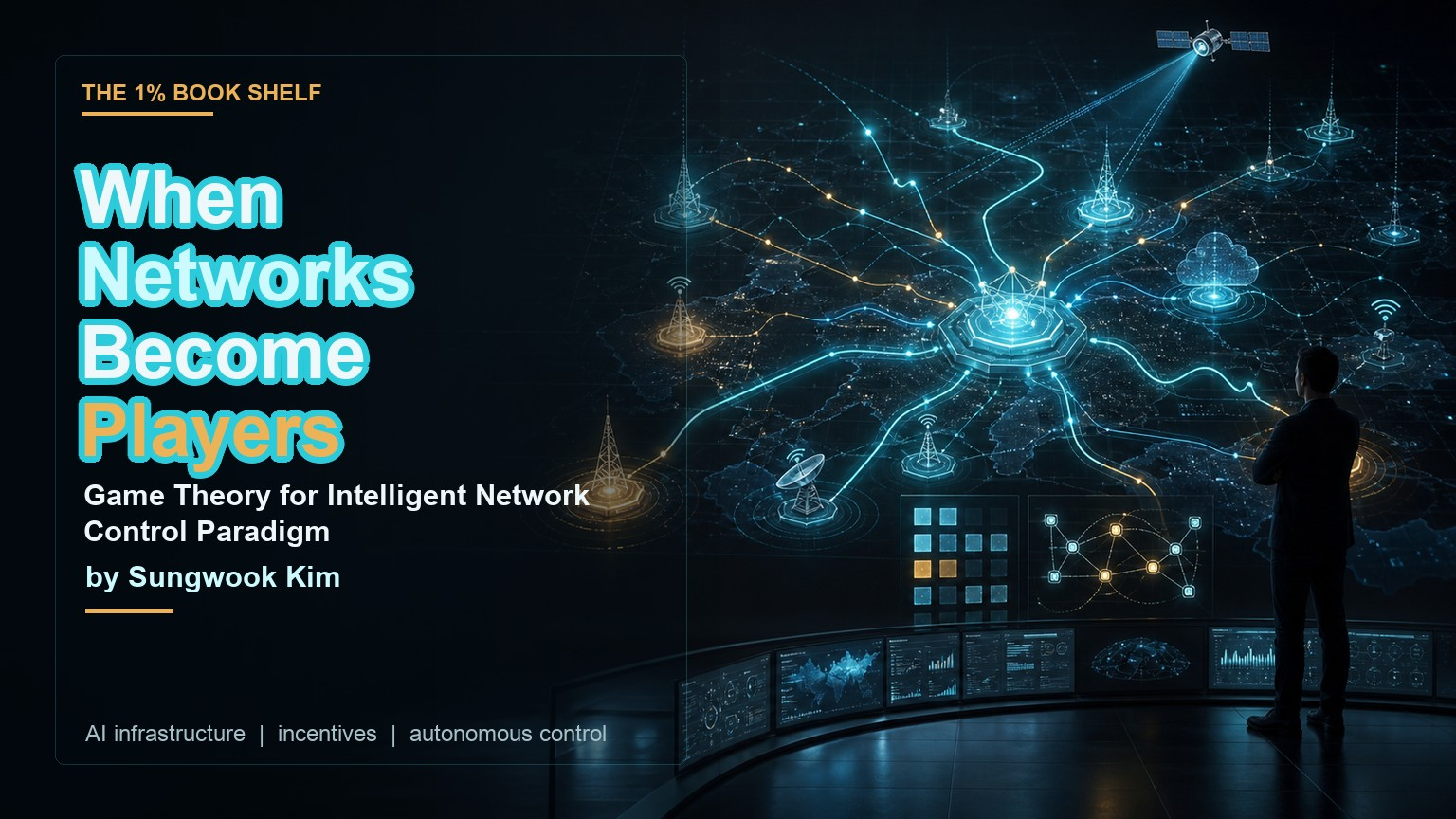
When Networks Become Players
Sungwook Kim's Game Theory for Intelligent Network Control Paradigm is dense, technical, and occasionally repetitive. It is also a useful warning: the next phase of infrastructure will be less about commanding systems and more about designing the rules they learn inside.
Read or skip?
Read selectively. Game Theory for Intelligent Network Control Paradigm is not a breezy technology leadership book, and it is not trying to be one. It is a technical survey and case-study collection for readers who already care about communication networks, resource allocation, game-theoretic modelling, and learning-based control.
That makes it a poor casual read and a useful specialist one. If you are working on 6G, edge computing, autonomous infrastructure, IoT platforms, network slicing, spectrum sharing, or agentic AI operations, there is a serious idea here worth extracting: the future network is not a pipe. It is a society of strategic actors.
The infrastructure problem hidden inside the maths
Sungwook Kim's book opens from a familiar telecom premise. 5G and beyond-5G networks are becoming more complex, more heterogeneous, and more important to everyday life. Users want coverage, speed, reliability, and seamless access. Operators face limited spectrum, cost pressure, uneven demand, mobility, edge workloads, privacy constraints, and new service types.
The book's answer is the intelligent network control paradigm: combine game theory with learning algorithms so network entities can model strategic interaction and adapt from feedback. In plain English, the system needs to understand both incentives and change.
That is the point worth carrying outside telecom. The more autonomous our infrastructure becomes, the less it behaves like a machine waiting for commands. It starts to look like a set of agents negotiating, competing, cooperating, and learning inside rules we designed, or failed to design.
Why game theory belongs in the operations room
Most infrastructure teams already live with game-theoretic problems, even if they never use the phrase. A service team wants lower latency. A platform team wants shared efficiency. A finance team wants lower cloud spend. A security team wants tighter controls. A customer-facing workflow wants priority during peak periods. An autoscaler wants to satisfy its local metric.
None of these actors is necessarily wrong. The problem is that local rationality can still create system-level stupidity. A team can optimize its own queue while starving another. A scheduler can maximize utilization while making recovery harder. An AI agent can satisfy a task objective while creating support burden elsewhere. A network node can protect its own resource budget while degrading the collective service.
Kim's technical models keep returning to this shape: players, resources, strategies, payoffs, constraints, equilibrium, learning. The vocabulary is mathematical, but the operating lesson is practical. If you do not design the game, you still get a game. It will just be designed accidentally by defaults, incentives, bottlenecks, and whoever shouts loudest during an incident.
Equilibrium is not the same as success
One useful caution in the book is implicit rather than loudly stated. Game-theoretic systems often seek stable outcomes: points where no player can improve by changing strategy alone, or where cooperative allocation becomes acceptable under a defined rule.
But stability is not morality, resilience, or business value. A network can settle into a stable allocation that is unfair to low-power devices. A market-like resource model can price out safety-critical traffic. A learning policy can converge on a behavior that performs well in simulation but fails under adversarial demand. A bargaining model can look elegant while hiding the politics of who was allowed to bargain in the first place.
This matters for AI infrastructure. Teams are increasingly tempted to turn operational decisions over to agents, optimizers, and closed-loop controllers. That can be powerful. It can also produce beautifully automated misalignment. The question is not only whether the system converges. The question is what it converges toward, who benefits, who pays the hidden cost, and how quickly humans can intervene when the reward function turns out to be naive.
The book's strongest pattern: scarcity plus feedback
The book moves through a large spread of network domains: cloud-based offloading, network virtualization, IoT communications, heterogeneous network management, device-to-device communication, vehicular ad hoc networks, non-terrestrial networks, wireless body-area networks, and emerging 6G control frameworks.
The examples vary, but the pattern is consistent. There is a scarce resource: bandwidth, spectrum, power, compute, cache, route quality, service priority, energy, or time. There are multiple actors with different objectives. There is incomplete information. The environment changes. The proposed answer is usually some form of bargaining, pricing, cooperative allocation, Stackelberg structure, Shapley-style contribution logic, or reinforcement learning loop.
That repetition can make the book feel mechanical. It also makes the thesis harder to miss. Future networks will be controlled less by static policy and more by adaptive resource negotiation. The real work is not simply making the algorithms smarter. It is deciding what smarter should mean.
What technology leaders should take from it
For a CTO, platform leader, or AI transformation lead, this book is a prompt to ask better questions about autonomy.
First: what are the agents in your system? They may be literal AI agents, but they may also be teams, services, schedulers, queues, policy engines, CI/CD pipelines, cost controls, model routers, edge nodes, or observability alerts. Anything that senses, decides, and acts against an objective is part of the game.
Second: what can each agent see? Imperfect information is not an edge case. It is the normal condition. If an optimizer cannot see downstream support load, carbon cost, degraded user trust, or security exceptions, it will not optimize for them.
Third: what is rewarded? A platform that rewards deployment frequency without service quality gets one kind of behavior. A cloud policy that rewards spend reduction without resilience gets another. An AI assistant that rewards task completion without auditability will find shortcuts. Payoff design becomes governance.
Fourth: what are the guardrails when learning works too well? Adaptive systems exploit the environment they are given. That means simulation, staged rollout, rate limits, rollback paths, anomaly detection, and human override are not bureaucracy. They are part of the control model.
The AI connection
Kim is writing about network control, not enterprise AI adoption. But the connection is obvious. As organisations add agentic workflows, autonomous remediation, AI-assisted DevOps, dynamic cloud optimization, model routing, and self-service platform layers, they are building multi-agent environments.
A single AI tool can be managed as a product. A network of AI-enabled services behaves more like an economy. Some agents will compete for resources. Some will cooperate. Some will shift work elsewhere. Some will learn from feedback in ways the designer did not expect. Some will optimize a proxy metric until the proxy becomes the problem.
This is why AI governance cannot stop at acceptable-use policy and model risk paperwork. It has to include incentive architecture. What are agents allowed to do? What information are they denied? What trade-offs are explicit? What is reversible? What is observable? What behavior would look successful in a dashboard while quietly making the system worse?
The sceptical read
The book's weakness is readability. It is dense, technical, and built more like a research catalogue than a guided argument. Many chapters follow a similar structure, moving from motivation to model to control scheme to summary. That is useful if you are mining it for approaches. It is tiring if you want a clean narrative.
It also leans heavily into formal models. That is expected, but it means readers must do the translation back into messy operating reality. Real networks include vendor constraints, legacy systems, regulatory pressure, security incidents, budget politics, skills gaps, and users who do not behave like clean utility functions.
There is also a risk in the wider field that mathematical elegance can make control feel more complete than it is. The hardest parts of autonomous infrastructure are often not the algorithm itself. They are defining the objective, deciding whose welfare counts, spotting perverse incentives, and keeping humans responsible for systems that increasingly act without asking.
What to do on Monday
Pick one adaptive system in your organisation: an autoscaler, AI agent, model router, incident bot, platform policy, queue prioritisation rule, recommendation engine, or cost optimizer.
Map the game around it. Who are the actors? What does each actor want? What can each actor observe? What is scarce? What is rewarded? What can be gamed? What cost can be pushed onto someone else? What would a stable but bad outcome look like?
Then add the missing operating controls. Make the objective explicit. Add measures for externalities, not just local success. Test under stress. Simulate adversarial or selfish behavior. Use staged exposure. Keep rollback close. Review what the system learned after it met real users.
This is the practical version of Kim's thesis for modern technology leadership. Intelligent control is not only about smarter algorithms. It is about designing environments where smart behavior is more likely to be useful, fair, resilient, and accountable.
Final thought
Game Theory for Intelligent Network Control Paradigm is not a book for everyone. It is too technical for general readers and too catalogue-like for anyone expecting a polished business argument.
But its core idea is important. Future infrastructure will not be controlled only by central commands. It will be shaped by adaptive actors making local decisions inside shared constraints. That is true for 6G networks. It is increasingly true for cloud platforms, AI operations, and digital organisations.
The leadership shift is subtle but serious. Stop asking only whether the system is automated. Ask what game the automation is playing.

Written by Kevin Campbell
Thirty years of technology, delivery and organisational change—translated into practical thinking for people doing the work.
Continue the journey
One thought leads to another.
Scroll to explore
 AI Governance
AI Is Not a University. But It Can Build You One.
AI Governance
AI Is Not a University. But It Can Build You One.
 AI Governance
The Hidden Verification Gap: A Practical 30-Day Way Forward
AI Governance
The Hidden Verification Gap: A Practical 30-Day Way Forward
 Enterprise Delivery
Stop Fixing Symptoms: A Practical Way to Diagnose Hidden Causes
Enterprise Delivery
Stop Fixing Symptoms: A Practical Way to Diagnose Hidden Causes
 Enterprise Delivery
Four Practical Truths About the Hidden AI Productivity Gap
Enterprise Delivery
Four Practical Truths About the Hidden AI Productivity Gap
 AI Governance
The Next Workplace Conflict Is Not Human vs AI
AI Governance
The Next Workplace Conflict Is Not Human vs AI
 AI Governance
Hyperadaptive Is a Blueprint for Rewiring the Enterprise Around AI
AI Governance
Hyperadaptive Is a Blueprint for Rewiring the Enterprise Around AI
Conversation
Add to the thinking
Questions, experience and thoughtful disagreement are welcome.