In this article7 min read
Simone Stolzoff’s new book is not really about indecision. It is about the discipline of staying useful when the answer is not yet available.
Read or skip?
Read. Especially if you work anywhere near AI adoption, platform engineering, product delivery, governance, or leadership. How to Not Know is not a technology book, but it names one of the most important technology problems of the next few years: the pressure to sound certain before the system, the users, or the evidence are ready.
The certainty problem
Most organisations do not have a shortage of answers. They have too many answers delivered too quickly, with too much confidence and too little inspection. Roadmaps arrive as if the future has agreed to cooperate. AI pilots are described as transformational before anyone has measured the workflow impact. Dashboards imply control because the graphs are tidy. Governance meetings create comfort because someone has signed the document.
Simone Stolzoff’s How to Not Know is useful because it challenges that reflex. The book is not asking us to be vague, indecisive, or allergic to commitment. It is asking us to stop treating uncertainty as a personal failure. Sometimes not knowing is exactly the honest state of the system.
That matters in technology because pretending to know is expensive. It leads to brittle plans, overconfident AI rollouts, misread customer behaviour, false precision in forecasts, and leadership cultures where people learn to hide doubt until the evidence becomes too loud to ignore.
The three certainty traps
Stolzoff organises the book around three traps: comfort, hubris, and control. It is a simple frame, but it carries a lot of weight.
Comfort is the appeal of a worldview that removes the strain of thinking. In the book, this shows up through stories of people drawn toward communities, relationships, preferences, and routines that offer a well-lit path through complexity. The cost is that comfort can make the world smaller. It can also make contradictory evidence feel like a threat rather than a gift.
Hubris is the second trap. This is where the book becomes especially relevant to work. Organisations often reward the person who sounds most certain. The confident forecast gets funded. The crisp transformation deck gets circulated. The leader with a five-year plan looks more serious than the one willing to say, ‘Here is what we know, here is what we assume, and here is what would change our mind.’
Control is the third trap, and maybe the most familiar to anyone in delivery. We try to manage the unknowable with more planning, more reporting, more steering groups, more tooling, and more checklists. Some of that is useful. Much of it is anxiety wearing a lanyard.
AI makes this harder
AI has made the certainty problem sharper because it produces fluent answers at industrial speed. Ask a model for a strategy and it will give you one. Ask for a risk register and it will produce a neat table. Ask for a market view, a project plan, a customer segmentation, or a policy draft and the output will often sound finished.
The danger is not that AI is useless. The danger is that it is useful enough to become persuasive before it is reliable enough to be trusted. A weak assumption in rough notes still looks weak. A weak assumption dressed in confident prose, executive structure, and plausible citations can travel much further before anyone challenges it.
This is where How to Not Know becomes an AI leadership book by accident. It reminds us that the scarce capability is not answer production. The scarce capability is judgement under ambiguity.
From answer culture to evidence culture
The practical shift is from answer culture to evidence culture. In answer culture, the goal is to remove uncertainty quickly. In evidence culture, the goal is to make uncertainty visible enough that people can act intelligently around it.
That changes the shape of leadership. A good leader still gives direction. People need priorities, constraints, boundaries, and decisions. But direction is different from false certainty. Direction says: this is the next responsible move, given what we know. False certainty says: this will work because the slide says so.
Technology teams already have some of the muscles needed for this. Progressive delivery, incident reviews, observability, feature flags, test-and-learn practices, pre-mortems, and decision records are all ways of making uncertainty operational rather than embarrassing. The best teams do not eliminate unknowns. They reduce the blast radius of being wrong.
What governance gets wrong
Traditional governance often tries to create confidence through approval. A document moves through committees. Risks are logged. A sponsor signs. Everyone briefly feels better.
But approval is not the same as understanding. A steering group can approve an AI rollout without knowing how the model behaves at the edge cases. A platform board can approve a migration without understanding where user habits will break. A security review can approve a control while missing the human workaround it creates.
Stolzoff’s book points toward a better version of governance: make the unknowns explicit. What are we assuming? How confident are we? What would disconfirm the plan? Which users should see this first? What is reversible? What trade-off are we accepting? Where are we seeking comfort rather than truth?
The useful kind of worry
One of the best parts of the book is its refusal to treat worry as purely negative. Worry can become avoidance, rumination, or compulsive checking. But it can also be information. It can tell us where the decision is fragile.
This is valuable for delivery leaders because teams often suppress worry until it becomes escalation. A product manager worries that users will not understand the new workflow. An engineer worries that the model evaluation set is too clean. An operations lead worries that the migration plan assumes a support capacity that does not exist. A compliance colleague worries that the policy wording is technically true but practically misleading.
Healthy organisations do not dismiss those worries as resistance. They interrogate them. Is there information to gather? A smaller test to run? A fallback to design? A user group to involve earlier? A value judgement to make explicit?
What to do on Monday
The Monday move is not to become more philosophical. It is to make uncertainty inspectable.
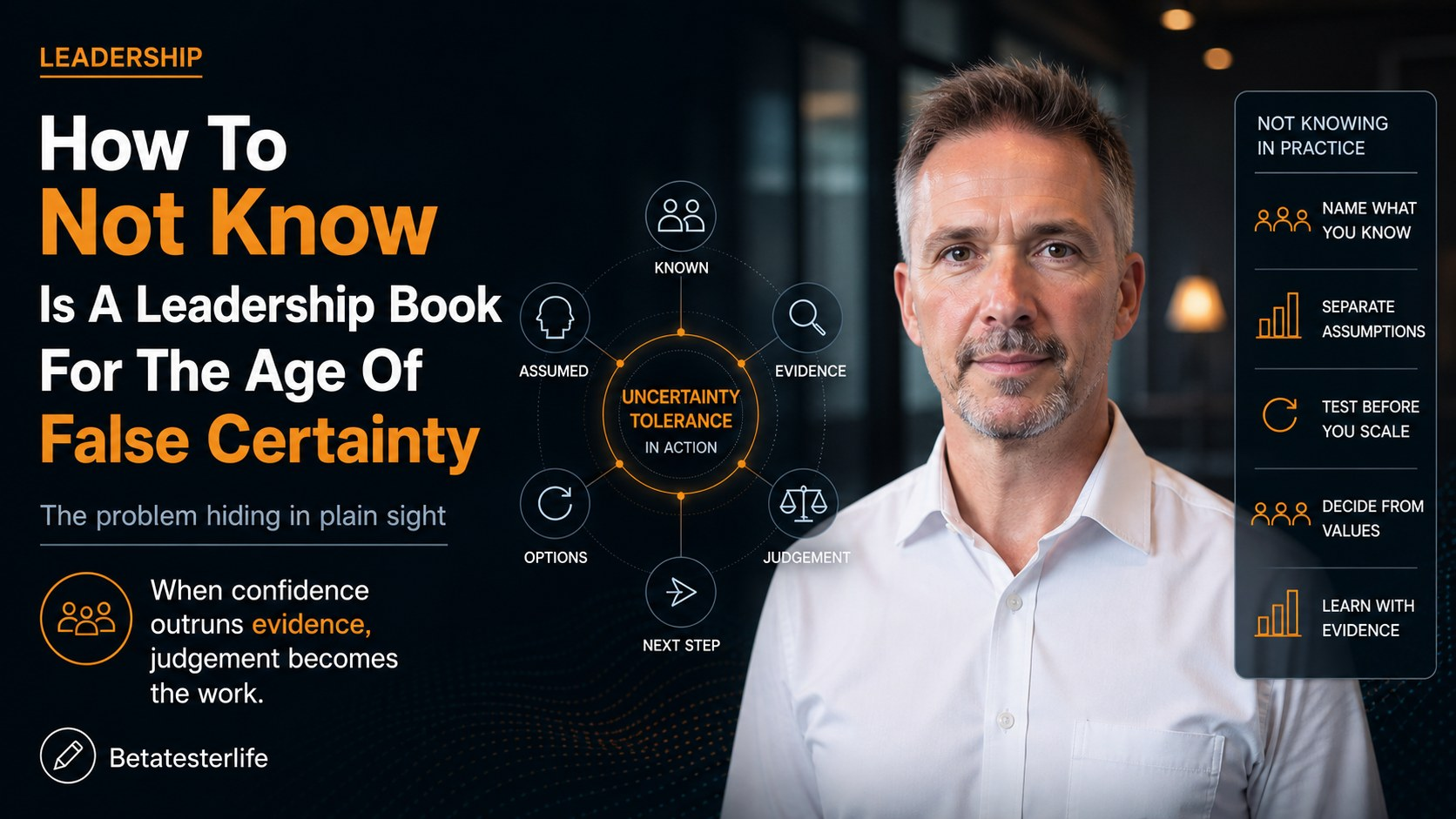
For any significant AI, delivery, or transformation decision, write down four things before the decision hardens. First, what do we know? Second, what are we assuming? Third, what are we uncertain about but able to test? Fourth, what is genuinely unknowable, meaning we need values, principles, or reversible design rather than more analysis.
Then attach operating mechanisms to the answer. Use staged exposure. Define kill criteria. Make confidence levels explicit. Ask for dissent before approval. Run pre-mortems. Keep decision records. Review what changed after first contact with users. Build rollback and opt-out paths where the risk justifies them.
Most importantly, stop rewarding certainty as a performance. Reward the person who can say, clearly and early, what the team does not yet know and what it will do next to learn.
The sceptical read
The book has limits. It is stronger as a human and leadership argument than as an enterprise operating manual. Readers looking for a delivery framework will have to do some translation. Some chapters lean more toward personal narrative than organisational diagnosis. And the book’s warmth may make it easy for a corporate reader to admire the message without changing any incentives.
That said, the translation is worth doing. The technology industry is entering a period where uncertainty will rise, not fall. AI capability is moving quickly. Regulation is uneven. User expectations are unstable. Cost pressure is high. The old comfort of pretending we can plan our way to certainty is not going to survive contact with reality.
Final thought
How to Not Know is a timely book because it gives permission to admit something serious people often avoid saying: we do not know yet.
That sentence is not a weakness if it is followed by discipline. We do not know yet, so we will test. We do not know yet, so we will expose the change gradually. We do not know yet, so we will listen harder. We do not know yet, so we will make the trade-offs visible. We do not know yet, so we will decide from principles where prediction runs out.
In a world full of confident machines and overconfident organisations, that may be one of the most practical leadership skills left.
Source note: Book details checked against W. W. Norton / Bookshop, Google Books, Publishers Weekly, and Simone Stolzoff’s official site.

Written by Kevin Campbell
Thirty years of technology, delivery and organisational change—translated into practical thinking for people doing the work.
Continue the journey
One thought leads to another.
Scroll to explore
 Field Notes
The CC List Is Not a Control
Field Notes
The CC List Is Not a Control
 Enterprise Delivery
Stop Owning People. Start Owning Outcomes
Enterprise Delivery
Stop Owning People. Start Owning Outcomes
 Field Notes
Self-Awareness Is Not Introspection. It Is System Monitoring.
Field Notes
Self-Awareness Is Not Introspection. It Is System Monitoring.
 Field Notes
The AI Creative Process: Why AI Should Enter Twice
Field Notes
The AI Creative Process: Why AI Should Enter Twice
 Field Notes
Human-Centred Change Is Not Soft. It Is Disciplined.
Field Notes
Human-Centred Change Is Not Soft. It Is Disciplined.
 Leadership & Culture
Constraints make us better
Leadership & Culture
Constraints make us better
Conversation
Add to the thinking
Questions, experience and thoughtful disagreement are welcome.