📊 Read or skip? Read. If you are still measuring success in uptime, velocity, or tickets closed — you are likely missing where value is actually created.
Why this, why now
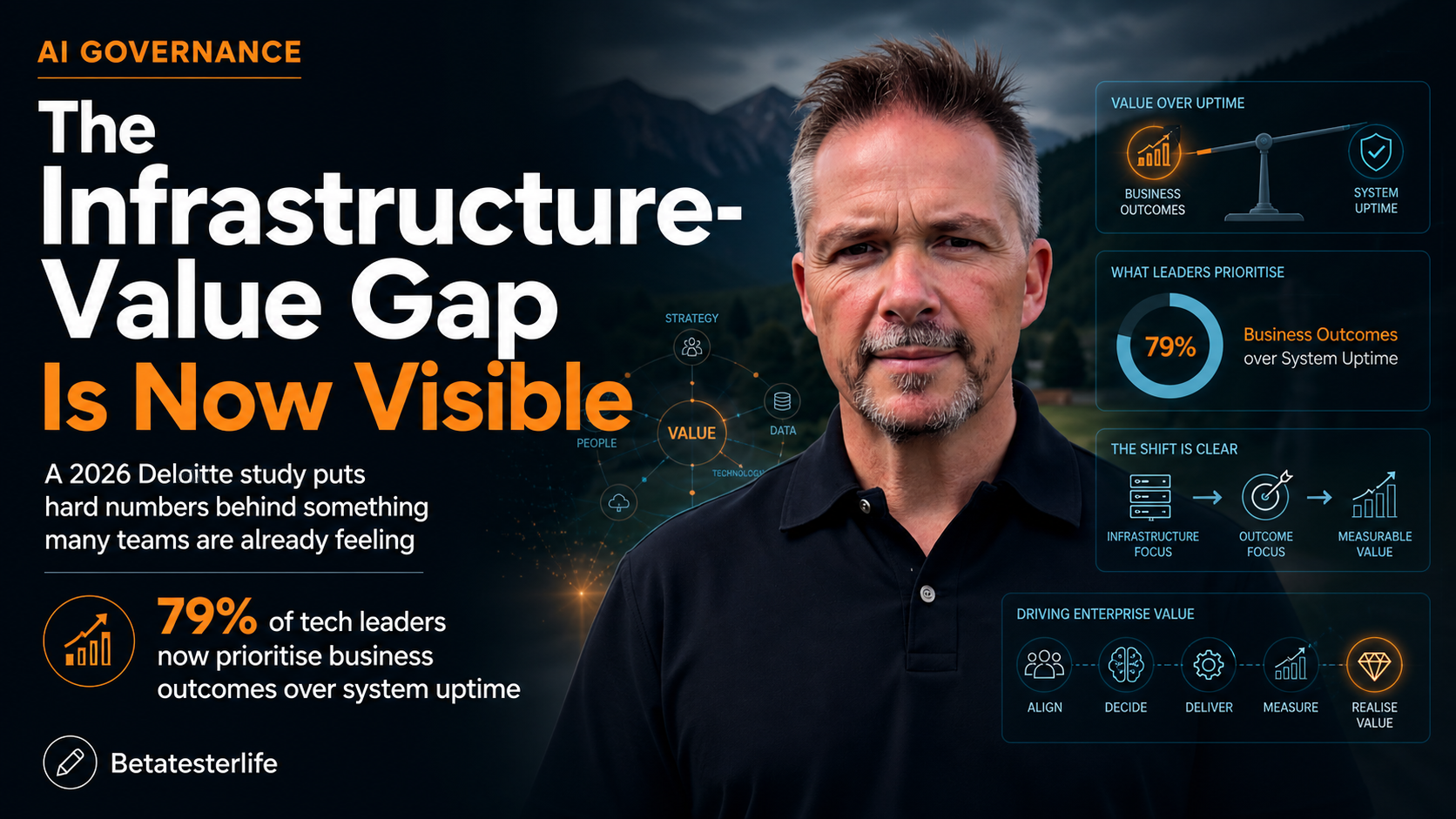
A Deloitte 2026 study puts hard numbers behind something many teams are already feeling:
- 79% of tech leaders now prioritise business outcomes over system uptime
- 42% report zero ROI from AI investments
- The primary cause: “structural lag”
This is not a tooling issue.
It is not a talent shortage problem.
It is a systems design failure at the enterprise level.
We are watching the shift from operators (keep systems running) to orchestrators (ensure systems deliver value).
The big idea: uptime vs. outcome
For years, reliability engineering has been framed as:
“Keep the system available.”
That framing is now insufficient.
Because the system can be 100% available and still delivering zero business value.
The reframing
- Old model:
Reliability = uptime, latency, error rates - New model:
Reliability = business process continuity under change
What changed?
AI, automation, and platformisation have introduced:
- More dependencies across systems
- Faster decision cycles
- Higher coupling between tech and business logic
This means failure is no longer:
“The server went down”
It is:
“The business outcome did not materialise”
The Infrastructure-Value Gap
This is the gap the Deloitte study exposes.
You can visualise it as two parallel systems:
| Layer | What it optimises | Typical metrics |
|---|---|---|
| Infrastructure layer | Stability & performance | Uptime, MTTR, throughput |
| Value layer | Business outcomes | Revenue impact, cycle time, decision quality |
The problem
Most organisations have:
- Mature infrastructure metrics
- Immature value metrics
- Weak linkage between the two
So they can answer:
“Did the system work?”
But not:
“Did the system matter?”
Structural lag (the real constraint)
“Structural lag” is not about people being slow.
It is about org design not keeping pace with capability.
Where it shows up
- Delivery pipelines optimised for output, not outcome
- Features shipped ≠ value realised
- Funding models locked to projects, not products
- AI gets built, but not embedded
- Ownership fragmentation
- No single owner for end-to-end value flow
- Metrics misalignment
- Teams rewarded for uptime, not impact
Result
AI initiatives land into an environment that cannot absorb them.
So you get:
- Working models
- Clean dashboards
- Zero ROI
Operators vs. Orchestrators
This is the capability shift that matters.
Operator mindset
- Focus: system health
- Success: stability, predictability
- Scope: bounded (service, platform, component)
Orchestrator mindset
- Focus: value flow across systems
- Success: business outcomes under uncertainty
- Scope: end-to-end (customer → decision → action → result)
The difference in practice
| Scenario | Operator response | Orchestrator response |
|---|---|---|
| AI model deployed but unused | “System is live” | “Why is adoption failing?” |
| Data pipeline stable but slow decisions | “No incidents” | “Where is latency in decision-making?” |
| Feature shipped with low impact | “Delivered on time” | “Was the hypothesis wrong?” |
Practical application: closing the gap
You do not fix this with a new tool.
You fix it by redesigning how value flows.
1. Define reliability at the value level
Move from:
- Service Level Indicators (SLIs)
To:
- Value Level Indicators (VLIs)
Examples:
- Time from data → decision → action
- % of AI outputs actually used in decisions
- Business process completion rate under load
2. Align ownership to value streams
Stop optimising components.
Start assigning:
- End-to-end accountability for outcomes
- Named owners for value streams (not just systems)
3. Rewire feedback loops
Shorten the distance between:
- Deployment → usage → outcome → learning
If you cannot see whether something worked:
You are not doing AI. You are doing theatre.
4. Fund for persistence, not delivery
AI and transformation require:
- Continuous tuning
- Behaviour change
- Integration into workflows
Shift from:
- Project funding → product/value funding
5. Instrument the “last mile”
Most organisations measure:
- System performance
Few measure:
- Decision quality
- User trust
- Action taken
That “last mile” is where ROI is either realised or lost.
Where I disagree (slightly)
The narrative risks overstating that uptime is now secondary.
It is not.
It is table stakes.
If your systems are unstable:
- You cannot orchestrate anything
But if you stop at stability:
- You will be replaced by those who can translate stability into value
The pattern to watch
The organisations that will outperform over the next 3–5 years will:
- Treat infrastructure as a means, not an end
- Design for value flow, not system health alone
- Build leaders who can orchestrate across technical and business boundaries
The takeaway
The shift is already happening:
From keeping systems running
To making systems matter
The risk is not that your systems fail.
The risk is that:
They work perfectly — and still do not move the business forward.
If you are leading this shift
Ask three questions:
- Can we trace a direct line from system performance to business outcome?
- Who owns that outcome end-to-end?
- How fast do we learn if it is not working?
If those answers are unclear:
You are not facing a technology problem.
You are facing an orchestration problem.
Next post
How to define Value Level Indicators (VLIs) in practice — with examples from AI, data platforms, and operational systems.
Series note
This is part of Beta Tester Life — exploring where AI, DevOps, and human systems intersect. The focus is simple: move from intent → system → outcome without losing the human layer in between.

Written by Kevin Campbell
Thirty years of technology, delivery and organisational change—translated into practical thinking for people doing the work.
Continue the journey
One thought leads to another.
Scroll to explore
 AI Governance
Generative AI Customer Insights: What AI Can and Can’t Do
AI Governance
Generative AI Customer Insights: What AI Can and Can’t Do
 AI Governance
Seeing the Full Story Isn’t a Data Problem. It’s an Empathy Problem.
AI Governance
Seeing the Full Story Isn’t a Data Problem. It’s an Empathy Problem.
 AI Governance
Token Spend Is Not a Cost to Cut. It Is a Portfolio to Manage.
AI Governance
Token Spend Is Not a Cost to Cut. It Is a Portfolio to Manage.
 AI Governance
Physical AI Isn’t a Shortlist. It’s a Sequence.
AI Governance
Physical AI Isn’t a Shortlist. It’s a Sequence.
 Field Notes
PI Planning Is Not The Problem. Pretending It Removes Complexity Is.
Field Notes
PI Planning Is Not The Problem. Pretending It Removes Complexity Is.
 The 1% Book Shelf
The 1% Bookshelf #01 — Unreasonable Hospitality by Will Guidara
The 1% Book Shelf
The 1% Bookshelf #01 — Unreasonable Hospitality by Will Guidara
Conversation
Add to the thinking
Questions, experience and thoughtful disagreement are welcome.