In this article7 min read
Read or skip?
Read if you are responsible for AI adoption, digital transformation, operating-model design, delivery governance, product leadership, or enterprise change. Skip if you only want another catalogue of AI tools. Hyperadaptive is not really about tools. It is about the organizational rewiring needed before tools can matter.
The most useful thing about Melissa M. Reeve's Hyperadaptive is that it refuses the comfortable version of the AI story.
The comfortable version says enterprises can become AI-native by buying platforms, issuing policies, training staff, and encouraging experimentation. That may create activity. It does not automatically create a different kind of company.
Reeve's sharper argument is that most organizations are trying to run AI through an operating system built for a slower century: functional silos, staged approvals, annual planning cycles, linear handoffs, role boundaries, and management layers that treat information as something to be escalated rather than sensed and acted on.
That is why the book's subtitle matters. Rewiring to become an AI-native organization is a stronger claim than adopting AI. It suggests that the enterprise itself has to be redesigned around learning speed, decision quality, value flow, and human-machine collaboration.
The real problem is the operating system
Reeve opens with a diagnosis that will feel familiar to anyone who has worked inside large transformation programmes. The technology changes faster than the organization can metabolize it.
Most companies can run pilots. They can create AI champions. They can publish acceptable-use policies. They can buy copilots and dashboards and workflow automation tools. What they struggle to change is the enterprise plumbing: how strategy becomes work, how work crosses functions, how decisions are made, how learning is captured, how funding moves, how roles evolve, and how accountability survives when machines are involved.
This is where Hyperadaptive earns its place in the AI leadership conversation. It frames AI not as another digital capability, but as a forcing function that exposes the weakness of linear organizations.
If work still moves left to right through departments, AI will accelerate local tasks while leaving the value stream slow. If strategy still flows top down through management layers, AI will create more signals than leaders can process. If governance is detached from delivery, AI risk will be managed through paperwork rather than feedback. If incentives reward functional protection, AI will sharpen the politics rather than improve the system.
Five capabilities, not one big transformation
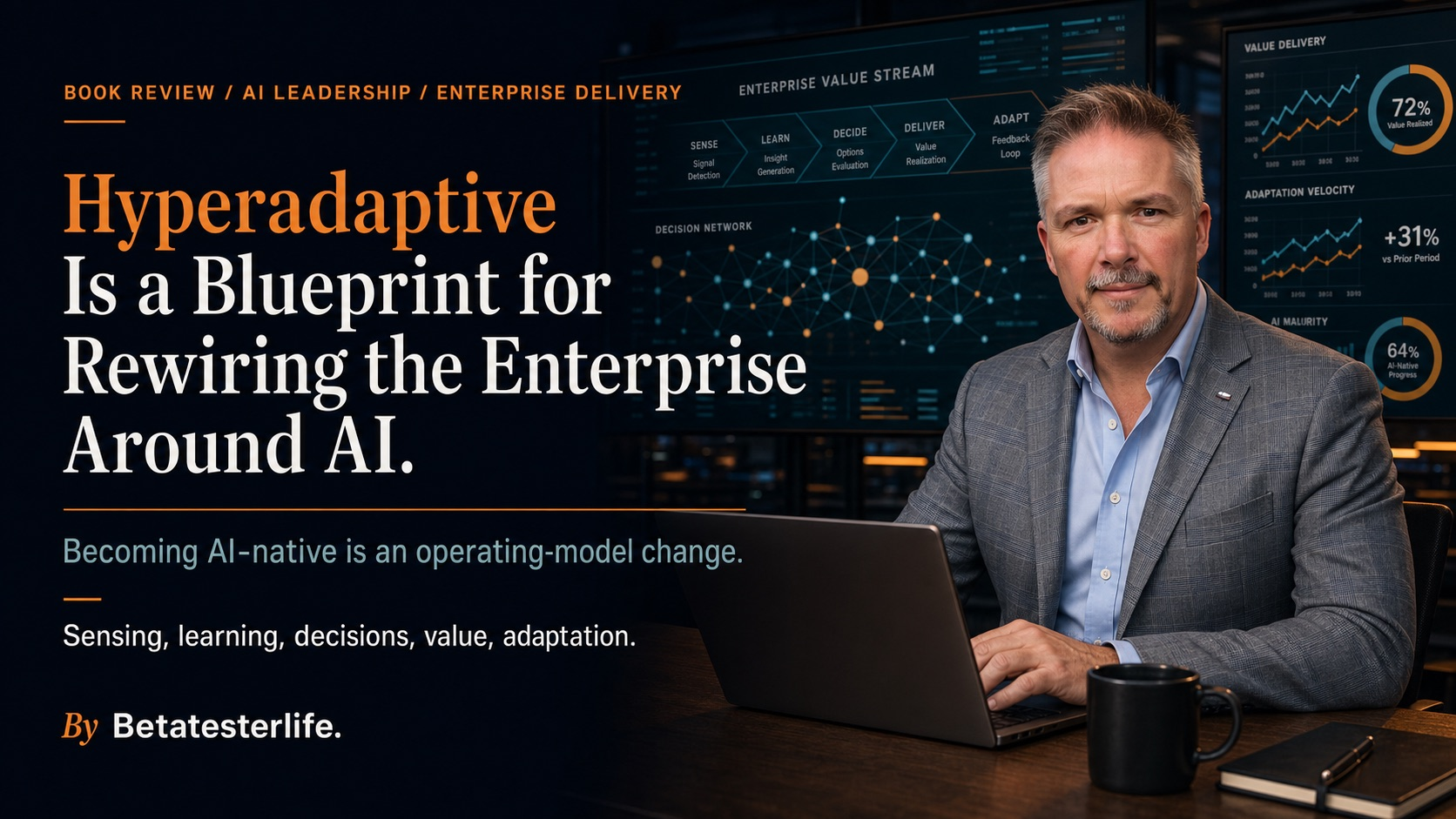
The book's central model is built around five capabilities: AI-powered sensing and response, integrated learning loops, augmented decision-making, value orientation, and continuous adaptation.
That list is useful because it shifts the question from 'Which AI tool should we deploy?' to 'What must this organization become capable of doing repeatedly?'
Sensing and response means the organization can detect change early and act before the signal goes stale. Learning loops mean experiments, feedback, and improvement are part of the operating model rather than an after-action ritual. Augmented decision-making means AI and human judgement are deliberately combined instead of treated as rivals. Value orientation means the organization is designed around outcomes and customer value rather than internal functions. Continuous adaptation means the system keeps improving without needing a heroic transformation programme every few years.
This matters because AI capability will not stay still. A company that optimizes around today's model or today's vendor will keep rebuilding its approach. A company that builds sensing, learning, decision, value, and adaptation muscles has a better chance of surviving the churn.
Why this lands for technology and delivery leaders
For Beta Tester Life readers, the strongest connection is with DevOps, Agile, platform thinking, and value-stream management.
Reeve's argument is basically an enterprise-scale version of a lesson technology teams have learned many times: speed comes from system design, not individual busyness.
You cannot inspect quality into a broken delivery system. You cannot automate your way out of poor flow. You cannot scale empowerment through permission-heavy governance. You cannot get the benefits of AI if every useful signal must wait for a committee, a handoff, a steering deck, and a quarterly funding conversation.
AI makes these old constraints more visible because it compresses some parts of the work while leaving others untouched. A team may generate analysis faster, produce code faster, create content faster, or automate routine process steps. But if the decision path, funding model, risk process, and organizational boundaries stay slow, the advantage leaks away.
The useful warning: do not skip stages
One of the better parts of Hyperadaptive is its resistance to big-bang AI transformation. The book describes a staged journey: foundation setting, process optimization and task augmentation, initial AI automations, scaling AI, and finally hyperadaptive realization.
That staged logic is important. Enterprises are very good at declaring a future state and very bad at building the muscles required to live there.
Reeve's warning is that organizations can hurt themselves by jumping from experimentation to scaled automation before they have governance, feedback, role clarity, human oversight, and learning systems in place. That is the kind of mistake AI makes tempting: once the demo works, leadership wants scale. But scale does not forgive weak operating design. It amplifies it.
This is the practical lesson: do not confuse a capable model with a capable organization.
The human system is not optional
Ryan Martens' foreword gives the book a useful emotional frame. His point is that AI is not moving like earlier enterprise technology waves. The pace is faster, the anxiety is higher, and the change is being pulled from every direction at once.
That matters because most AI strategies still underinvest in the human side of adoption. They talk about productivity and capability, but they do not always deal honestly with fear, identity, trust, job redesign, status, skill obsolescence, and the nervous-system reality of people being asked to reinvent their work while the tools keep changing underneath them.
Hyperadaptive is strongest when it treats the human system as part of the architecture. AI-native does not mean human-light. It means the relationship between humans and machines has to be designed with more care, not less.
That includes transparent governance, practical support, psychological safety for experimentation, honest conversations about role change, and leaders who can create direction without pretending certainty exists.
The sceptical read
There is a risk with any maturity model: it can make the path look cleaner than real change feels.
Most enterprises will not move neatly from one stage to the next. Different departments will mature at different speeds. Some functions will protect old power structures. Some AI champions will burn out. Some early wins will be overclaimed. Some governance forums will become theatre. Some vendors will sell 'AI-native' as a label while leaving the operating model untouched.
The book acknowledges some of this messiness, but leaders should read it as a map, not a guarantee. The hard part will not be understanding the five capabilities. The hard part will be changing incentives, funding, decision rights, architecture, data ownership, management behaviour, and career paths while the business still expects quarterly performance.
That is not a criticism of the book so much as a warning about the work. Rewiring the enterprise is not a workshop outcome. It is a power, process, and behaviour change.
What to do on Monday
Start by diagnosing where AI is currently accelerating activity without improving flow.
Pick one important value stream. Map how an idea becomes a decision, how a decision becomes work, how work crosses teams, how AI is used, where human judgement is required, where risk is reviewed, where learning is captured, and where customers actually see value.
Then ask five questions.
What can we sense earlier? What can we learn faster? Which decisions should be augmented rather than escalated? Which functional boundary is slowing customer value? What adaptation should become automatic rather than episodic?
That is a more useful AI adoption conversation than asking which department has the most prompts or which tool has the highest usage.
Final thought
Hyperadaptive is valuable because it moves the AI conversation away from tool enthusiasm and towards organizational design.
The winners in the AI era will not simply be the companies with the best models, the most pilots, or the loudest innovation theatre. They will be the organizations that can sense, learn, decide, deliver, and adapt faster than their operating model used to allow.
That is the real rewiring. Not AI pasted onto the enterprise, but the enterprise redesigned so AI and human judgement can work through it.

Written by Kevin Campbell
Thirty years of technology, delivery and organisational change—translated into practical thinking for people doing the work.
Continue the journey
One thought leads to another.
Scroll to explore
 AI Governance
AI Is Not a University. But It Can Build You One.
AI Governance
AI Is Not a University. But It Can Build You One.
 AI Governance
The Hidden Verification Gap: A Practical 30-Day Way Forward
AI Governance
The Hidden Verification Gap: A Practical 30-Day Way Forward
 Enterprise Delivery
Stop Fixing Symptoms: A Practical Way to Diagnose Hidden Causes
Enterprise Delivery
Stop Fixing Symptoms: A Practical Way to Diagnose Hidden Causes
 Enterprise Delivery
Four Practical Truths About the Hidden AI Productivity Gap
Enterprise Delivery
Four Practical Truths About the Hidden AI Productivity Gap
 AI Governance
AI Coding Has Moved the Bottleneck From Creation to Verification
AI Governance
AI Coding Has Moved the Bottleneck From Creation to Verification
 Leadership & Culture
Supercommunicators Is A Leadership Book About Alignment, Not Charisma
Leadership & Culture
Supercommunicators Is A Leadership Book About Alignment, Not Charisma
Conversation
Add to the thinking
Questions, experience and thoughtful disagreement are welcome.