📖 Read or skip? ikigai book review Skim it — and ignore the four-circle diagram that made it famous, because that diagram isn’t in the book. There’s one idea here worth keeping, which is exactly what this shelf is for.
Why this book, why now
You already know this book even if you’ve never opened it. It’s the four-circle diagram — what you love, what you’re good at, what the world needs, what you can be paid for — with ikigai sitting in the overlap. It’s on every careers deck and half the motivational posts published since 2017.
I picked it up because purpose has become a live engineering question, not a wellness slogan. When a platform shift wipes out a role — and I’ve watched four do exactly that, mainframe to client-server, on-prem to cloud, waterfall to agile, now AI — the people who cope are the ones whose sense of purpose wasn’t welded to a job title. So I went looking for what the book actually says, rather than what the diagram says it says.
They turn out to be different things.
The big idea: the diagram isn’t in the book
Here’s the part nobody mentions. I searched the full text of García and Miralles’ book. “Venn” appears zero times. “Diagram” appears zero times. “What the world needs” and “what you can be paid for” — the two circles everyone quotes — appear zero times.
The famous quadrant isn’t Japanese, and it isn’t theirs. It was drawn by a Western entrepreneur, Marc Winn, in a 2014 blog post. He took an existing “purpose” diagram by the Spanish author Andrés Zuzunaga and swapped the word purpose for ikigai. Winn later admitted it doesn’t capture the original meaning. A repurposed graphic got bolted onto a real word, went viral, and a 2017 book rode the wave.
What the book — and the concept — actually describe is smaller and more useful. Neuroscientist Ken Mogi and researcher Akihiro Hasegawa make the same point: ikigai isn’t one grand life-purpose you solve for. It’s the running total of small daily reasons to get up. A garden. A craft. A standing coffee with someone.
📊 The stat that stuck: the book reports there is “no word in Japanese that means retire in the sense of leaving the workforce for good.” The elders in Ogimi, Okinawa — one of the densest concentrations of centenarians on earth — don’t stop. They keep doing what they’re good at.
Four ideas worth stealing
1. Purpose is a daily verb, not a life sentence
The Okinawan model isn’t “find your one true calling.” It’s “have a reason to get up tomorrow, and never fully stop.” Viktor Frankl — quoted throughout — found that around 80 per cent of people in his clinic believed humans need a reason to live. Purpose is load-bearing, not decorative.
My read: I’ve watched people fuse their identity to a system or a role, then lose both in a reorg. Purpose pinned to a daily activity survives the reorg. Purpose pinned to a job title doesn’t. In an AI-displacement decade, that’s not philosophy — it’s risk management.
2. Hara hachi bu — ship at eighty per cent
Okinawans eat until they’re about 80 per cent full, then stop. The book calls it the 80 per cent rule: “when you notice you’re almost full but could have a little more . . . just stop eating.”
My read: the last 20 per cent of “full” is where the bloat lives, and it’s the same in delivery. The last fraction of polish, scope, and gold-plating is where budgets and people burn out. Stopping at eighty, on purpose, is a discipline most teams never learn.
3. Flow is an engineering problem, not a mood
The book leans on Mihály Csikszentmihalyi’s research on flow — total immersion in a task. It also lands a sharper line than it seems to notice: people who believe they’re good at multitasking “are some of the least productive people.”
My read: flow doesn’t happen by accident; you architect for it. Protect deep-work blocks the way you’d protect production capacity. Treat a wall of non-essential alerts as the reliability problem it is — every interruption is an unplanned context switch, and context switches are never free.
4. Moai — the team is a longevity factor
In Ogimi, people belong to a moai — a small group that supports one another for life. The book notes they aren’t “organised around any concrete objective; they function more like a family.”
My read: the durable team outlasts any individual hero. A group with real trust and no fixed deliverable is exactly what most “high-performing teams” models miss — they optimise the objective and starve the relationship that carries it.
What I disagreed with
The book is padded, and it’s padded in a revealing way. The original material — the authors did fly to Ogimi and interview the residents — is a thin slice at the front. The middle is a borrowed tour: flow theory, Morita therapy, Stoicism, antifragility, yoga, and some hand-waving about radical life extension and “escape velocity.” Interesting, mostly second-hand.
There’s also the survivorship problem that haunts the whole centenarian-secrets genre. You interview the people who reached 100, note what they happen to do, and call it the cause. Genetics, diet baselines, and a hundred confounders get waved through. Correlation in a kimono.
And the icon that sells the book on every cover and slide? Still not theirs.
How I’m applying it
Three experiments off the back of it:
- A reason to get up, written down. One line on the whiteboard each Monday — the concrete thing, not the mission statement.
- The eighty per cent rule on a live delivery. Pick one workstream and ask which slice of “polish” is actually bloat, then cut it before it’s built.
- One protected flow block, alerts off. A daily window with notifications killed, treated as non-negotiable production time.

ikigai book review verdict
⭐⭐⭐ Skim it. This is a 1% book in the truest sense — one idea worth keeping, wrapped in a couple of hundred pages of borrowed material and a diagram that isn’t even inside.
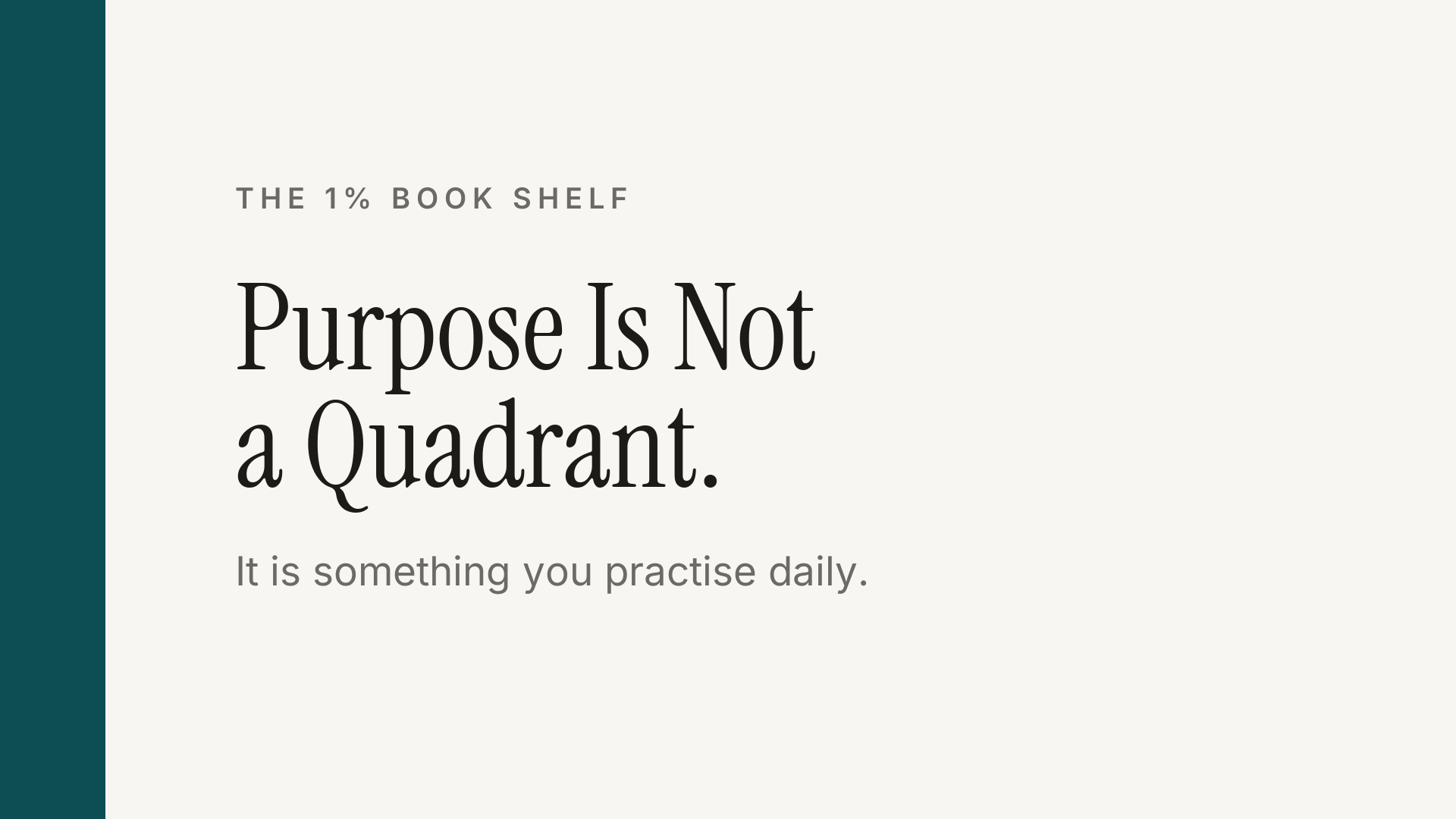
The one per cent worth stealing: purpose is something you do daily, not a quadrant you solve once. If you read one section, read the Ogimi opening. Skip the longevity science. And stop sharing the diagram — it was never in the book, and it was never Japanese.
ikigai book review sources used
Good call — the draft’s Sources list is plain text. Let me verify the exact live URLs (especially Marc Winn’s original 2014 post and the publisher pages) so I’m linking real, resolving references rather than guessing, then I’ll hyperlink them in the draft.Verified every URL. They all resolve. Let me hyperlink them in the draft’s Sources section so the file is publish-ready.Done — the draft’s Sources section now has live hyperlinks, and here they are:
ikigai book review
- García & Miralles, Ikigai (Penguin, 2017): https://www.penguinrandomhouse.com/books/549469/ikigai-by-hector-garcia-and-francesc-miralles/
The “diagram isn’t theirs” claim
- Marc Winn, What Is Your Ikigai? (2014, the original Venn post): https://theviewinside.me/what-is-your-ikigai/
- Ikigai Tribe, Ikigai Misunderstood (Winn/Zuzunaga origin): https://ikigaitribe.com/ikigai/ikigai-misunderstood/
What ikigai actually means
- Ken Mogi, The Little Book of Ikigai (Quercus): https://www.quercusbooks.co.uk/titles/ken-mogi/the-little-book-of-ikigai/9781786489043/
- BBC Worklife — Mitsuhashi, citing Hasegawa: https://www.bbc.com/worklife/article/20170807-ikigai-a-japanese-concept-to-improve-work-and-life
Longevity / Okinawa
- Blue Zones, Power 9 (Buettner): https://www.bluezones.com/2016/11/power-9/
Supporting references in the review
- Csikszentmihalyi, Flow (HarperCollins): https://www.harpercollins.ca/9780061339202/flow/
- Frankl, Man’s Search for Meaning (Beacon Press): https://www.beacon.org/Mans-Search-for-Meaning-P602.aspx
And the format template I matched (not cited in the post itself):
- The 1% Book Shelf index: https://betatesterlife.com/category/book-shelf/
- #01 Unreasonable Hospitality: https://betatesterlife.com/the-1-bookshelf-01-unreasonable-hospitality-by-will-guidara/
Next on The 1% Bookshelf: TBC. Drop your suggestions in the comments — I read every one.
The 1% Bookshelf is a betatesterlife series. One book. One post. Frameworks over hype.
Latest Posts

Written by Kevin Campbell
Thirty years of technology, delivery and organisational change—translated into practical thinking for people doing the work.
Continue the journey
One thought leads to another.
Scroll to explore
 Leadership & Culture
How to Build Products People Love: One Risky Bet
Leadership & Culture
How to Build Products People Love: One Risky Bet
 The 1% Book Shelf
Difference Isn’t the Landmine. Justification Is.
The 1% Book Shelf
Difference Isn’t the Landmine. Justification Is.
 Leadership & Culture
Human Magic: Leading with Wisdom in an Age of Algorithms
Leadership & Culture
Human Magic: Leading with Wisdom in an Age of Algorithms
 AI Governance
When Networks Become Players
AI Governance
When Networks Become Players
 Leadership & Culture
Intent Is Not Inspiration. It Is Infrastructure.
Leadership & Culture
Intent Is Not Inspiration. It Is Infrastructure.
 AI Governance
Physical AI Isn’t a Shortlist. It’s a Sequence.
AI Governance
Physical AI Isn’t a Shortlist. It’s a Sequence.
Conversation
Add to the thinking
Questions, experience and thoughtful disagreement are welcome.