In this article4 min read
AI can cut the effort a task takes without cutting the time it takes — and that gap quietly distorts how we judge productivity.
Ask most people whether AI made them faster this week and they will say yes. They felt the friction drop. The blank page filled itself. The first draft arrived before they had finished framing the problem.
But “felt faster” and “was faster” are not the same measurement. And a growing body of behavioural research suggests we are routinely confusing the two.
The speedup illusion
In a set of pre-registered studies, researchers asked thousands of participants to complete simple cognitive tasks — some independently, some with AI assistance — and then compared what people predicted against what actually happened.
The prediction was confident. The reality was not.
On average, people expected AI to save around 55 seconds on a task. The real saving was closer to 7. On the simplest tasks, AI assistance did not just fail to help — it made the work marginally slower to complete, even as participants reported lower effort and rated the experience as quicker.
The authors call this an “efficiency-gain illusion”. I think of it more simply as a speedup illusion — the belief that you saved time when the clock says you did not.
Why effort and time come apart
The mechanism is not mysterious. AI reduces cognitive load — the mental tax of starting, structuring and second-guessing. Lower load feels like speed because, for most of our working lives, effort and time have moved together. Hard things took longer. Easy things were quick.
AI breaks that link. It can make a task feel effortless while the actual minutes — reading the output, checking it, fixing it, deciding whether to trust it — stay stubbornly the same.
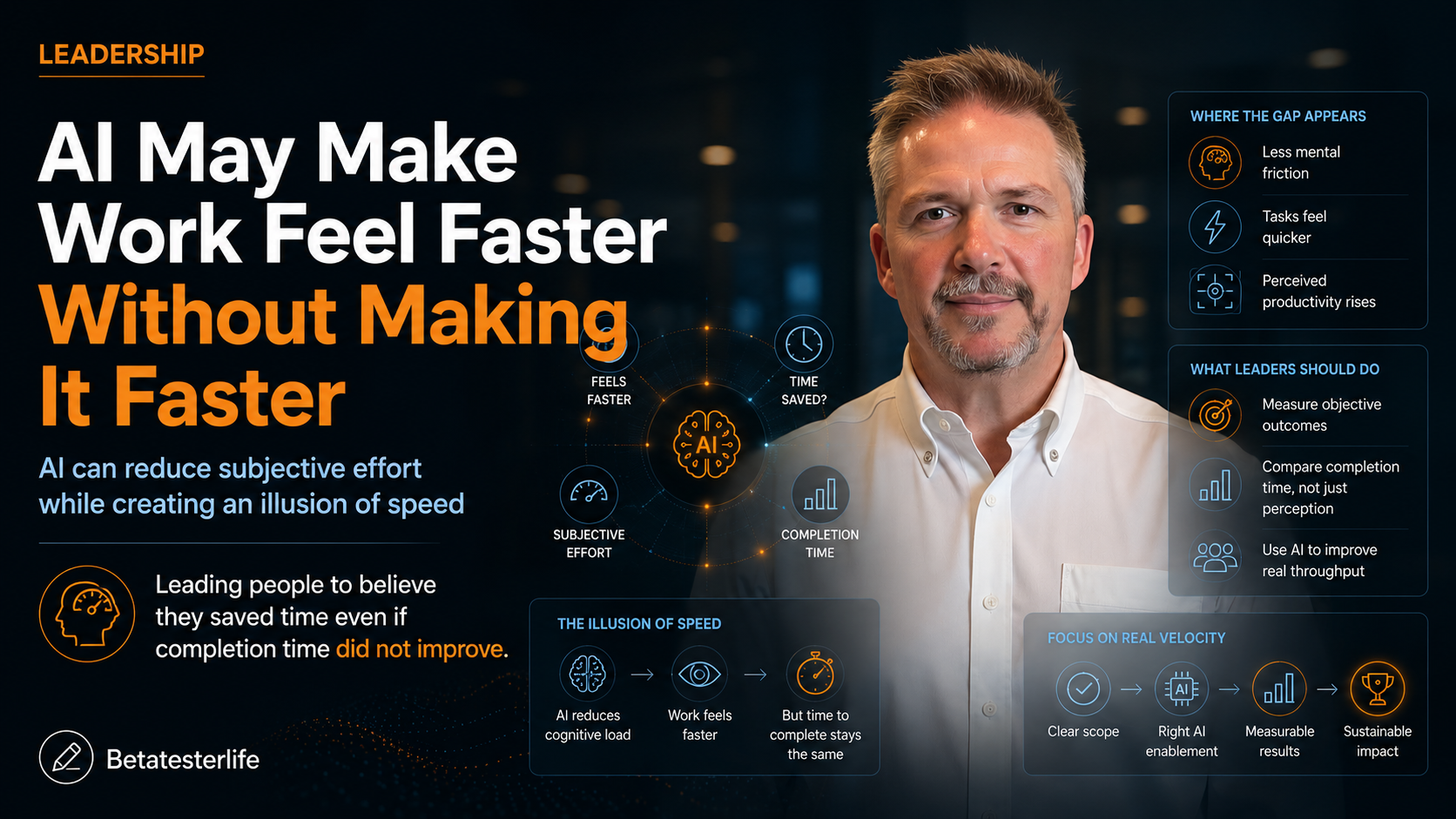
So the chain runs like this:
- AI reduces the cognitive load of the task.
- Lower load makes the work feel faster.
- We infer time saved from the feeling, not the clock.
- Completion time has not actually moved.
The feeling is real. The time saving is assumed.
Why this matters for leaders
If you run a team, this is not an academic curiosity. It is a measurement problem hiding inside an adoption story.
The studies also found a carryover effect: once people believed AI was saving them time, they reached for it more often — entrenching the misjudgement with every use. Perceived productivity rises. Reported effort falls. Sentiment improves. And none of it tells you whether anything actually got done faster.
Organisations that mistake the feeling for the outcome will over-invest in tools that improve experience and under-invest in the workflow changes that improve throughput. They will report AI ROI built entirely on self-reported speed — the one number the research says we cannot trust.
Four questions to separate feeling from fact
Before you accept that AI is making your organisation faster, pressure-test the claim:
- Are we measuring outcomes or impressions? A satisfaction survey is not a stopwatch.
- Did completion time actually fall — for the same quality bar? Faster-but-worse is not faster.
- Where did the saved effort go? Lower load is valuable on its own — but only if the freed capacity lands somewhere useful.
- Are we adopting the tool because it works, or because it feels good? The carryover effect makes habit look like evidence.
What to do instead
None of this is an argument against AI. Reduced cognitive load is a genuine benefit — less friction, less fatigue, more willingness to start. That is worth having.
The mistake is letting a real benefit (lower effort) stand in for a different benefit (more speed) you have not verified.
So measure the thing you actually want:
- Compare completion time, not perception. Same task, with and without AI, against a fixed quality standard.
- Track real throughput. What shipped, at what quality, in what window — not how the week felt.
- Treat lower effort as its own goal. If a tool reduces strain without saving time, say so honestly and value it for that.
- Aim for real velocity. Clear scope, the right AI in the right place, measurable results, sustainable impact.
AI is reshaping how work feels. Whether it reshapes how much work gets done is a separate question — and the only one worth putting on a slide.
Measure the clock, not the comfort.
Sources used
- “The efficiency-gain illusion: People underestimate the rate of AI use and overestimate its benefits on simple tasks” — pre-registered behavioural studies on predicted versus actual AI time savings, cognitive load and adoption carryover. arxiv.org/abs/2605.22687

Written by Kevin Campbell
Thirty years of technology, delivery and organisational change—translated into practical thinking for people doing the work.
Continue the journey
One thought leads to another.
Scroll to explore
 AI Governance
AI Is Not a University. But It Can Build You One.
AI Governance
AI Is Not a University. But It Can Build You One.
 Leadership & Culture
The Hidden Value of Fleeting Encounters in a Transactional World
Leadership & Culture
The Hidden Value of Fleeting Encounters in a Transactional World
 AI Governance
The Hidden Verification Gap: A Practical 30-Day Way Forward
AI Governance
The Hidden Verification Gap: A Practical 30-Day Way Forward
 Enterprise Delivery
Stop Fixing Symptoms: A Practical Way to Diagnose Hidden Causes
Enterprise Delivery
Stop Fixing Symptoms: A Practical Way to Diagnose Hidden Causes
 AI Governance
When Networks Become Players
AI Governance
When Networks Become Players
 AI Governance
The Next Workplace Conflict Is Not Human vs AI
AI Governance
The Next Workplace Conflict Is Not Human vs AI
Conversation
Add to the thinking
Questions, experience and thoughtful disagreement are welcome.