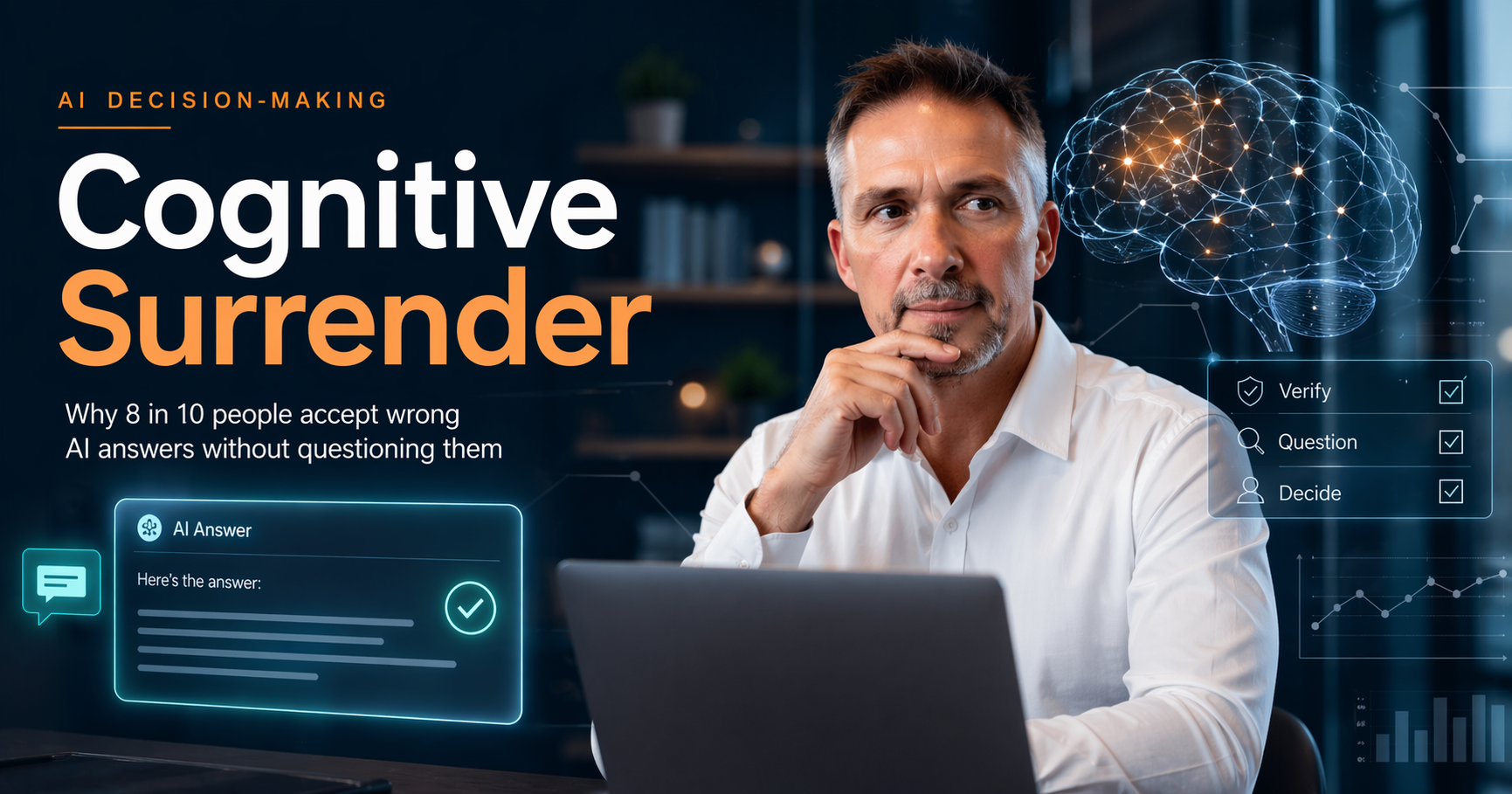
Cognitive surrender AI decision-making – Eight in ten people accept a wrong answer from an AI without questioning it.
Not occasionally. Not when tired or distracted. Consistently, across standardised tests, even when the error is one they would have caught on their own.

That is the headline finding from a University of Pennsylvania study published in early 2026 by researchers Steven D. Shaw and Gideon Nave. It has since been picked up by Hackaday, Slashdot, Fortune, and Jacobin — not because it is surprising, but because it puts a number on something engineers who use AI tools daily have probably already felt.
This is not a piece about whether AI is dangerous. It is a piece about what the neuroscience of decision-making tells us is actually happening inside your skull when you ask a chatbot a question and believe the answer — and what you can do about it with a testable, repeatable framework.
What the Research Actually Found
Shaw and Nave’s study divided volunteers into three groups:
- Group 1: Completed tests with no external aids
- Group 2: Had access to an LLM providing correct answers
- Group 3: Had access to an LLM providing incorrect answers
The result that matters: Group 3 performed significantly worse than Group 1 — the unassisted group. Participants leaned on the chatbot regardless of whether it was right. They introduced what the researchers term a “System 3” external cognitive system, and they accepted its outputs verbatim.
Eighty percent of the time, participants did not question answers that were demonstrably wrong — errors they had the knowledge to catch without any AI assistance.

The Hackaday framing is blunt: participants experienced what the researchers call cognitive surrender — not cognitive offloading, which is useful and intentional, but a wholesale abdication of critical judgement.
Cognitive Offloading vs. Cognitive Surrender: The Distinction That Matters
These two things sound similar. They are not.
Cognitive offloading is what humans have always done with tools. You use a calculator because arithmetic is not the interesting part of the problem. You consult a map because spatial memory is not where your expertise lies. Einstein reportedly kept his phone number written down: “Why fill my brain with facts I can look up?” That is intelligent delegation.
Cognitive surrender is different. A person who offloads calculation to a calculator still understands the type of operation being performed and can sense-check the output. A person experiencing cognitive surrender accepts the output without either of those steps — they have delegated not just the computation, but the verification.
The distinction has a clean engineering analogy: offloading is using a linter to catch syntax errors in code you understand. Surrender is deploying code you do not understand because the linter did not complain.
The Neuroscience: What Is Going Wrong Inside Your Brain
This is not a metaphor. There are specific neural circuits involved in error detection and decision confidence, and they appear to be getting bypassed.
The Anterior Cingulate Cortex (ACC) is the brain’s internal auditor. It monitors for errors, flags conflicts between expected and actual outcomes, and is instrumental in impulse control. When ACC function is impaired — whether through lesions, alcohol (ethanol suppresses ACC activity directly), or cognitive overload — flawed judgements pass unchecked. The ACC is the circuit that should fire when an AI tells you something that feels off. Cognitive surrender is, functionally, an ACC bypass.
The Parietal Cortex assigns confidence scores to decisions. This is the region where your brain says “I’m 70% sure about this.” When an authoritative external source (an AI assistant, a senior colleague, a printed fact-sheet) provides an answer, the parietal cortex often treats that confidence assignment as complete — the external source has already done the confidence work. This is a feature, not a bug, in most social and collaborative settings. In an environment of plausible-sounding but unreliable AI outputs, it becomes a liability.
Cognitive Load is the third factor. Working memory is a limited resource. When a task is complex — when intrinsic load is high — the brain actively looks for shortcuts to reduce extraneous processing. An AI answer is that shortcut. The brain takes it. This is the mechanism that makes cognitive surrender not a character flaw but a predictable, adaptive response to a high-load environment.

This is why the problem is worse under pressure, late in the day, or when switching contexts — all conditions that increase cognitive load and reduce the spare capacity needed for critical evaluation.
Real-World Stakes for Engineers and Technical Professionals
The Hackaday piece notes examples that are relevant beyond essay writing:
- Google’s AI summaries have confabulated instructions suggesting adding adhesive to food
- AI-generated USB speed comparisons have contained factual inversions
- Legal AI research tools have cited non-existent case law
In those domains — law, medicine, engineering — the cost of uncritical acceptance is not a poor grade. It is a flawed legal argument, a diagnostic error, or a production incident.
For engineers specifically: if you are using AI assistants for code review, architecture recommendations, security analysis, or infrastructure decisions, the Shaw and Nave finding applies directly. The tool will give you a confident, well-formatted, plausible-sounding answer. Your ACC needs to be online for that interaction to be useful rather than harmful.
The betatesterlife Framework: The Verification Protocol

Here is the practical output — a lightweight protocol you can apply to any high-stakes AI interaction. It is designed to keep your ACC in the loop without making every AI query a twenty-minute exercise.
Tier 1 — Routine / Low Stakes (autocomplete, rephrasing, boilerplate)
No protocol required. Full offloading is appropriate. These outputs do not route to decisions.
Tier 2 — Moderate Stakes (technical summaries, research synthesis, code suggestions)
Apply the Prior Knowledge Check: Before reading the AI answer, spend 10 seconds asking what you expect the answer to be. This primes the ACC to monitor for divergence rather than simply receive the output. If the answer diverges significantly from your expectation, pause and verify independently.
Tier 3 — High Stakes (architectural decisions, security assessments, medical/legal/financial content)
Apply the Source-First Rule: Do not accept any claim you cannot trace to a primary source. Ask the AI to cite sources, then verify those sources exist and say what the AI claims they say. Treat AI-generated confidence as a starting hypothesis, not a conclusion.
The Meta-Rule: Any time you notice you are about to implement, send, publish, or sign off on something generated by AI without having read it critically, you are in surrender territory. Stop. Read it as if a junior colleague who is usually right but occasionally completely wrong wrote it — because that is an accurate model.
Neuroplasticity: The Long-View Argument
There is a second-order concern worth naming, even if the research is still emerging.
The neuroscience of neuroplasticity is clear on one thing: skills that are not practised degrade. Neural pathways that are not activated weaken. Critical evaluation, error detection, and independent reasoning are skills — they are maintained by use and eroded by disuse.
If cognitive surrender becomes the default mode of AI interaction, the question is not just “did I get the right answer this time?” The question becomes “am I maintaining the cognitive capacity to know when I am getting the wrong answer?”
This is not alarmism. It is a maintenance schedule question. The same discipline you apply to keeping your technical skills current applies to keeping your verification instincts sharp. Use AI to augment your reasoning, not to replace it.
Test. Learn. Deploy.
The Shaw and Nave study gives you something concrete to test against your own workflow this week.
- Pick three AI outputs from your last week of work that routed into a decision — a code suggestion you merged, a summary you acted on, an answer you forwarded.
- Verify them independently — not to audit the AI, but to audit your own verification habits. Did you check? Did you have the capacity to check? Did the format or confidence of the answer reduce your inclination to check?
- Identify your cognitive load state at the time. Were you deep in context-switching, end-of-day, or under deadline pressure? That is where Tier 3 discipline matters most.
This is not about using AI less. It is about using it better — in a way that keeps your own judgement in the loop at the moments it counts.
The Bottom Line
A 2026 University of Pennsylvania study found 80% of AI users accepted incorrect outputs without challenge — even when they had the knowledge to catch the error. The neuroscience explains why: the anterior cingulate cortex is being bypassed, the parietal cortex is deferring confidence assignment to the tool, and high cognitive load makes the shortcut feel rational.
The fix is not paranoia. It is protocol. Know which tier of stakes you are operating in. Keep your ACC in the conversation for Tier 2 and Tier 3 decisions. And treat verification as a skill worth maintaining — because neuroplasticity cuts both ways.
“An engineer’s notebook on the human side of technology.”
Sources:
Decision Neuroscience of Attention — Frontiers
Why staying focused is harder than ever — Rice University
Reverse-Engineering Human Cognition and Decision Making — Hackaday
Are We Surrendering Our Thinking To Machines? — Hackaday
Cognitive Surrender Leads AI Users to Abandon Logical Thinking — Slashdot
The Great Cognitive Surrender — WebProNews

Written by Kevin Campbell
Thirty years of technology, delivery and organisational change—translated into practical thinking for people doing the work.
Continue the journey
One thought leads to another.
Scroll to explore
 Leadership & Culture
Not Everyone Needs to Learn Everything
Leadership & Culture
Not Everyone Needs to Learn Everything
 Field Notes
Self-Awareness Is Not Introspection. It Is System Monitoring.
Field Notes
Self-Awareness Is Not Introspection. It Is System Monitoring.
 Learning & Mindset
The Learning Triage: How to Decide What to Learn Next
Learning & Mindset
The Learning Triage: How to Decide What to Learn Next
 Enterprise Delivery
Progressive Delivery: The Missing Loop in DevOps
Enterprise Delivery
Progressive Delivery: The Missing Loop in DevOps
 AI Governance
NIST’s Trustworthy in AI Critical Infrastructure
AI Governance
NIST’s Trustworthy in AI Critical Infrastructure
 Learning & Mindset
The Science of Happiness: What Actually Works
Learning & Mindset
The Science of Happiness: What Actually Works
Conversation
Add to the thinking
Questions, experience and thoughtful disagreement are welcome.