Life at the Speed of Play Is A Book About What Happens When Founders Refuse To Grow Up
Life at the Speed of Play: Launch Products People Love! by Mark Pincus
Somewhere in the last two decades, “build an MVP, get buy-in, disagree and commit” hardened into gospel. Ship something viable. Bring the room along. Once the room decides, salute and move. It sounds disciplined. Mark Pincus founded Zynga and spent thirty years watching that discipline kill good products. It happened slowly enough that nobody noticed until the market had moved on.
Life at the Speed of Play argues that the market no longer grants that kind of patience. Pincus’s own numbers are blunt. The first thing you put in front of users has a success rate close to zero. A “viable” product can consume months of engineering time and still answer a question nobody asked.
Consensus management, the other pillar of corporate discipline, fares no better in his account. He calls it “death by 1,000 compromises”. Every stakeholder gets a vote but not a stake in the outcome, and each one sands another edge off a sharp idea.
The book’s real subject is not process. It is what a leader has to become once process stops providing the promised safety net. Pincus’s answer is the active protagonist. This person signs a “moral contract” with their instincts and their team. They act as the CEO of their piece of the company, not as a contributor waiting for permission.
From Expert Witness To CEO Of The Job
The book’s defining reframe comes from Pincus’s own twenties, when he was repeatedly right and repeatedly ignored. At Bain, he told the team their market-share chart was wrong. Later, he advised a media company to buy AOL for $110 million instead of a rival platform. The “adults” in the room chose otherwise. He calls this position the expert witness: closest to the data and the right answer, but furthest from the final decision.
Most organisations produce expert witnesses by the dozen and let almost none of them decide anything. Pincus says the wrong question is how to build consensus around their analysis. Ask who is closest to the truth instead. Then ask whether the organisation has given that person the authority to act.
His answer is to collapse the distance. Give practitioners P&L ownership of their domain. Hold them to the standard of a founder, not the standard of a good analyst. Life at the Speed of Play is strongest when it turns authority into an operating question rather than another speech about empowerment.
The Strongest Warning In Life at the Speed of Play: The MVP Trap
Pincus’s sharpest concept is what he calls the MVP Trap, and it comes with a body count. In 2015, a Zynga team spent six months and hundreds of engineering days building a faster-paced version of Words With Friends, convinced their core audience wanted more speed. Five percent of players tried it. None returned.
The team had built a viable product without ever testing whether the underlying idea had any heat, and had missed that their actual audience—largely middle-aged women—loved the unhurried, turn-based rhythm of the original game.
Quibi is Pincus’s larger example of the same trap at a different scale. It raised $1.75 billion and launched a “maximum launch product” to Hollywood production standards. Six months later, it shut down. Nobody had tested the cheaper, rougher version of the idea first.
A third pattern he calls “squeezing the lemon”. YoVille’s bakery feature forced players to log in daily to harvest coins, which lifted short-term engagement metrics while quietly turning a game into a chore and killing the retention it was meant to protect.
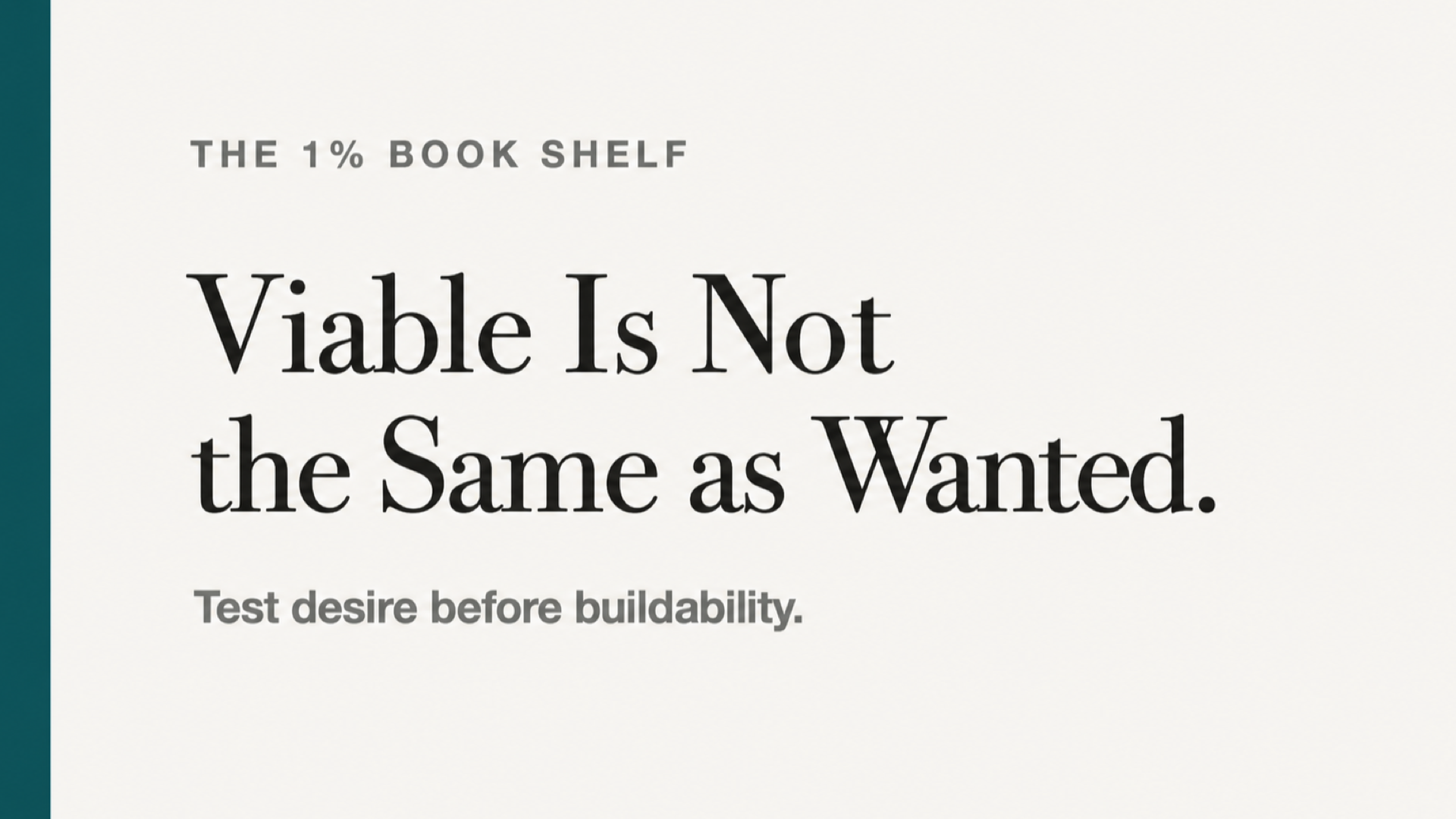
The common thread is sequencing. All three examples spent real money proving an idea was buildable before spending five minutes proving anyone wanted it. That is the most useful warning in Life at the Speed of Play: viable is not the same as wanted.
The Useful Frameworks In Life at the Speed of Play
Pincus’s answer to the MVP Trap is a framework he calls Proven Better New. Copy the exact mechanics of a product your audience already loves (Proven). Make one objective improvement so sharp that ten out of ten users say yes (Better). Then isolate a single genuinely novel bet (New) instead of spreading risk across the whole product.
- Proven: keep the mechanics customers already understand and value.
- Better: make one improvement objective enough that users can judge it.
- New: isolate one genuinely novel bet so the product can survive if it fails.

Pincus’s operating assumption is blunt—“all New fails”—which is less pessimism than a discipline for keeping the untested part of the build small enough to survive being wrong.
Test The Idea Before You Fund The Build
Ahead of any of that, there is the Minimum Idea State: the smallest artefact that can test whether an idea has heat before engineers write production code. It could be a text link, a PowerPoint or a “ripomatic” made from screenshots of other products. Pincus tested one Mafia Wars concept as a single clickable link to a dead page. Some 22.7 percent of players clicked it. That was the signal that mattered.
Two more frameworks give the philosophy teeth. The Rule of Four—everything costs twice as much and takes twice as long as estimated—is his argument against “mouse nuts”, the small features that quietly absorb a whole quarter’s capacity for no measurable return.
Active Social Network, his leading engagement metric, tracks interactive round-trips between users rather than logins. Zero to one round-trip predicts an 80 percent chance of returning next month. One to four predicts an 80 percent chance of returning 25 of the next 30 days. The metric catches habit formation before revenue shows it.
Why Life at the Speed of Play Matters For Enterprise Delivery And DevOps
Strip away the gaming examples and the mechanics map directly onto enterprise delivery. Pincus ran Zynga’s product teams as a federation of start-ups, each with full P&L accountability. The same logic underpins teams owning outcomes rather than people. Leaders judge the team against a business metric, not a functional output.
His “Blue Sheets”—a single company-wide roadmap listing every project by resources, expected outcomes and dates, reviewed in one mandatory weekly hour—solve the same problem enterprise delivery teams solve badly: siloed squads independently discovering the same failure twice.
His warning against “redlining”, spending less than 25 percent of engineering capacity on future growth, reads like a DevOps capacity model in different clothes—the same discipline used to separate time spent keeping the lights on from time spent building what comes next.
This is where Life at the Speed of Play travels best. Speeding up the builder does not clear the jam. Giving a team more delivery capacity is pointless if the organisation still makes it wait for evidence, authority or a decision.
The Moral Contract Isn’t A Communications Plan
The most human argument in the book is that messaging does not produce trust. Pincus’s “moral contract” is explicit. If someone gives everything and helps deliver a genuine result, leaders should recognise and reward them. That often means a bigger role before they have to ask for one. He says action must back this bond, not “any paper it’s written on”.
He is equally direct about what breaks trust. In his account, the one-to-one meeting generates corporate politics. The private channel rewards extroverts and leaves quiet contributors unseen. He removes it in favour of public forums that evaluate the work, not the relationship.
Leaders also break trust when they make decisions far from the data. Pincus insists they stay “close to the metal”, visibly in the trench with the engineers whose work they judge.
The Sceptical Read
The moral contract is also where the book’s biggest gap opens up. Pincus writes about having his team’s back “at war”, then describes refusing to meet with anxious employees during a round of layoffs because “they were going to leave anyway”. That is a transactional definition of loyalty dressed as a human one, and it sits uneasily next to the book’s warmer language.
The ban on one-to-ones has the same problem from a different angle. Teams present their metrics in public “Teaching Hospital” reviews, often in front of a gallery of new hires. That rewards people who already feel comfortable under scrutiny. Introverted engineers and quieter delivery leads lose a private channel for structural concerns or development conversations. It is a strange gap in a book so focused on unlocking individual contributors.
There is a practical cost too. In the early Zynga years, Pincus hired fast for a narrow skill and kept whoever proved productive. That looks more like churn-and-burn than a repeatable talent strategy. Most regulated enterprises would find it legally and financially reckless.
And “all New fails” as an operating principle, useful as a risk discipline, doubles as an innovation ceiling. A Proven Better New process optimised for fast-following a hot market has little to say about building something with no existing analogue to copy.
None of this undoes the central argument in Life at the Speed of Play. It does mean the frameworks travel better than the culture they were built inside.
What Product Leaders Should Do On Monday
The most immediately usable habit is running a Minimum Idea State test before any production code gets written—a clickable placeholder, a scrapbook mock-up, anything cheap enough to prove at least a quarter of the target audience shows real behavioural interest.
Pair it with a Proven Better New session. Map a competitor’s product feature-for-feature in one column. List the single objective improvement that would make every tester say yes. Then isolate the one genuinely new bet worth risking failure on.
Then fix the roadmap. Merge every team’s plan into one document and lock the quarter’s objectives at the top. Hold a standing weekly hour where nothing changes without the whole room seeing it. The document matters less than the discipline. Priorities cannot drift unnoticed between one team and the next.
The practical test from Life at the Speed of Play is simple: can the team show what it learned before asking for the next block of engineering time?
Strongest Ideas
- Viable is not the same as wanted. Pincus’s numbers say the first version of anything succeeds close to zero percent of the time, which makes proving desire, not buildability, the actual first milestone.
- Consensus has a body count. Death by 1,000 compromises is what happens when everyone with a vote has none of the accountability for the outcome.
- Instinct and idea are not the same bet. Pincus argues gut instinct is right roughly 95 percent of the time; the specific product built to express it is wrong 75 percent of the time—an argument for testing the idea, not doubting the instinct.
- B+ ideas are more dangerous than bad ones. A mediocre idea that keeps limping along on partial belief consumes the funding and attention a genuine breakout would need.
- Your roadmap is your operating system. A plan nobody else can see is not a strategy. It is a private opinion with a deadline attached.
Frameworks Worth Carrying Forward
Proven Better New: Copy what already works, make one improvement sharp enough to be undeniable, and isolate a single risky new bet rather than spreading uncertainty across the whole build.
Minimum Idea State: Test the smallest possible version of an idea—a link, a mock-up, a demo—before committing engineering time to a “viable” build.
Active Social Network: A leading engagement metric that tracks interactive round-trips between users rather than logins, built to catch habit formation before it shows up in revenue.
Rule of Four: Everything costs twice as much and takes twice as long as planned—a working assumption for deciding what is worth building at all.
The Blue Sheets: One company-wide roadmap, reviewed weekly, that forces siloed teams to see and copy each other’s breakthroughs before they duplicate each other’s mistakes.
The Teaching Hospital: A weekly public review where teams present hypotheses, expected outcomes and real results in front of the wider organisation, built to spread pattern recognition faster than private reporting ever could.
Useful Tensions
- Instincts versus ideas: the gut-level read on what people need is usually right; the specific product built to satisfy it is usually wrong.
- MVP versus Minimum Idea State: months of engineering spent on a functioning product versus minutes spent on a raw test of real behavioural signal.
- Squeezing the lemon versus player obsession: short-term monetisation metrics versus the feature people will actually thank you for.
- Democratic dictatorship versus corporate harmony: one person owning the uncomfortable call versus a room optimising for a safe, shared one.
- Bits versus atoms: software that can be tested and rebuilt in a day against physical products bound by capital and lead time.
Practical Leadership Lessons
- Test desire before you test buildability. A five-minute mock-up beats a five-month build.
- Isolate your risk. Copy the plumbing, sharpen one improvement, and bet on exactly one new idea at a time.
- Put every team’s roadmap in one place, and review it somewhere the whole organisation can see the trade-offs.
- Measure round-trips and habit formation, not logins. Engagement that fades in a week was never loyalty.
- Give the moral contract teeth: reward the people who deliver before they have to ask, and mean it when it costs you something.
Final Thought On Life at the Speed of Play
Life at the Speed of Play is at its best when it treats speed as a discipline rather than a personality trait. Cheap tests, isolated risks and a visible roadmap create that speed. Charisma and urgency do not. Its weakest moments come when the same intensity curdles into a definition of loyalty that only runs one way.
Read past the swagger and the book leaves a harder question than “how do we move faster?” Will an organisation let the person closest to the truth actually decide? Can it build a culture that survives being wrong in public without treating its people as disposable?
“We waste so much time building a viable product when we should be solely focused on building a learning product.”
Source: Mark Pincus, Life at the Speed of Play: Launch Products People Love! (HarperCollins, 2026).

Written by Kevin Campbell
Thirty years of technology, delivery and organisational change—translated into practical thinking for people doing the work.
Continue the journey
One thought leads to another.
Scroll to explore
 Enterprise Delivery
Stop Owning People. Start Owning Outcomes
Enterprise Delivery
Stop Owning People. Start Owning Outcomes
 Enterprise Delivery
Speeding Up the Builder Won’t Clear the Jam: Why Most Digital Transformations Fail to Deliver Impact
Enterprise Delivery
Speeding Up the Builder Won’t Clear the Jam: Why Most Digital Transformations Fail to Deliver Impact
 AI Governance
Generative AI Customer Insights: What AI Can and Can’t Do
AI Governance
Generative AI Customer Insights: What AI Can and Can’t Do
 The 1% Book Shelf
Difference Isn’t the Landmine. Justification Is.
The 1% Book Shelf
Difference Isn’t the Landmine. Justification Is.
 AI Governance
Seeing the Full Story Isn’t a Data Problem. It’s an Empathy Problem.
AI Governance
Seeing the Full Story Isn’t a Data Problem. It’s an Empathy Problem.
 AI Governance
Token Spend Is Not a Cost to Cut. It Is a Portfolio to Manage.
AI Governance
Token Spend Is Not a Cost to Cut. It Is a Portfolio to Manage.
Leave a Reply