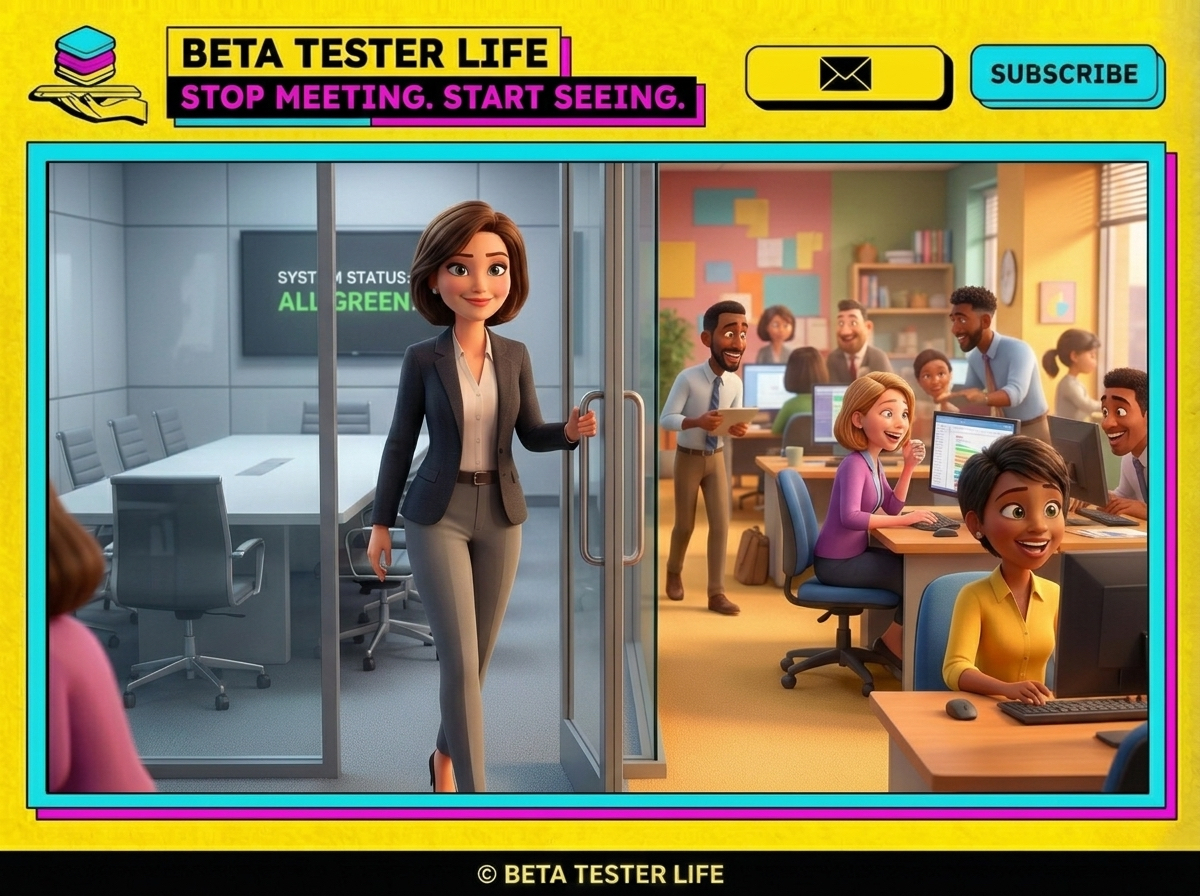
Here’s a question nobody asks in leadership meetings. When was the last time you actually watched someone do the work you’re managing?
Not reviewed their dashboard. Not read their status update. Watched them. Stood next to them. Asked what slows them down.

Most leaders never do this. And it shows.
There’s a growing body of research. It suggests that the gap between what leaders think is happening and what’s actually happening is bigger than most organisations realise. McKinsey’s Organizational Health Index data was drawn from 3 million employees across nearly 1,300 organisations. It found that top managers are consistently more positive than frontline workers. They are more optimistic about their organisation’s ability to motivate employees and inspire leadership. The biggest perception gaps sit exactly where they hurt most.
Gallup’s 2025 State of the Global Workplace report puts global engagement at just 21%. Four out of five workers are disengaged. And frontline employees are the least engaged of all.
So what’s going wrong? Let me walk through three angles.
1. The Gemba Principle: Go and See for Yourself
Toyota figured this out decades ago. They called it Genchi Genbutsu – literally “go and see for yourself.” It’s Principle 12 of the Toyota Production System. The idea is disarmingly simple: you cannot understand a problem unless you physically go to where the work happens and observe it.

Taiichi Ohno, the father of the Toyota Production System, used to draw a chalk circle on the factory floor. He made engineers stand in it for hours. Just watching. The goal wasn’t to catch people out. It was to train leaders to see what they’d been missing from their offices – subtle wastes, workarounds, micro-delays, and the informal networks people actually rely on.
This isn’t just a manufacturing concept anymore. Safran Cabin Canada requires multiple Gemba walks daily, with the first walk directly informing their daily management meetings. Healthcare systems like Virginia Mason Medical Center adopted the same principle. Software companies send product managers to sit with support agents. The pattern is consistent: direct observation reveals things that no report captures.
What does it reveal? Three things mainly. First, workarounds – the duct tape people use daily that never appears in any documentation. Second, handoff friction – the three-day delay that sits between two teams’ “green” status reports, invisible in any individual update. Third, information decay – how a priority that was “critical” in the executive meeting becomes “when we get to it” by the time it reaches the floor.
2. The MBWA Paradox: Presence Without Action Backfires
Management By Walking Around (MBWA) became famous through Tom Peters and Robert Waterman’s 1982 book In Search of Excellence. Hewlett-Packard’s co-founders practised it. Steve Jobs did it. The military calls it “battlefield circulation.”

But here’s where it gets interesting. Harvard Business School researchers Anita Tucker and Sara Singer ran a randomised controlled study across 56 hospital work areas in 20 hospitals over 18 months. They expected MBWA to improve performance. It didn’t. On average, it made things worse.
The reason? Managers spent too much time analysing which problems to solve and not enough time actually solving them. When they walked the floor and surfaced issues but didn’t follow through with action, they raised expectations they then failed to meet. Staff morale dropped. Tucker put it bluntly: MBWA can backfire if management fails to meet the expectations the programme raises.
The units that did improve shared one trait: they prioritised easy-to-solve problems first. Quick wins. Visible action. That built trust. And when senior managers took personal responsibility for ensuring identified problems got resolved, performance improved further.
The lesson: showing up is necessary but not sufficient. What you do after you observe is what matters.
3. Systems Thinking: Seeing the Whole Machine
This is the deeper shift. Functional understanding means knowing what each part does in isolation – the org chart view. You get this from meetings, dashboards, and status reports. Systemic understanding means knowing how the parts interact, where friction lives, and what actually drives outcomes. You only get this from direct observation.

Research by Bui and Galanou (2022) found that organisations implementing systems thinking experienced 30% faster decision-making cycles and a 20% boost in cross-departmental efficiency. Separate research by Françozo and Paucar-Caceres (2022) showed a 31% improvement in strategic adaptability among organisations that adopted systems thinking practices.
The WEF and McKinsey’s 2025 Frontline Talent of the Future Initiative identified five principal drivers of frontline challenges: talent shortages, widening skill gaps, evolving worker needs, overburdened supervisors (roughly 40% report burnout), and insufficient recognition. Notably, 56% of the talent innovations they studied were developed at the site level – by people who could see the system, not just read about it.
Here’s the shift in question. The leader who leaves meetings to observe stops asking “is everyone doing their job?” and starts asking “is the system producing the outcome we need, and if not, where is the design failing people?” That’s a fundamentally different question. And it leads to fundamentally different interventions.
What To Do With This
Start small. Block one hour this week. Go to where the work happens. Don’t bring a clipboard. Don’t bring solutions. Just watch. Ask open questions: what slows you down? What information do you wish you had? What’s the biggest gap between how this is supposed to work and how it actually works?
Then act on what you find. The research is clear: observation without action is worse than no observation at all.

The best leaders I’ve seen don’t manage from meeting rooms. They manage from the place where value is created. And the difference between those two locations is the difference between functional understanding and systemic understanding.

Primary Research:
• Tucker, A.L. & Singer, S.J. (2015). The Effectiveness of Management-By-Walking-Around: A Randomized Field Study. Production and Operations Management, 24, 253–271.
• Bui, H. & Galanou, E. (2022). Cross-functional collaboration and systems thinking impact on decision-making. [Referenced in systems thinking leadership frameworks]
• Françozo, R. & Paucar-Caceres, A. (2022). Systems thinking and strategic adaptability. Journal of the Operational Research Society, 73(5), 994–1013.
• Grösser, S.N. (2017). Complexity Management and System Dynamics Thinking. OAPEN. [Executives using systems thinking outperform by 20%]
Industry & Institutional Sources:
• McKinsey Organizational Health Index – 3 million employees, 1,300 organisations (referenced in McKinsey.com)
• McKinsey & WEF Frontline Talent of the Future Initiative (2025) – frontline talent challenges and innovations
• Gallup State of the Global Workplace 2025 – global engagement at 21%, manager engagement at 27%
• JFF Frontline Manager Forum on Worker Voice (2025) – McKinsey data: frontline managers spend 30–60% time on admin, only 10–40% on managing people
• Gallup: managers determine 70% of variance in team engagement
Lean/Toyota Sources:
• Toyota Production System – Genchi Genbutsu (Principle 12), Taiichi Ohno’s chalk circle method
• Liker, J. (2004). The Toyota Way. McGraw-Hill.
• Safran Cabin Canada – daily Gemba walk practice (Tervene case study)
• Virginia Mason Medical Center – lean healthcare adoption of Gemba principles
Historical/Framework Sources:
• Peters, T. & Waterman, R. (1982). In Search of Excellence. Harper & Row. [Originated MBWA term from HP practices]
• Senge, P. (1990). The Fifth Discipline. Doubleday. [Systems thinking in learning organisations]
• Frankel, A. et al. (2008). Leadership WalkRounds – original MBWA healthcare programme design
• Chaanine, J.C. (2025). The Efficiency of Management by Working Around: Lebanese Healthcare Organizations. SAGE Open.

Written by Kevin Campbell
Thirty years of technology, delivery and organisational change—translated into practical thinking for people doing the work.
Continue the journey
One thought leads to another.
Scroll to explore
 Leadership & Culture
The Hidden Value of Fleeting Encounters in a Transactional World
Leadership & Culture
The Hidden Value of Fleeting Encounters in a Transactional World
 AI Governance
The Hidden Verification Gap: A Practical 30-Day Way Forward
AI Governance
The Hidden Verification Gap: A Practical 30-Day Way Forward
 Enterprise Delivery
Stop Fixing Symptoms: A Practical Way to Diagnose Hidden Causes
Enterprise Delivery
Stop Fixing Symptoms: A Practical Way to Diagnose Hidden Causes
 Leadership & Culture
How to Build Products People Love: One Risky Bet
Leadership & Culture
How to Build Products People Love: One Risky Bet
 Learning & Mindset
AQ Anchors Explained: The People, Places and Routines That Keep You Grounded During Change
Learning & Mindset
AQ Anchors Explained: The People, Places and Routines That Keep You Grounded During Change
 Learning & Mindset
There Is No Wrong Turn
Learning & Mindset
There Is No Wrong Turn
Conversation
Add to the thinking
Questions, experience and thoughtful disagreement are welcome.