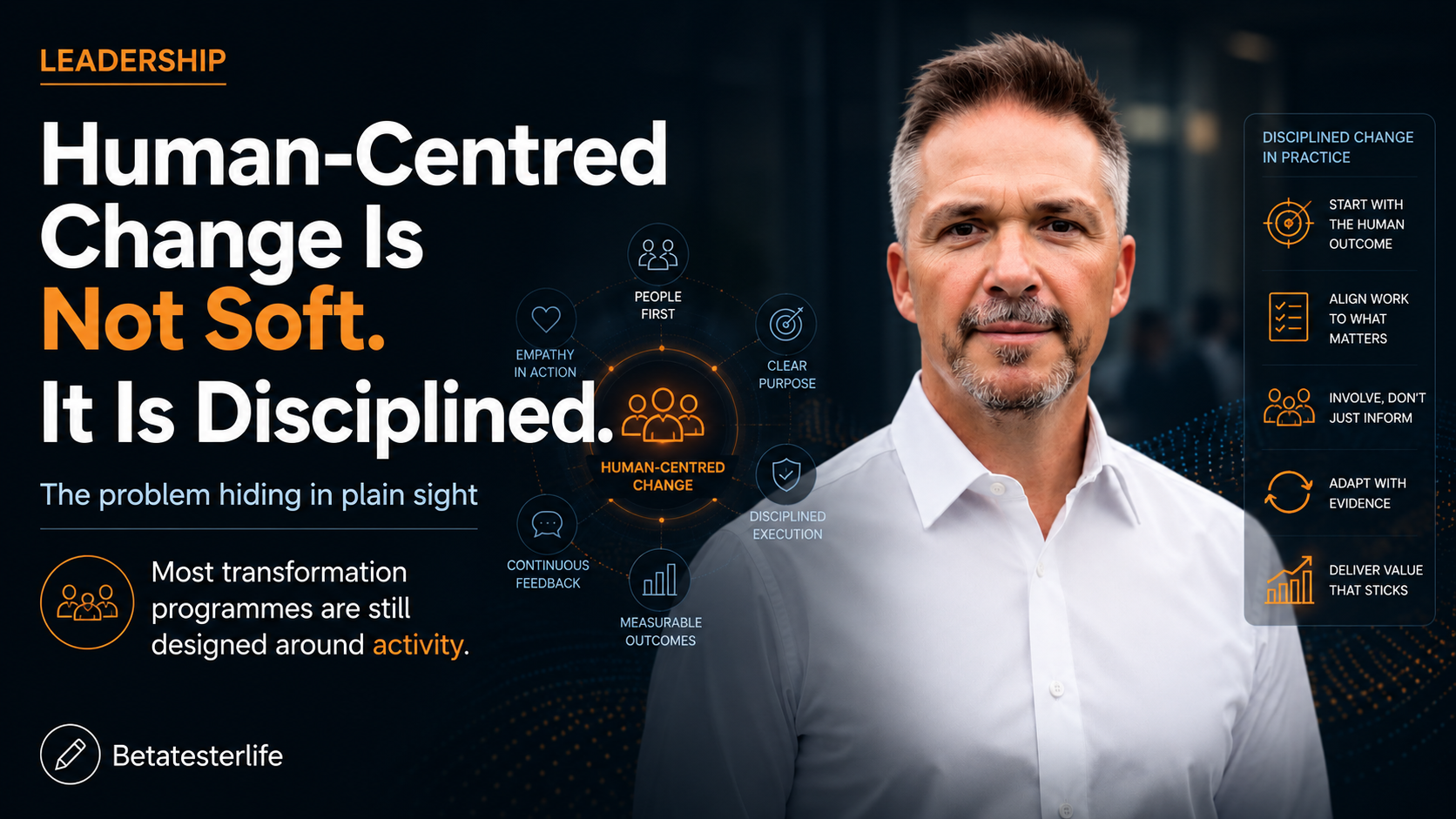
Human-centred change is often misunderstood as slow, emotional, or permissive. In reality, it is one of the more disciplined forms of transformation because it measures whether people can actually absorb, practise, and sustain the change.
The problem hiding in plain sight
Most transformation programmes are still designed around activity.
- Town halls delivered.
- Slides published.
- Training completed.
- Comms sent.
- Governance updated.
- Milestones reported green.
On paper, the change appears to be moving.
But activity is not adoption.
A team can attend the briefing and still not understand what is expected. A manager can cascade the message and still avoid the difficult conversation. A process can be launched and still be quietly worked around. A tool can be deployed and still fail to change behaviour.
This is where human-centred change is often misread.
It is not about making change comfortable. It is about making change absorbable.
That means designing for clarity, pacing, feedback, psychological safety, reinforcement, and actual behaviour change — not just announcement volume.
The harder truth is this: many transformations do not fail because the strategy was never announced. They fail because the organisation never absorbed it.
Why this matters now
Organisations are carrying more simultaneous change than most people can realistically metabolise.
AI adoption, operating model redesign, cost pressure, regulatory change, platform modernisation, agile transformation, cyber resilience, data governance, automation, and workforce reshaping are all competing for attention.
The limiting factor is no longer only budget or technology.
It is organisational absorption capacity.
Research and practice in change management increasingly point to the same issue: individual transition is the unit of change. Prosci’s ADKAR model, for example, frames change through Awareness, Desire, Knowledge, Ability, and Reinforcement, with adoption measured through speed of adoption, utilisation, and proficiency rather than communications activity alone.
Psychological safety matters here because people need to surface confusion, risk, friction, and unintended consequences early. Edmondson’s work defines psychological safety as a shared belief that a team is safe for interpersonal risk-taking, which links directly to learning behaviour in teams.
That is not softness.
That is operational intelligence.
The wrong way to frame it
The lazy framing is:
“People resist change.”
Sometimes they do.
But often, people are not resisting the change itself. They are responding rationally to poor change design.
They may be unclear on the “why”.
They may not trust the sequence.
They may not have time to practise.
They may see contradictions between leadership messages and local incentives.
They may be overloaded by competing priorities.
They may know the new process will not survive contact with operational reality.
Calling that “resistance” is convenient.
It also lets leaders avoid examining whether the change was designed for absorption.
A better question is not:
“Why are people resisting?”
It is:
“What have we failed to make clear, safe, practical, or repeatable?”
A better framework
Human-centred change should be managed as an absorption system.
1. Clarity
People need to know what is changing, why it matters, what will stop, what will start, and what good looks like.
If the message cannot be translated into day-to-day behaviour, it is not yet clear enough.
2. Pacing
Change has a cognitive load.
If everything is urgent, people will default to old habits. Pacing is not delay. It is sequencing.
Good transformation leaders ask:
- What must land first?
- What can wait?
- What dependencies exist?
- Where are teams already saturated?
3. Practice
Training is not the same as capability.
Capability forms when people can try the new behaviour, receive feedback, correct mistakes, and repeat it in context.
This is where many transformations underinvest. They fund launch activity but not practice loops.
4. Feedback
Feedback is the early-warning system of change.
If people are not telling leaders what is confusing, broken, risky, or impractical, the programme is flying blind.
Low noise does not always mean high adoption. It may mean low trust.
5. Reinforcement
People revert when the environment rewards the old behaviour.
If governance, metrics, incentives, tooling, leadership attention, and workload still point backwards, the new behaviour will decay.
Reinforcement is where change becomes operational rather than performative.
What leaders should watch
Measure absorption, not just activity.
Useful signals include:
- Can teams explain the change in their own words?
- Are people using the new process without escalation?
- Are workarounds reducing or increasing?
- Are managers reinforcing the same message consistently?
- Are defects, delays, or rework linked to misunderstanding?
- Are people raising risks early?
- Is proficiency improving over time?
- Has the old behaviour actually stopped?
This is the shift from “we told them” to “they can now do it”.
That distinction matters.
Prosci’s measurement approach separates organisational performance, individual performance, and change management performance, including adoption speed, utilisation, and proficiency.
What to do next
For any active transformation, leaders should ask five practical questions:
- What behaviour are we actually trying to change?
- Where are people most likely to misunderstand it?
- Where do teams need practice, not more communication?
- What feedback would tell us the change is not landing?
- What old incentives or habits are still being rewarded?
If those questions cannot be answered, the transformation is probably still operating at announcement level.
Closing thought
Human-centred change is not the opposite of disciplined delivery.
It is disciplined delivery applied to human behaviour.
The serious work of transformation is not producing more noise around the change. It is creating the conditions where people can understand it, test it, trust it, practise it, challenge it, and eventually make it normal.
The organisations that learn to measure absorption will see something others miss.
The real status of change is not in the slide deck.
It is in the behaviour that survives after the announcement has faded.
Sources used
- Prosci — useful for ADKAR, adoption, utilisation, proficiency, and measuring individual change outcomes.
- Amy C. Edmondson — foundational research on psychological safety, learning behaviour, and team performance.
- Harvard Business School — supporting source for psychological safety and organisational learning.

Written by Kevin Campbell
Thirty years of technology, delivery and organisational change—translated into practical thinking for people doing the work.
Continue the journey
One thought leads to another.
Scroll to explore
 Leadership & Culture
The Hidden Value of Fleeting Encounters in a Transactional World
Leadership & Culture
The Hidden Value of Fleeting Encounters in a Transactional World
 AI Governance
The Hidden Verification Gap: A Practical 30-Day Way Forward
AI Governance
The Hidden Verification Gap: A Practical 30-Day Way Forward
 Field Notes
The CC List Is Not a Control
Field Notes
The CC List Is Not a Control
 Enterprise Delivery
Stop Fixing Symptoms: A Practical Way to Diagnose Hidden Causes
Enterprise Delivery
Stop Fixing Symptoms: A Practical Way to Diagnose Hidden Causes
 Leadership & Culture
Constraints make us better
Leadership & Culture
Constraints make us better
 Enterprise Delivery
Progressive Delivery: The Missing Loop in DevOps
Enterprise Delivery
Progressive Delivery: The Missing Loop in DevOps
Conversation
Add to the thinking
Questions, experience and thoughtful disagreement are welcome.