Discover why Harvard research shows innovation is no longer a solo act. Learn the Architect, Bridger, Catalyst framework from Genius at Scale and how to apply it in your organisation.
Written by
The Beta Tester
·
In this article6 min read
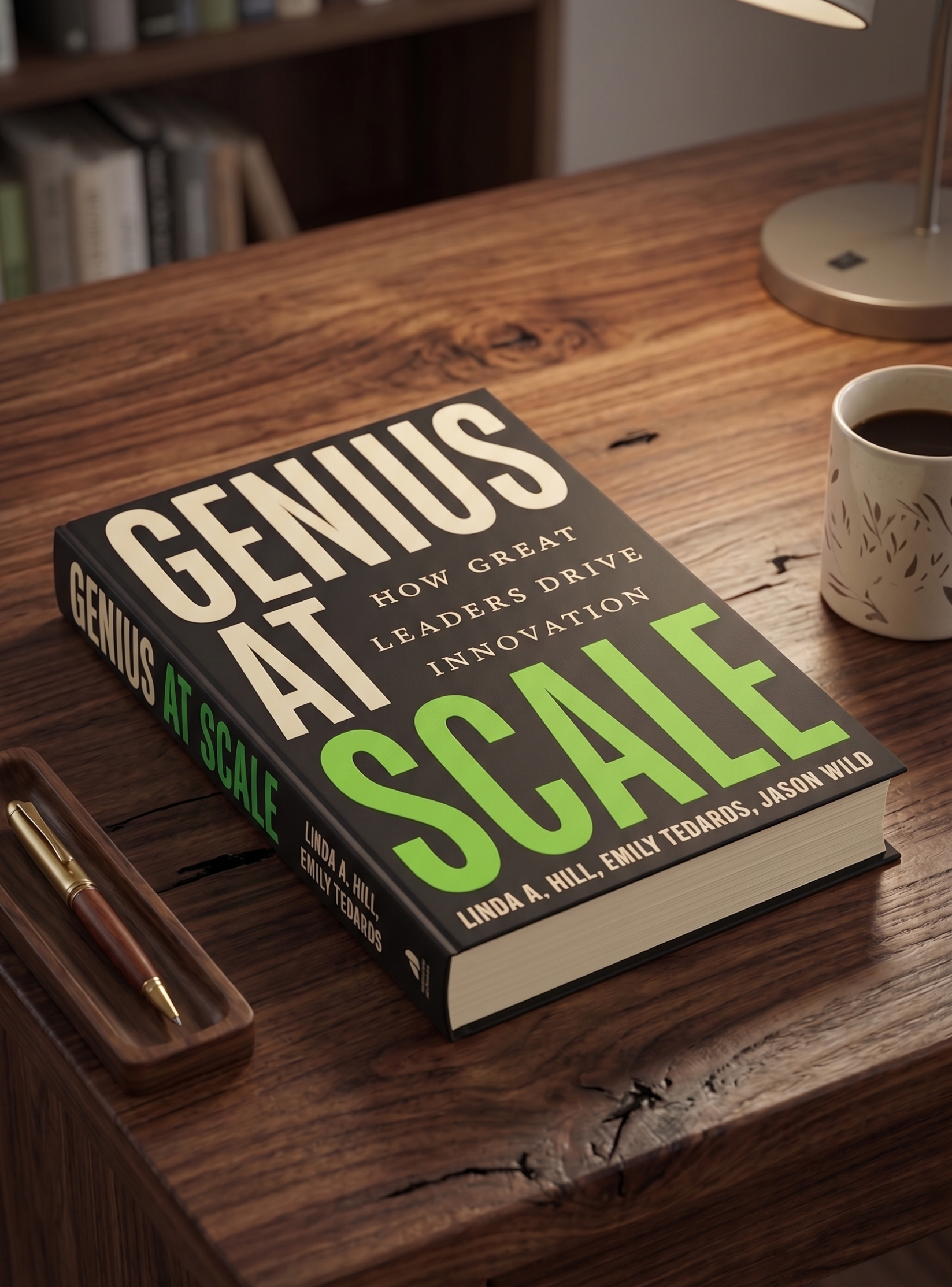
Genius At Scale By Linda A. Hill, Emily Tedards & Jason Wild | Harvard Business Review Press, 2026
What if the biggest barrier to innovation in your organisation isn’t a lack of brilliant people — it’s the model of leadership you’re still running?
What’s the Book About?
Harvard Business School professor Linda A. Hill spent a decade studying the world’s most innovative organisations — Mastercard, Pfizer, P&G, Delta, Cleveland Clinic Abu Dhabi — and came back with an uncomfortable finding: the solo genius at the top is a liability, not an asset. Genius at Scale, co-authored with Emily Tedards and Jason Wild, presents the ABC framework — Architect, Bridger, Catalyst — as the practical playbook for leading cocreation at increasing levels of scale. If you lead teams, programmes, or ecosystems in a fast-moving environment, this book is a direct challenge to how you think about your own role.
Key Themes
1. The End of the Solo Genius
The conventional leadership model — visionary at the top, everyone else executes — works fine in stable environments. It collapses under complexity. Hill’s research shows that sustained innovation comes from cocreation: diverse people collaborating, experimenting, and learning together. The leaders who thrive are the ones willing to share the driver’s seat, not the ones white-knuckling the wheel.
2. The ABCs of Innovation Leadership
The book’s central framework splits innovation leadership into three escalating roles.
Architects build the internal culture and conditions for cocreation — they shape social norms, remove friction, and make collaboration the default rather than the exception.
Bridgers operate at organisational boundaries, connecting tech with business, internal teams with external partners, translating across different worlds of expertise.
Catalysts go furthest — they launch ecosystem-wide movements, activating and aligning stakeholders they don’t control toward shared goals. Most leaders are comfortable in one role.
The book argues you need to move between all three.
3. Psychological Safety Is a Structural Advantage
This isn’t a soft concept. Companies with high psychological safety are five times more likely to demonstrate high team performance. A meta-analysis of 85 studies shows it increases idea generation by 25% and team performance by 30%. The unsettling data point: 60% of employees held back an idea or concern in the last year because they feared the consequences. That’s the innovation your organisation already has but can’t access.
4. The Bridger Gap Is the Talent Crisis Nobody Is Naming
Hill has been running C-suite roundtables since the book’s release. The consistent signal from executives: they are desperate for Bridgers. Specifically, people who can bridge AI and technology with real business outcomes. Most organisations have technical teams building without business context, and business leaders who can’t translate the technology. The Bridger is supposed to close that gap. Right now, most organisations don’t have one — and don’t have a plan to develop one.
5. Frugal Innovation and Autonomous Scale
The Catalyst chapters show how movements sustain themselves beyond the founder’s direct involvement. The Sampark Foundation reached 20 million children in India through low-cost, easily adoptable tools and a network of local change agents — “Sparks” — who could regenerate the movement without central oversight. The design principle: make the innovation so accessible and the local ownership so genuine that it scales autonomously. This is the opposite of the control-and-scale model most organisations default to.
Action Plan
Audit your default role — Identify whether you operate primarily as Architect, Bridger, or Catalyst, and map where the gap is in your team or programme.
Run a psychological safety temperature check — Ask your team directly: “When did you last hold back an idea or concern?” The answer will tell you more than any engagement survey.
Map your Bridger gap — Identify one place where tech and business understanding are not connected in your organisation, and name the person — or absence of one — responsible for bridging it.
Replace one instruction with a generative question — In your next meeting, try “What did you learn? How do you know? How can I help?” before offering your own answer.
Apply the DFV framework to your next initiative — Before scaling anything, test it against Desirability, Feasibility, and Viability explicitly. Treat early decisions as working hypotheses, not commitments.
Favourite Quotes
“Innovation is not about some individual having an a-ha moment. Innovation is usually the result of diverse people with diverse talents and points of view, being able to collaborate and experiment and learn together.”
“Many organisations don’t have enough of those people.”
(Hill, on Bridgers — from C-suite roundtables, 2026)
“Shared the driver’s seat isn’t a sign of weak leadership. According to a decade of Harvard research, it’s exactly what the most innovative leaders in the world do.”
Who Should Read This?
Engineering and delivery leaders — The ABCs framework maps directly onto SAFe and Lean-Agile practice: PI Planning is Architect work, cross-ART coordination is Bridger work, and a Lean-Agile Centre of Excellence operating as a movement is Catalyst work.
Innovation and transformation leads — If you’re accountable for scaling AI or digital change across an organisation, the Bridger chapter alone is worth the cover price.
CTOs and Heads of Product — Anyone building platforms, partnerships, or ecosystems will recognise the Catalyst challenges and find the case studies (avatarin, Mastercard Labs, DIFC Fintech Hive) practically useful.
Related Reading
Collective Genius — Linda A. Hill, Greg Brandeau, Emily Truelove & Kent Lineback
The Right Kind of Wrong — Amy C. Edmondson
Competing in the Age of AI — Marco Iansiti & Karim R. Lakhani
Teaming — Amy C. Edmondson
The 1% Bookshelf is a betatesterlife series where I test books the same way I test tech — with frameworks, honest analysis, and an infrastructure engineer’s lens. 1% better, one book at a time. [Read more reviews →]
Frameworks over hype. Test. Learn. Deploy. (Rocky approves.) 🐾
Hill, L.A., Brandeau, G., Truelove, E. & Lineback, K. (2014). Collective Genius: The Art and Practice of Leading Innovation. Harvard Business Review Press.
Questions, experience and thoughtful disagreement are welcome.
Cookie Consent
We use essential cookies to run and protect the site. With your permission, we also use analytics to understand which articles are useful. You can accept, reject or manage your choices.



 Learning & Mindset
Aligned: The Data-Driven Guide to Performance, Recovery, and Human Potential
Learning & Mindset
Aligned: The Data-Driven Guide to Performance, Recovery, and Human Potential
 Leadership & Culture
How to Build Products People Love: One Risky Bet
Leadership & Culture
How to Build Products People Love: One Risky Bet
 The 1% Book Shelf
Difference Isn’t the Landmine. Justification Is.
The 1% Book Shelf
Difference Isn’t the Landmine. Justification Is.
 Leadership & Culture
Human Magic: Leading with Wisdom in an Age of Algorithms
Leadership & Culture
Human Magic: Leading with Wisdom in an Age of Algorithms
 Leadership & Culture
Stop Meeting. Start Seeing: Why the Best Leaders Observe Frontline Work
Leadership & Culture
Stop Meeting. Start Seeing: Why the Best Leaders Observe Frontline Work
 Learning & Mindset
AQ Anchors Explained: The People, Places and Routines That Keep You Grounded During Change
Learning & Mindset
AQ Anchors Explained: The People, Places and Routines That Keep You Grounded During Change
Conversation
Add to the thinking
Questions, experience and thoughtful disagreement are welcome.