In this article6 min read
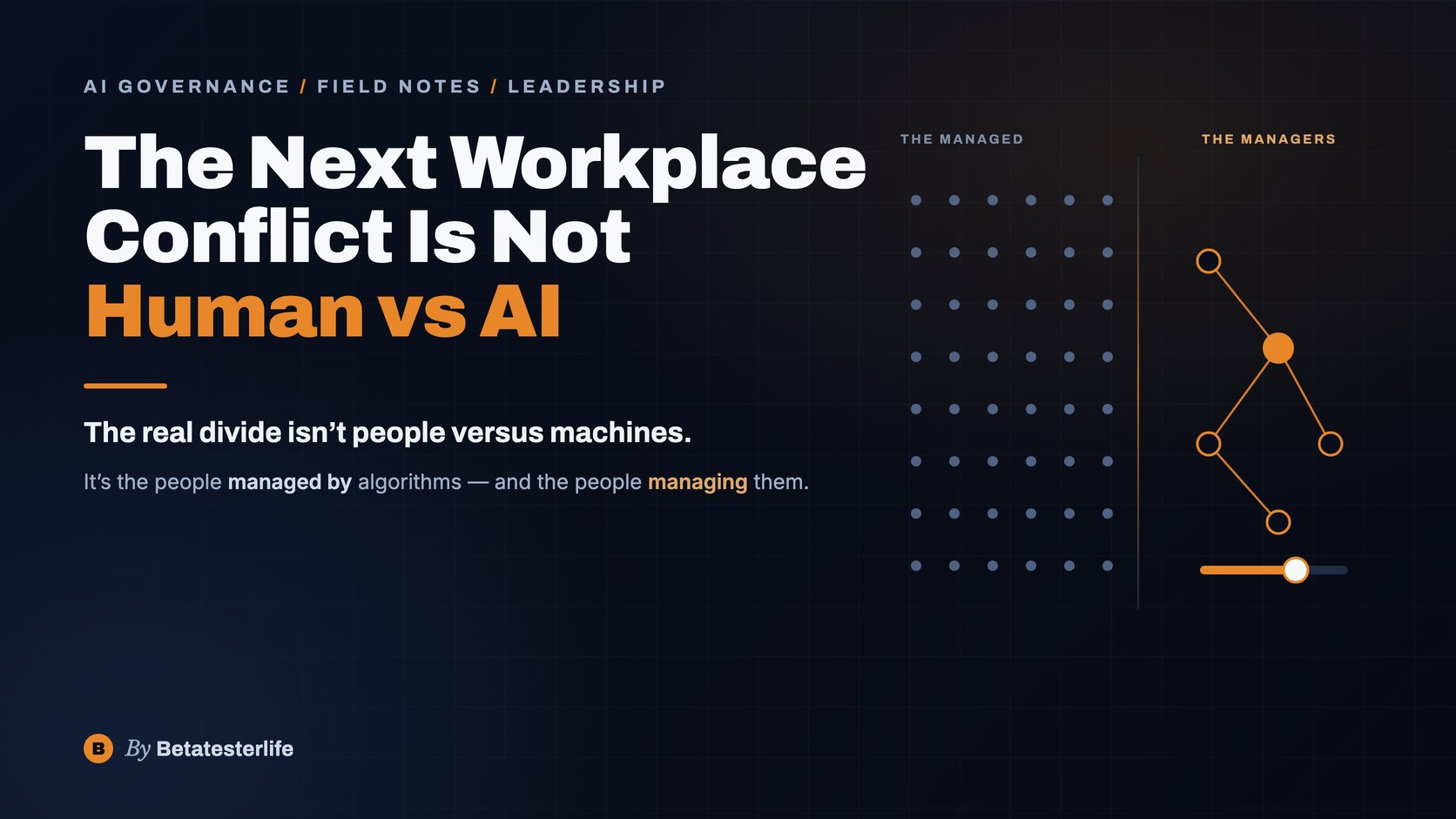
The real workplace divide forming under AI is not between people and machines. It is between the people who are managed by algorithms and the people who manage them.
The fight we keep expecting
The dominant story about AI at work is a contest. Humans against machines. Who gets automated, who survives, whose job disappears next.
It makes for a clean headline. It is also the wrong fault line.
The conflict already forming inside organisations is not human versus AI. It is human versus human, with an algorithm sitting in the middle.
On one side are the people whose work is increasingly assigned, scored, paced, and corrected by automated systems. On the other are the people who design, tune, and own those systems.
Same building. Same payroll. A very different relationship to the machine.
Two relationships to the same system
Start with the people being managed by algorithms.
Their shifts are allocated by a scheduler. Their output is ranked against a model. Their next task arrives in a queue they did not design. Their performance is summarised in a dashboard they rarely see in full. When the system gets it wrong, the route of appeal is often another system.
This is not science fiction. It began in warehouses, ride-hailing, delivery, and contact centres. It is now spreading into knowledge work through productivity scoring, automated quality monitoring, and “copilot” tools that quietly learn what good looks like.
Now look at the other group.
They write the prompts, set the thresholds, choose the metrics, and decide what the model optimises for. They can see the dashboard from above. When the system misbehaves, they can change it.
The first group experiences the algorithm as weather. The second group experiences it as a steering wheel.
Why the gap is widening
Three forces are pulling these groups apart.
First, tooling. The systems that direct work are becoming cheaper and faster to deploy than the systems that explain it. It is far easier to roll out automated scoring than to roll out a meaningful account of how the score is produced.
Second, speed. Algorithmic management scales instantly. A change to a model reaches ten thousand workers the moment it ships. The human capacity to understand, question, and absorb that change does not scale at the same rate.
Third, distance. The people tuning the system are increasingly remote from the people living inside it. Decisions that once belonged to a visible manager are now encoded in logic written by someone the worker will never meet.
None of this is inevitable. But left unmanaged, it produces a predictable result: one group accumulating agency, the other slowly losing it.
It cuts across the org chart
The uncomfortable part is that this divide does not map neatly onto seniority.
A senior professional can find themselves managed by an algorithm — consultants ranked by utilisation, clinicians paced by scheduling software, engineers measured by automated productivity metrics. A relatively junior analyst tuning a model can hold more practical influence over how work feels than the people that model directs.
So this is not simply white collar versus blue collar, or senior versus junior. It is a new axis: proximity to the controls.
The closer you sit to where the algorithm is configured, the more your work feels like authorship. The further away you sit, the more it feels like compliance.
Why this is a leadership problem, not an HR footnote
It is tempting to file this under wellbeing or engagement. That underestimates it.
When a meaningful share of your workforce experiences direction without explanation, three things follow.
Trust erodes. People do not trust instructions they cannot interrogate, especially when those instructions affect pay, shifts, or progression.
Feedback dies. If the algorithm cannot be questioned, the early-warning signals that something is wrong stop reaching the people who could fix it. Low noise gets misread as healthy adoption.
Risk hides. The worker who knows an automated decision is wrong, but has no route to challenge it, eventually stops trying. The error stays in the system.
This is the same pattern that breaks any transformation: a gap between the people who decide and the people who absorb. AI simply makes the gap faster, quieter, and harder to see.
What good looks like
The organisations that handle this well will not be the ones with the most advanced models. They will be the ones that deliberately narrow the distance between the managed and the managers.
That means a few concrete commitments.
Explainability as a default, not a favour. If an algorithm assigns, scores, or ranks a person’s work, that person should be able to understand why, in terms they can act on.
A real route to challenge. Human review of an automated decision should not be a legal formality buried in a policy. It should be a working loop with names attached.
Shared visibility. The dashboard that judges the worker should not be invisible to the worker. Asymmetric visibility is asymmetric power.
Workers in the design room. The people directed by a system know where it breaks first. Excluding them from how it is tuned is not only unfair — it is bad engineering.
What to ask before the next rollout
For any team deploying systems that direct human work, five questions are worth asking before the next rollout.
- Who in this process is managed by the algorithm, and who manages it?
- Can the managed group see and understand the same information the system uses to judge them?
- When the system is wrong, what is the actual route to correct it — and how long does it take?
- Whose feedback would tell us the system is harming work rather than helping it, and are we listening for it?
- Are we widening the distance between these two groups, or closing it?
If those questions cannot be answered, the organisation is not really managing AI. It is just distributing it unevenly.
Closing thought
The “human versus AI” story is comfortable because it lets everyone stand on the same side — humans, together, against the machines.
The real story is harder. The machines are not the other side. They are the medium through which one group of people now manages another.
The next workplace conflict will not be decided by how powerful the algorithms become. It will be decided by how fairly we share the right to shape them.
That is not a technology problem. It is an old leadership problem wearing new software.
Sources used
- Lee, Kusbit, Metsky & Dabbish (2015) — early research that introduced the idea of “algorithmic management” through a study of ride-hailing drivers, useful for how automated direction shapes the experience of work.
- EU Directive on improving working conditions in platform work (2024) — notable as one of the first regulations to require transparency and human oversight of algorithmic management decisions.
- Amy C. Edmondson — foundational research on psychological safety and why people stay silent when they cannot safely challenge a decision.

Written by Kevin Campbell
Thirty years of technology, delivery and organisational change—translated into practical thinking for people doing the work.
Continue the journey
One thought leads to another.
Scroll to explore
 AI Governance
AI Is Not a University. But It Can Build You One.
AI Governance
AI Is Not a University. But It Can Build You One.
 Leadership & Culture
The Hidden Value of Fleeting Encounters in a Transactional World
Leadership & Culture
The Hidden Value of Fleeting Encounters in a Transactional World
 AI Governance
The Hidden Verification Gap: A Practical 30-Day Way Forward
AI Governance
The Hidden Verification Gap: A Practical 30-Day Way Forward
 Field Notes
The CC List Is Not a Control
Field Notes
The CC List Is Not a Control
 AI Governance
Hyperadaptive Is a Blueprint for Rewiring the Enterprise Around AI
AI Governance
Hyperadaptive Is a Blueprint for Rewiring the Enterprise Around AI
 AI Governance
AI Coding Has Moved the Bottleneck From Creation to Verification
AI Governance
AI Coding Has Moved the Bottleneck From Creation to Verification
Conversation
Add to the thinking
Questions, experience and thoughtful disagreement are welcome.