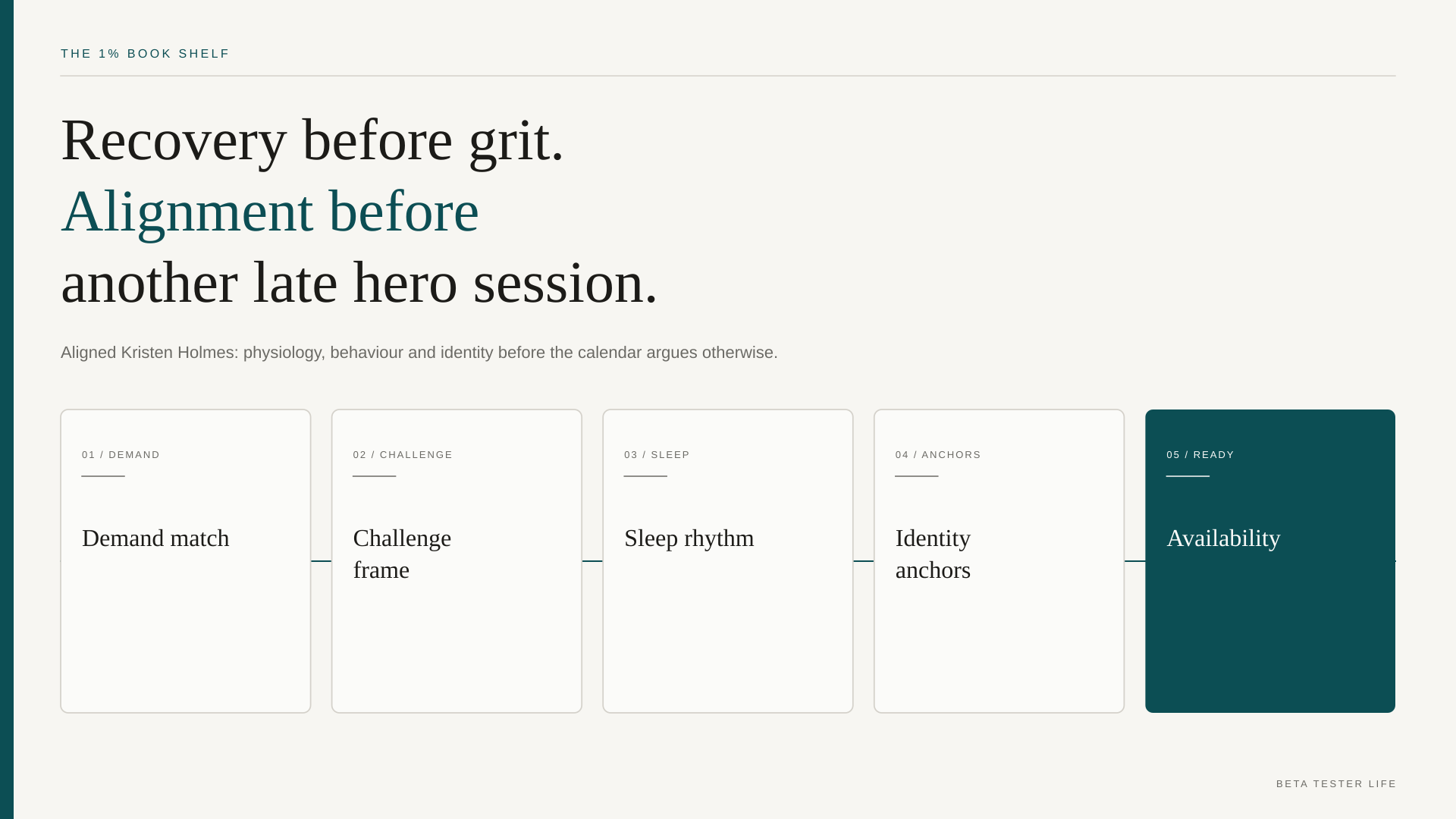
In this article20 min read
Read slowly. Keep what is useful. Question the rest.
The 1% Book Shelf. Aligned: The Data-Driven Guide to Performance, Recovery, and Human Potential by Kristen Holmes, PhD (Avery / Penguin Publishing Group, 2026).
The warning did not arrive as a dashboard. It arrived as grass under the tyres. Kristen Holmes was driving with her children in the car when she fell asleep at the wheel. The verge woke her. At the time she was a Division I head coach at Princeton, running a youth national programme, an academy, a club, and a start-up, while raising an eighteen-month-old and a newborn. She told athletes that performance was a choice. She lived on Diet Coke, coffee, and packaged food, worked into the early hours, and treated sleep as optional. On campus, T-shirts from a local coffee shop read "Sleep is for the weak." The line matched her calendar.
Holmes opens Aligned with that life, not with a TED-style miracle. Readers looking for Aligned Kristen Holmes will find a book that starts with failure rather than a polished origin myth. Childhood with an alcoholic mother, All-American field hockey, the U.S. national team, coaching at Princeton, the WHOOP years, and a PhD in psychology from the University of Queensland. The through-line is blunt: she built systems for other people's recovery while her own life ran on grit until the body vetoed it. The book's argument follows from that failure. Sustainable transformation has less to do with willpower and more to do with alignment, which she defines as the feeling of inner stability when physiology, behaviour, and identity converge. Performance, in her framing, is a by-product of that convergence, not a substitute for it.
The uncomfortable claim for anyone who leads delivery, ships under automation pressure, or treats burnout as a character test is that most of us still try to out-discipline biology. Holmes's word for the alternative is recovery as competitive advantage: the twenty-one hours outside the meeting, the training block, or the release window are not downtime. They are the system that decides whether you can show up tomorrow with capacity left. She maps that system across twelve domains of alignment: time awareness, attachments, expectations, purpose, self-efficacy, autonomy, connection, circadian and sleep health, recovery practices, nutrition, hydration, and training/movement. The later chapters add named frameworks (HEAL, TEAM, PEAC, A.L.I.G.N.) and twenty-two recovery techniques. The book is part memoir, part psychophysiology primer, part workbook, and part brief for WHOOP-shaped metrics such as HRV, sleep consistency, and a composite Recovery score.
Here is what holds, what softens, and what a knowledge-work reader can steal without pretending this is a software delivery manual.
1. Rhythm before grit: stress, light, and intelligent load
Part One is the book's strongest stretch, because it refuses the fantasy that mindset overrides empty reserves.
Chapter 2 reframes stress as energy expenditure rather than moral failure. Acute stress sharpens. Chronic stress, unresolved, keeps cortisol circulating and recovery incomplete. Holmes's evidence set includes her team's work with acute-care surgeons on continuous biometric devices: on-call nights wrecked total, REM, and slow-wave sleep, and sleep timing "became essentially random," with incomplete rebound even off call. The pattern will be familiar to anyone who has watched an incident week leave a team greener on the board than in the room.
Her practical distinction is challenge versus threat. In a study of more than 11,000 WHOOP members published in Emotion, people who framed daily stressors as challenges rather than threats showed better overnight physiology: lower resting heart rate and more restorative sleep when the next day was cast as manageable rather than overwhelming. The coaching translation she used at Princeton is useful without a wearable. Bucket the next hard thing as easy, challenging, or very difficult. Easy breeds flat effort. Very difficult floods the system. Challenging is the working middle, and she made it concrete by tying athletes to one skill or resource that would raise self-efficacy before the match. For a delivery lead, that is closer to "name the one rehearsal that would make Friday's cutover feel held" than to a motivational poster.
Underneath sits the Demands-Resources (D-R) Model, adapted from Bakker and Demerouti's Job Demands-Resources work. When resources match or exceed demands, Holmes calls it demand match. When demands outrun resources, demand mismatch. Recovery is not a weekend hobby in this model. It is the buffer that widens what you can process when the next stressor hits. Her one-line boundary practice is almost boring enough to work: turn technology off at dinner, and stop checking work email or Slack an hour before sleep. Detachment is treated as a recovery strategy, not a lifestyle brand.
Holmes also gives the reader a dashboard language for capacity: resting heart rate, HRV, respiratory rate, sleep performance, VO2 max trends, blood pressure, glucose patterns, and subjective readiness. The useful instruction is to watch trends rather than single readings. One NHL case she describes is a veteran with chronically low HRV who added resonance frequency breathing, sleep-wake consistency, and alcohol abstinence, then saw baseline HRV and energy rise by mid-season. With Claude Giroux, then of the Philadelphia Flyers, above-average recovery days coincided with more puck touches, completed passes, and scoring efficiency. You do not need to copy the sensor stack to copy the question: is my recovery trend rising, flat, or quietly eroding while my calendar still says I am fine?
Chapter 3, First Light, is the keystone. The body runs on timing more than willpower. Light to the eyes sets the master clock in the suprachiasmatic nucleus. Meals and movement set peripheral clocks in liver, gut, and muscle. Misalignment is described as a daily form of circadian jet lag: artificial light, irregular meals, shifting sleep windows, and the slow flattening of hormonal amplitude. The recommendations are specific enough to run without buying anything. Choose a wake time and keep it most days. Get outdoor light early, without sunglasses and not only through a window. Eat breakfast as a timing cue. Stop caffeine after 2 p.m. Stop food and alcohol three to four hours before bed. Prefer a sleep window roughly between 9 p.m. and 11 p.m. into 5 a.m. to 7 a.m., allowing seasonal drift. Keep the room cool. If the mind races, try cognitive shuffling: pick a neutral five-letter word and list unrelated words by letter without building a story. The chapter's best claim is also its most Monday-useful: sleep consistency and timing are not wellness garnish. They are load-bearing infrastructure for attention, mood, and metabolic health.
Chapter 4 turns exercise into intelligent training and introduces availability reserve: surplus physical, mental, and emotional capacity so other people do not have to carry your collapse. Five domains organise the plan: cardiovascular work (including polarised Zone 2 with some Zone 5), resistance training, exercise snacks (roughly one-minute high-intensity bursts every few hours), mobility, and recovery. Load management borrows the sports science language of functional overreaching versus nonfunctional overload, tracked with HRV and resting heart rate trends rather than vibes. The citizen-duty rhetoric occasionally overreaches. The concrete advice does not. For desk-bound readers, the steal is exercise snacks and Zone 2 as metabolic insurance, not a call to become an athlete. Holmes's own experiment with snacks shifted her from "I did my hour in the gym, now I can sit all day" to movement as a day-long pattern. That is closer to how knowledge work breaks people than another 6 a.m. hero session that leaves the nervous system spent before the first stand-up.
The bridge out of Part One is Florida State University's women's soccer programme, where Holmes worked with strength and conditioning lead Elisa Angeles and head coach Mark Krikorian. They tested travel protocols, menstrual-cycle tracking, napping, and cooling mattresses in a culture that treated athlete availability as a competitive advantage. When the team won the 2021 national championship, they gave Holmes a ring. The anecdote could have been pure brand gloss. What she extracts from it is narrower and better: everyday decisions outrank big moments, and leadership has to protect recovery as policy, not as optional wellness.

2. The architecture within: HEAL, TEAM, and PEAC
Part Two is where Holmes stops pretending physiology alone explains why people sabotage the plan they already understand.
Chapter 5 treats trauma as an embedded stress injury in the body-mind system, not only a story. She cites the familiar World Mental Health Survey finding that roughly 70 percent of people experience a clinical trauma exposure across a lifetime, and she is careful that exposure is not the same as PTSD. The working framework is HEAL: Heart, Energy, Autonomy, Love. Heart is autonomic regulation and the return of safety signals through breath, sleep, gentle movement, and nature. Energy is mitochondrial and nutritional capacity when the nervous system has been stuck on high alert. Autonomy is the rebuilding of choice and self-trust. Love is connection and oxytocin pathways as physiological safety, not soft extras. Affect labeling ("I feel anxious," "I feel ashamed") is offered as a small prefrontal lever that reduces amygdala intensity. This is not a trauma therapy manual, and Holmes does not pretend it is. It is a performance scientist arguing that unhealed nervous systems will keep defeating training plans.
Chapter 6 pairs fear with trust and offers TEAM: Time, Expectations, Attachments, Memory. Time is the ability to move among past, present, and future without getting stuck in rumination or fantasy. Expectations are the silent scripts that tighten the body before a hard conversation. Attachments are what we cling to when identity feels threatened, including roles and outcomes at work. Memory is treated as both narrative and biology, degraded by poor sleep and substance use. Holmes notes WHOOP data from tens of thousands of adults linking alcohol and other disruptors to weaker recovery and memory-related functioning. The move from fear to trust is described as physiological as much as philosophical: the body that reads uncertainty as threat narrows; the body that senses enough safety can learn.
TEAM is most useful when you treat it as a diagnostic label in the moment rather than a personality quiz. Before a difficult review, ask which lever is active. Am I time-traveling into last quarter's failure? Am I performing against an unspoken expectation of perfection? Am I attached to being the person who never says no? Am I replaying an old memory as if it were a forecast? Naming the lever does not fix the calendar. It stops you from solving the wrong problem with more hours.
Chapter 7 defines performance as "the capacity of an individual to intentionally behave at a level equal to their physical, mental, and emotional potential." The readiness stack is PEAC: Purpose, Efficacy, Autonomy, Connection, drawn from self-determination theory and Bandura's self-efficacy work. Purpose is operationalised through an identity statement ("I want to be a person who…"), supported by named values and visible behaviours. Efficacy grows when anchors prove you can keep those behaviours. Autonomy shows up as chosen routines that reduce decision fatigue. Connection is real support, not network theatre. Holmes's own enduring identity line is "I am a person who lives my values with joy and energy." The anchors beneath it are ordinary: rest, nature, training, fuel, protected mornings and evenings with her children, work boundaries that leave energy for cooking.
The chapter's most transferable idea for leaders is anchors as non-negotiable habits that make autonomy real. Hidden commitments, borrowing Kegan and Lahey's immunity-to-change language, are the quiet rivals: the nightly wine that looks like connection but displaces presence, the late-night inbox that looks like dedication but buys validation. If SuperSkills asked for a ten-word line you will not trade, Aligned asks for the daily behaviours that prove the line is inhabited.
3. Availability and the recovery tool kit
Part Three opens with the word Holmes wants to rehabilitate: availability. Citing Raysmith and Drew, she notes that 86 percent of successful athletic seasons in one five-year study were explained by showing up illness-free and injury-free. The leap to knowledge work is not exact, but the analogy is fair enough. Teams do not lose quarters only to bad architecture. They lose them to depleted people who are still marked available in the staffing plan.
Chapters 9 to 12 are a catalogue of twenty-two techniques, grouped with unusual clarity. Breath first: diaphragmatic breathing, the physiological sigh, super oxygenation, and resonance frequency breathing, with a CO₂ tolerance test as a baseline. Then hormetic stressors: cold, heat, contrast. Then core inputs: fueling, hydration, mobility. Then rebalancing rituals: napping, Yoga Nidra / non-sleep deep rest, nature, journaling, gratitude, awe, mindfulness, loving-kindness, Hatha and Yin yoga, Zone 2 again, and creative rest.
The ordering matters. Holmes starts with breath because it is free, portable, and fast enough to use between meetings. Hormetic tools come next as controlled stress that trains rebound, not as lifestyle cosplay. Core inputs are the unglamorous base: you cannot breathwork your way out of chronic under-fueling or dehydration. The rebalancing chapter is where the book risks becoming a spa menu, and Holmes mostly avoids that by insisting on dose, timing, and measurement. A twenty-minute nap before 2 p.m. is not the same intervention as scrolling in bed. Ten minutes of outdoor light after lunch is not the same as a weekend hike you never take. The point of the list is not to do all twenty-two. It is to treat recovery as designable inputs with dose and timing, the way training already is for serious athletes.
Chapter 8's gatekeeper claim is the one I would keep on a team wall: availability is earned. You do not stumble into readiness on the morning of the release. You build it in the unglamorous hours before. Holmes's personal stress test in this section is visceral: her son suffered a double compound fracture at a hockey game, bones through skin. She uses it to show how an overloaded autonomic system responds when the demand is no longer abstract. The book does not linger for spectacle. It returns to the same thesis. Capacity is built before the crisis, or it is not there when the crisis arrives.
4. The workbook: A.L.I.G.N. and the twelve-domain score
Part Four turns the book into a practice system. A.L.I.G.N. is the scaffold:
| Letter | Move |
|---|---|
| A | Align inner values with actions |
| L | Listen to body and rhythms |
| I | Integrate learning into practice (worksheets often say Inspire: one small experiment) |
| G | Grow through weekly reflection |
| N | Steer the next stretch with intention |
The baseline assessment scores the twelve domains from 1 to 5 and averages them. Holmes is explicit that it is a self-report snapshot, not a clinical diagnosis, subject to bias and context. That honesty matters. Scores from 4.5 to 5.0 are "radiant alignment"; below 3 drifts toward fragile or deep misalignment. I would not over-index on the labels. I would use the twelve prompts as a quarterly audit of whether your calendar still matches your stated identity.
The daily tracker is more valuable than the score: wake time, light, fueling, hydration, movement, wind-down, reflection. The weekly check-in asks what nourished you, what drained you, and what needs to change next week. The workbook is where the book either becomes useful or becomes shelf weight. Insight, she repeats, does not change us. Embodiment does.
The 1% takeaway from Aligned Kristen Holmes: protect tomorrow's judgement
If you keep one idea from Aligned, keep demand match as an operating principle. Before you add another initiative, another late review, or another "quick" evening merge, ask whether the team's resources still cover the demand. Sleep consistency, a challenge rather than threat frame for the next hard gate, and one identity-linked anchor will do more for judgement under automation than another productivity framework layered on an exhausted nervous system.
That matters in delivery because most organisations measure throughput and almost never measure the recovery that makes good decisions possible. We track story points, cycle time, and change failure rate. We rarely track whether the people approving the change slept enough to notice the risk the model missed. Holmes's version of performance science is useful here precisely because it is not about software. It is about what software work still runs on: attention, emotional range, and the capacity to stay in challenge rather than threat when the incident channel lights up.
Your downtime is your competitive advantage.
Here I would push back on Holmes, and the push-back starts with the flagship golf study she uses to sell that line. In chapter 2 she reports a WHOOP analysis of 389 PGA Tour athletes across 521 events from 2017 to 2025, published in the International Journal of Sports Physiology and Performance. The direction of the finding is real and replicated in the paper: better recovery, sleep consistency, and autonomic markers associate with better scores. The rhetoric is looser than the coefficients. Holmes writes that players in the bottom tenth of recovery averaged nearly 73, the top tenth averaged 70, and that "for every 10-point increase in recovery, golfers gained just over one stroke per round." The peer-reviewed abstract and WHOOP's own public summary of the same study put the between-athlete association nearer half a stroke per 10 recovery points, and the within-athlete season-to-season association nearer two-tenths. A three-stroke gap between extreme groups is not the same claim as a one-stroke return on every 10-point gain across the distribution. Association is also not a clean causal lever you can dial before Thursday's tee time. The study supports her thesis that recovery predicts performance. The book's sharpest number oversells the dose-response.
The second problem is commercial gravity. Holmes is Global Head of Human Performance and Principal Scientist at WHOOP. Much of the evidence is WHOOP-derived, and the narrative often treats the company's Recovery score, Journal, and continuous monitoring as the natural instrumentation layer. She does say you can track signals manually and should not depend on technology alone. That caveat sits quietly beside hundreds of pages in which the wearable is the teacher. Readers without a subscription still get the behaviours. They should notice when a metric is being asked to carry more certainty than a consumer device can give. A morning resting heart rate taken by hand, a sleep diary, and an honest threat-versus-challenge note in a notebook will get you most of the operating system without importing a vendor's composite score as gospel.
The third is density and small fractures in the system that is supposed to hold the density. By the end you have twelve domains, D-R, challenge/threat, five training domains, HEAL, TEAM, PEAC, A.L.I.G.N., and twenty-two techniques. That is a lot of named machinery for a book whose thesis is rhythm and subtraction. The workbook itself wobbles on the "I" in A.L.I.G.N.: chapter 13 defines it as Integrate, while the chapter worksheets repeatedly run it as Inspire. It is a small inconsistency, but in a book about alignment it is an ironic one. Choose a short list. One circadian rule, one breath protocol, one identity anchor, one weekly review. Leave the rest on the shelf until those hold.
None of this sinks the book. The diagnosis is right for a culture that still confuses depletion with commitment. The Princeton recruiting insight still travels: the hours outside formal practice decide whether the practice was worth doing. So does the quieter claim that grit without rhythm is often a trauma pattern wearing a medal. Holmes earned the argument the hard way, on a roadside verge with children in the car. That scene is more persuasive than any Recovery percentile, and it is the standard I would use on the rest of the genre. If a performance book cannot survive contact with a Tuesday after a bad night, it is not a performance book. It is a costume.

Application to work, leadership and change
Holmes is writing about human performance, not agile delivery. The useful move is to translate her physiology into the conditions under which delivery judgement remains sane.
| Practice | What it guards | Try this Monday |
|---|---|---|
| Demand match check | Chronic overload dressed as commitment | Before accepting a new date or scope cut, name the resource that will fund it: sleep, rehearsal time, or a dropped demand. |
| Challenge, not threat, framing | Threat physiology before gates and incidents | In the pre-mortem, ask: what one skill, artefact, or backup would make this feel challenging rather than overwhelming? |
| Sleep consistency as infrastructure | Degraded attention and mood across the week | Protect a stable wake time for the team week of a major release. Treat late-night “heroics” as a risk, not a virtue. |
| Identity statement and anchors | Values that never reach the calendar | Write “I want to be a person who…” once. Attach two non-negotiable anchors (for example, no Slack in the last hour before sleep; one outdoor light walk after stand-up). |
| Availability over theatre | Green status with empty people | In staffing and on-call design, track who is actually recoverable this week, not only who is rostered. |
| One recovery input with dose | Vague wellness intentions | Pick one technique from the book for two weeks: physiological sigh between meetings, Zone 2, or a 10-minute wind-down without screens. Review on Friday. |
1. Demand match check
Put D-R on the programme board in plain language. Demands are scope, dates, incident load, and political noise. Resources are sleep, skill, staffing, rehearsal, and support. If the date moves left, name what resource moves with it, or which demand leaves.
Scenario. A regulatory deadline is pulled forward by two weeks. Instead of absorbing it as threat, the team lists the demands that will be dropped or deferred so recovery and rehearsal remain solvent. The conversation becomes capacity arithmetic, not toughness theatre.
2. Challenge, not threat, framing
Borrow the Princeton bucket. Easy, challenging, very difficult. If the room says very difficult, do not answer with slogans. Answer with one concrete resource that changes the appraisal: a dry run, a rollback rehearsal, a paired decision owner.
Scenario. A cutover plan reads as very difficult because the rollback has never been timed. The challenge reframe funds a ninety-minute rehearsal. The physiology of the room changes because the resource changed, not because someone said "we've got this."
3. Sleep consistency as infrastructure
Treat wake time and wind-down as production dependencies during high-load weeks. Holmes's circadian chapter is clearer than most corporate wellness decks: light in the morning, dark and cool at night, caffeine curfew, food timing, stable wake-ups.
Scenario. In the week before go-live, the delivery lead stops scheduling "optional" evening syncs after 8 p.m. and asks on-call pairs to protect a fixed wake time. Defect discovery the next morning improves because attention did.
4. Identity statement and anchors
Write the person you intend to be under pressure, then pick anchors that make the statement expensive to ignore. "I want to be a person who decides cleanly" might anchor as no approval emails after a sleepless night, or a three-breath pause before merging.
Scenario. A tech lead's identity line is "I want to be a person who protects the team's judgement." The anchor is no same-day double incident reviews after a short night. The second review is deferred, and the write-up is better for it.
5. Availability over theatre
Raysmith and Drew's athletic finding does not transfer one-to-one, but the staffing question does. Who is actually able to show up illness-free, injury-free, and cognitively present?
Scenario. Two engineers are marked available. Both have done three late incident nights. The board still shows green. An availability check moves one to support-only and brings a fresh reviewer into the release path.
6. One recovery input with dose
Do not implement twenty-two techniques. Pick one. Holmes's physiological sigh or resonance breathing between meetings is the cheapest nervous-system tool in the book. Zone 2 and outdoor light are the best metabolic ones for desk work.
Scenario. A programme manager runs two physiological sighs before every steering meeting for a fortnight. The meeting behaviour that changes is not mysticism. It is a slower first response and fewer threat-shaped interruptions.
Holmes spent years telling athletes that performance was a choice, then learned that choice without recovery is just another story the exhausted tell themselves. The roadside wake-up is the book's real methodology section. Alignment is not a mood. It is a set of rhythms you can defend when the calendar argues otherwise.
Becoming the person you want to be doesn't always happen in grand, sweeping motions. It happens in how you breathe, how you heal, how you move your body, how you honor your rhythms and restore your mind.
Sources
- Kristen Holmes, PhD, Aligned: The Data-Driven Guide to Performance, Recovery, and Human Potential (Avery / Penguin Publishing Group, 2026). Publisher page.
- Gregory J. Grosicki et al., "Wearable-Derived Sleep and Physiological Metrics Are Associated With Performance in Professional Golfers," International Journal of Sports Physiology and Performance (2025), DOI 10.1123/ijspp.2025-0226; WHOOP summary of the same work noting ~0.5 strokes per 10 recovery points between athletes and smaller within-athlete effects: Recovery and pro golf performance.
- William von Hippel et al., "Cardiac responses to daily threats and challenges during wakefulness and sleep," Emotion (2025), PubMed 40455521; WHOOP overview: How You Think About Stress Shapes How You Recover.
- Corina Benjet et al., "The epidemiology of traumatic event exposure worldwide: results from the World Mental Health Survey Consortium," Psychological Medicine (2016): lifetime trauma exposure around 70.4% across surveyed countries (PMC4869975).
- Arnold Bakker and Evangelia Demerouti, Job Demands-Resources model (2001), adapted by Holmes as the Demands-Resources (D-R) framing in chapter 2.
- Benjamin P. Raysmith and Michael K. Drew, athletic availability research cited by Holmes for the claim that illness- and injury-free availability explained 86% of successful seasons in their five-year sample.
- Robert Kegan and Lisa Lahey, immunity-to-change / hidden commitments, as referenced in Holmes's discussion of anchors.
- Edward Deci and Richard Ryan, self-determination theory; Albert Bandura, self-efficacy, the research base Holmes uses for PEAC.
Written by Kevin Campbell
Thirty years of technology, delivery and organisational change—translated into practical thinking for people doing the work.
Continue the journey
One thought leads to another.
Scroll to explore
 AI Governance
AI Is Not a University. But It Can Build You One.
AI Governance
AI Is Not a University. But It Can Build You One.
 Leadership & Culture
The Hidden Value of Fleeting Encounters in a Transactional World
Leadership & Culture
The Hidden Value of Fleeting Encounters in a Transactional World
 Leadership & Culture
How to Build Products People Love: One Risky Bet
Leadership & Culture
How to Build Products People Love: One Risky Bet
 The 1% Book Shelf
Difference Isn’t the Landmine. Justification Is.
The 1% Book Shelf
Difference Isn’t the Landmine. Justification Is.
 AI Governance
Reliable AI Systems: A Practical Way to Control Risky Outputs
AI Governance
Reliable AI Systems: A Practical Way to Control Risky Outputs
 AI Governance
AI Job Design: How to Make Agents Earn Their Place
AI Governance
AI Job Design: How to Make Agents Earn Their Place
Leave a Reply