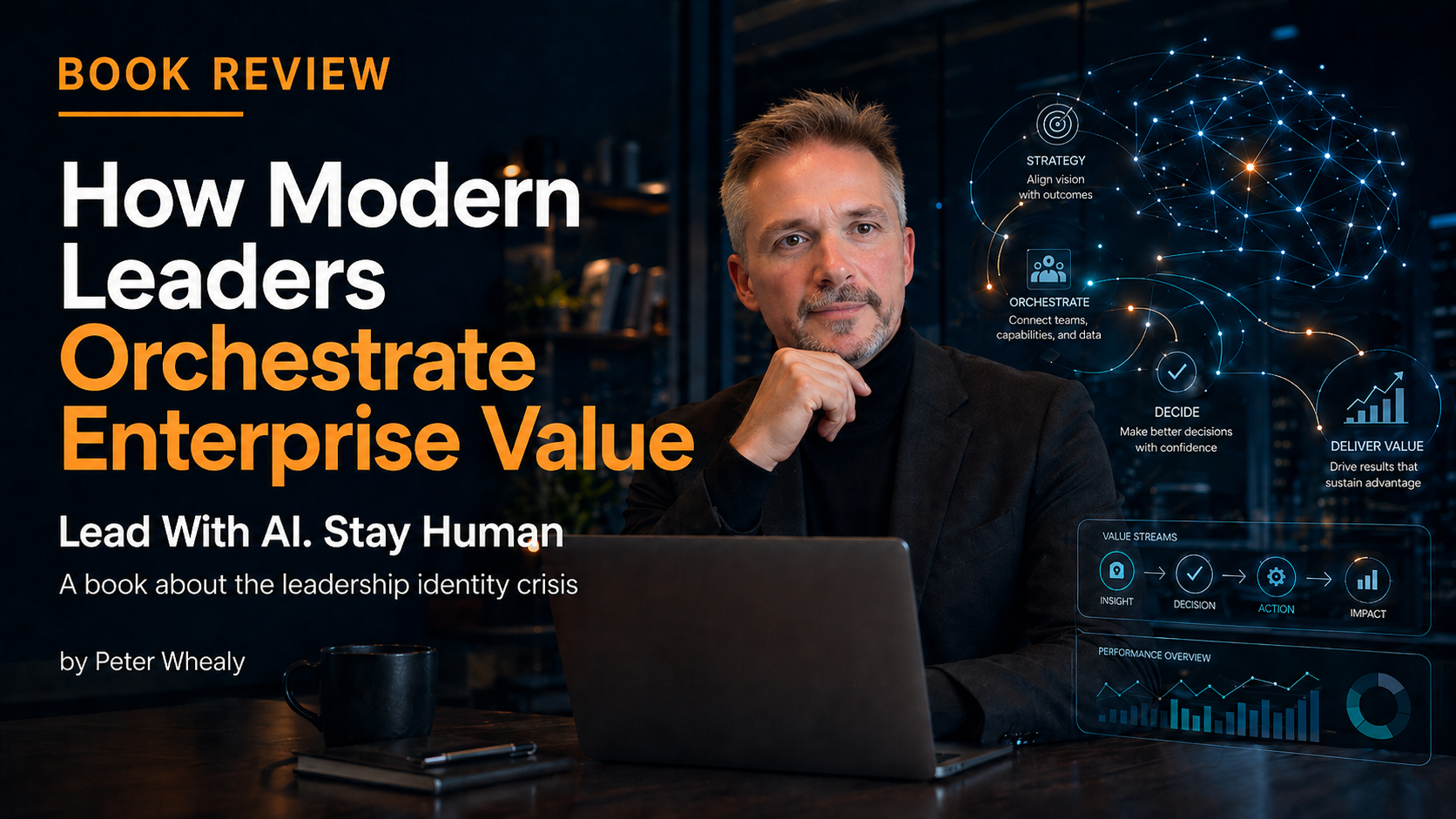
Lead With AI Stay Human Is A Book About The Leadership Identity Crisis
How Modern Leaders Orchestrate Enterprise Value by Peter Whealy
AI has a way of turning familiar leadership advice into something more uncomfortable. For years, leaders were told to be decisive, informed, expert, resilient, and close enough to the work to know what was really happening. Those are still useful qualities. But Peter Whealy’s Lead with AI. Stay Human argues that they are no longer enough, because AI has changed the economics of expertise.
If analysis, synthesis, scenario planning, drafting, research, and pattern recognition are available to almost anyone with a good prompt, leadership can no longer depend on being the person with the best answer in the room. The leader’s value moves elsewhere: into framing the problem, judging the consequences, maintaining trust, coordinating across boundaries, and deciding when the organisation should pause, learn, or accelerate.
That makes this book more interesting than a simple “how leaders should use AI” guide. Its real subject is identity. What happens to leaders whose credibility was built on knowing, deciding, controlling, and personally delivering when AI starts doing parts of that work faster than they can? Whealy’s answer is not that leaders become obsolete. It is that the old identity does.
From Answer-Giver To Conductor
The central metaphor in the book is conductor leadership. A conductor is not the person playing every instrument. Their value lies in rhythm, timing, interpretation, coordination, and the ability to turn separate contributions into a coherent performance. In an AI-enabled organisation, that is a more useful image than the heroic expert who personally solves the hardest problems.
This matters because many AI strategies still begin from the wrong place. They ask: how much work can we automate, how much cost can we remove, and how quickly can we scale the tools? Those are legitimate questions, but they are not sufficient leadership questions. They say little about judgement, trust, learning, accountability, customer experience, or whether the organisation is becoming more capable over time.
Whealy’s better question is whether AI elevates human potential or merely extracts more output. That distinction is not sentimental. It is operational. An organisation that uses AI to speed up weak decisions, flatten human agency, or bypass coordination will not become more intelligent. It will simply make its existing dysfunction travel faster.
The Book’s Strongest Warning: Artificial Ignorance
One of the book’s more useful phrases is “Artificial Ignorance”: the atrophy that follows when leaders trust AI outputs without doing the work of critical reasoning. This is a more practical risk than science-fiction anxiety about machines taking over. The immediate danger is that AI makes weak thinking feel fluent, finished, and defensible.
Anyone who has worked around delivery, governance, or transformation will recognise the pattern. A slide looks crisp. A summary sounds plausible. A decision paper has the right headings. A risk register is neatly populated. Yet the hard questions have not been answered. Which assumptions are fragile? Who is affected? What trade-off are we hiding? What evidence would change our mind? What breaks when this leaves the pilot environment?
AI can help with all of those questions, but only if it is used as a sparring partner rather than an authority figure. The point is not to ask AI for the answer and then decorate it with human approval. The point is to use AI to generate challenge, compare perspectives, expose blind spots, and sharpen human judgement before the decision scales.
The Useful Frameworks
The book is full of frameworks, and some readers may find the density slightly overwhelming. But several are genuinely useful. The +3/-2 leadership shift is a strong starting point: build judgement, connection, and vision; release control and execution pride. That captures the personal work many leaders avoid. Letting go of control is easy to admire in a keynote and very hard to practise when you remain accountable for the outcome.
SPAR is the broader leadership rhythm: Strengthen, Partner, Amplify, Reshape. It starts with identity and judgement, moves into collaboration with AI and people, expands into team capability, and finally asks whether the organisation’s structures, incentives, and flows are fit for the speed it has created. This sequencing matters. Many companies try to reshape the enterprise before leaders have strengthened the human judgement needed to steer it.
The AI Board Consult is perhaps the most immediately usable idea. Before an AI-enabled decision scales, test it through multiple voices: future impact, risk and ethics, people proxy, and execution reality. In plain English: do not let the person most excited about the technology be the only one defining the decision. Invite the future, the risk, the workforce, and the delivery system into the room early enough that their objections can still improve the work.
Why This Matters For DevOps And Delivery Leaders
Although this is a leadership book, its argument maps neatly onto modern delivery. DevOps taught organisations to reduce handoffs, automate repeatable work, improve feedback loops, and bring development and operations closer together. AI now raises a similar challenge at a wider scale. It increases the speed of analysis, experimentation, documentation, coding, testing, support, and decision-making. But speed without coherence is not flow. It is turbulence.
The delivery lesson is simple: local acceleration can create system-level drag. A product team uses AI to produce faster discovery notes. Engineering uses AI to generate code and tests. Security uses AI to classify risk. HR uses AI to redesign capability planning. Finance uses AI to prioritise investment. Each function may improve its own cycle time, while the enterprise becomes harder to coordinate because everyone is now moving faster in slightly different directions.
This is why Whealy’s emphasis on orchestration is valuable. AI transformation is not just a tooling rollout. It is a coordination problem. Leaders need shared decision context, clear rights, visible trade-offs, and mechanisms that help decisions travel across functions without being distorted or delayed. Otherwise the organisation gets the theatre of modernisation and the reality of fragmentation.
Trust Is Not A Communications Plan
The most human part of the book is its insistence that trust is not created by messaging. Leaders often treat trust as something restored through communication: more town halls, more FAQs, more manager talking points, more change comms. Those may help, but they are not the core of the issue. Trust is built when people see consistent evidence that leaders are making choices with values, clarity, and regard for human consequences.
This is especially important in AI adoption because people are watching for the real story. Is AI being used to develop capability, reduce drudgery, and improve decisions? Or is it being used to justify reductions, intensify workload, and make people feel interchangeable? Organisations can say “human-centred AI” all they like. Employees will judge the claim by budget decisions, operating targets, role design, and whether learning is treated as an investment or an inconvenience.
For technology leaders, this is not a soft concern. Trust affects adoption, experimentation, incident response, learning behaviour, risk escalation, and the willingness of teams to surface inconvenient truths. If people believe AI is primarily a threat, they will protect themselves. If they believe leaders are using AI to elevate capability, they are more likely to engage, challenge, learn, and improve the system.
The Sceptical Read
The book’s weakness is related to its strength. It offers many models, and at times the reader may wonder whether the number of frameworks risks becoming its own form of complexity. SPAR, Conductor Capabilities, the AI Board Consult, the Readiness Trinity, the Three Clocks, CROS, and other tools are individually useful. Together, they demand discipline from the reader.
There is also a practical implementation gap. It is easier to tell leaders to release control than to change the incentives that reward control. It is easier to say learning must outpace change than to fund time for learning when delivery pressure is rising. It is easier to run an AI pilot than to redesign governance, roles, metrics, and decision rights around the new reality.
But this is also why the book is useful. It does not pretend AI leadership is a prompt-engineering problem. It treats AI as a force that reveals whether the organisation’s leadership system is mature enough for the speed it now wants.
What Leaders Should Do On Monday
The most practical takeaway is to make AI decisions more inspectable. Before scaling a tool or workflow, write down the decision context: the problem being solved, the assumptions being made, the people affected, the risks being accepted, the evidence required, and the point at which the organisation will pause or reverse course. This sounds basic. In practice, it is often missing.
Second, use AI to challenge the decision rather than merely accelerate it. Ask it to argue from the customer’s view, the regulator’s view, the sceptical employee’s view, the operations team’s view, and the future failure review. Then bring humans back in to judge what matters.
Third, measure the things that show whether AI is elevating capability: learning velocity, decision quality, trust, rework, escalation patterns, adoption friction, and whether teams are getting better at applying judgement under pressure. If the only measures are cost reduction and speed, the organisation will optimise for extraction and call it transformation.
Strongest Ideas
- Being right is no longer enough. When more people can access similar analysis, leadership differentiates through judgement, framing, timing, and coherence.
- AI should be treated as a sparring partner, not an oracle. The point is not to outsource thinking, but to expose assumptions, test blind spots, and improve the quality of human judgement.
- Trust becomes operational infrastructure. In AI-enabled organisations, trust has to show up in decision rights, transparency, peer validation, and visible trade-offs.
- Learning rate is now strategic. Training completion is a weak proxy for capability; the real question is whether organisational learning keeps pace with technological and market change.
- Coordination is the hidden constraint. AI can accelerate analysis inside functions, but value collapses if strategy, operations, people, risk, and delivery are not moving in rhythm.
Frameworks Worth Carrying Forward
+3/-2 Leadership Shift: Build judgement, connection, and vision; release control and execution pride. A useful personal diagnostic for leaders who feel AI has undermined the old basis of authority.
SPAR: Strengthen, Partner, Amplify, Reshape. A journey from self-leadership to enterprise flow: first identity, then collaboration, then capability, then system design.
AI Board Consult: Future impact, risk and ethics, people proxy, and execution reality. A lightweight way to make AI-enabled decisions more resilient before they scale.
Four Conductor Capabilities: Judgement under ambiguity, enterprise orchestration, trust stewardship, and adaptive learning. The book’s strongest operating model for leadership when expertise is distributed and speed is unavoidable.
Readiness Trinity / Three Clocks: Strategy, operations, and people must advance together. A sharp challenge to transformation programmes that declare readiness while workflows and people remain out of sync.
CROS: Coordinate readiness into results through decision context, rights, ownership, and synthesis. A practical reminder that execution breaks down when decisions do not travel clearly across functions.
Useful Tensions
- Speed versus judgement: AI makes it easier to move, but easier movement can hide weaker thinking.
- Efficiency versus potential: cost-saving AI narratives can damage trust if people experience automation as extraction rather than elevation.
- Autonomy versus orchestration: local AI experimentation creates energy, but enterprise value depends on shared context and coordination.
- Confidence versus humility: polished AI outputs can make weak assumptions look finished.
- Training versus capability: knowledge transfer matters less than whether people can apply judgement under pressure.
Practical Leadership Lessons
- Ask better questions before asking AI for better answers.
- Make decision reasoning visible enough that others can challenge, validate, and reuse it.
- Use AI to widen the room: simulate dissenting voices, customer impact, risk, and operational friction before committing.
- Measure trust and learning as part of AI readiness, not as soft side issues handled after deployment.
- Treat coordination as a designed capability, especially where AI speeds up one function faster than another.
Final Thought
Lead with AI. Stay Human is strongest when it refuses the lazy binary of human versus machine. The better question is not whether AI replaces leaders. The better question is whether leaders can become mature enough to use AI without becoming narrower, faster versions of their old selves.
The future belongs less to leaders who can produce answers quickly and more to leaders who can create conditions for better judgement at scale. That means clearer questions, more visible reasoning, stronger trust, faster learning, and better coordination across the enterprise.
AI may accelerate the work. It does not absolve leaders from the human responsibility of deciding what the work is for.

Written by Kevin Campbell
Thirty years of technology, delivery and organisational change—translated into practical thinking for people doing the work.
Continue the journey
One thought leads to another.
Scroll to explore
 Leadership & Culture
How to Build Products People Love: One Risky Bet
Leadership & Culture
How to Build Products People Love: One Risky Bet
 The 1% Book Shelf
Difference Isn’t the Landmine. Justification Is.
The 1% Book Shelf
Difference Isn’t the Landmine. Justification Is.
 Leadership & Culture
Human Magic: Leading with Wisdom in an Age of Algorithms
Leadership & Culture
Human Magic: Leading with Wisdom in an Age of Algorithms
 The 1% Book Shelf
ikigai book review by Héctor García & Francesc Miralles
The 1% Book Shelf
ikigai book review by Héctor García & Francesc Miralles
 Leadership & Culture
Worker-Positive AI: Why Skills, Not Job Titles, Decide Who Wins the Next Five Years
Leadership & Culture
Worker-Positive AI: Why Skills, Not Job Titles, Decide Who Wins the Next Five Years
 Learning & Mindset
The 80% Problem: Why Your Brain Is Outsourcing Its Judgement to AI
Learning & Mindset
The 80% Problem: Why Your Brain Is Outsourcing Its Judgement to AI
Conversation
Add to the thinking
Questions, experience and thoughtful disagreement are welcome.