In this article21 min read
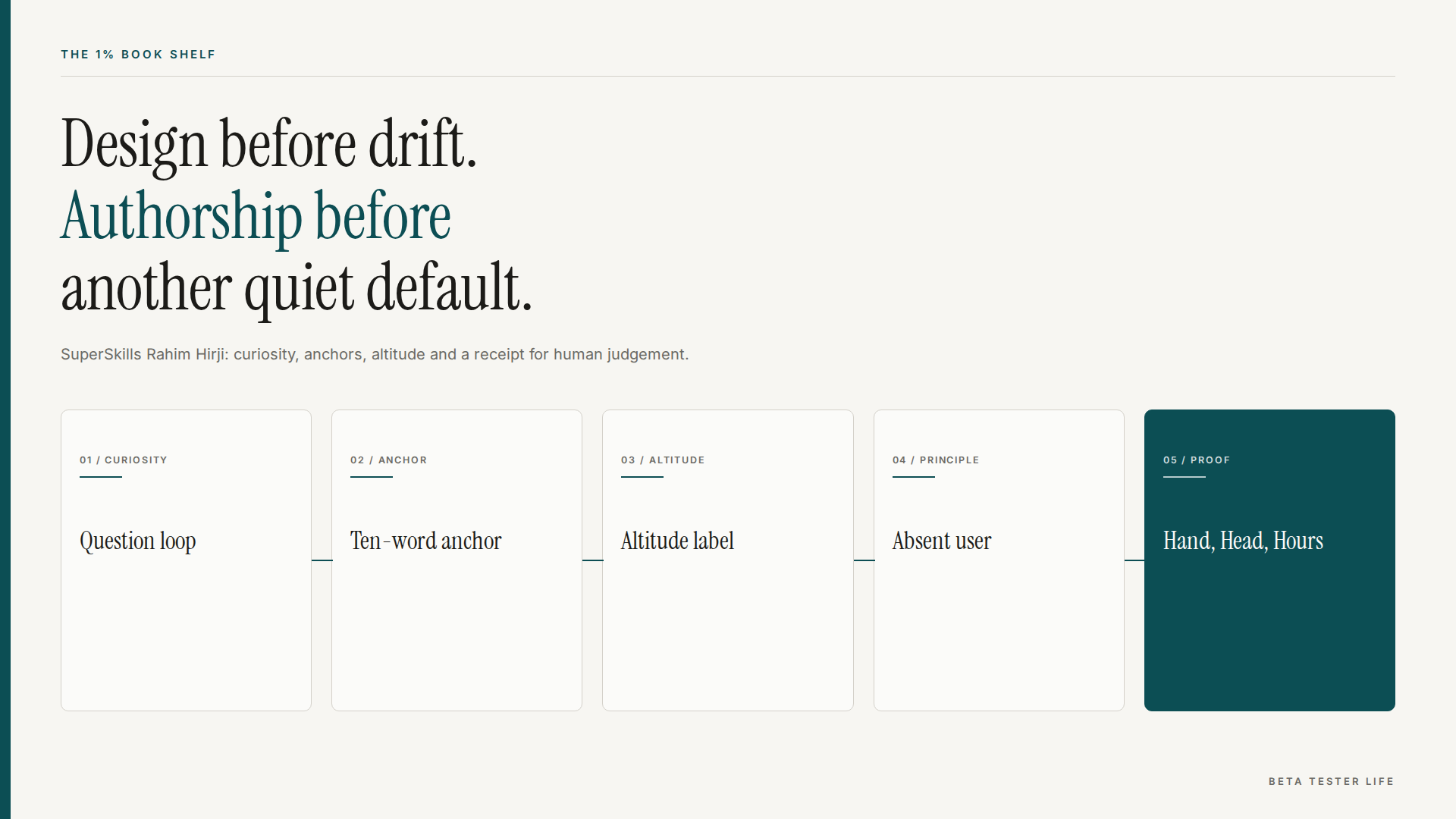
The 1% Book Shelf. SuperSkills: The Seven Human Skills for the Age of AI by Rahim Hirji (Kogan Page, 2026).
Read slowly. Keep what is useful. Question the rest.
The end of a career rarely arrives as an announcement. It arrives as one sentence in a stand-up. The new workflow handles deployments now. Nobody is dismissed. The salary continues. What leaves the building is the part of the job that made it worth doing: the 2am call, the judgement about when to roll back, the reason people turned to you when the system broke.
Rahim Hirji opens SuperSkills with that sentence and the engineer who hears it, and he is honest enough to include himself. He describes feeding a client brief into an AI tool and watching it produce, in ninety seconds, a better strategy deck than the one he had spent a morning building. His phrase for what he was doing when he "refined" the output is the sharpest line in the introduction: "quality-checking my own replacement".
Drift, design, and the two-by-two
The book's argument is that this is an agency problem before it is a technology problem. Hirji's word for the failure is drift, "the passive surrender to machine-made choices". His word for the alternative is design, which he defines as authorship, "choosing with intent while others wait for permission". The distinction runs from a prologue about four generations of his family (a dhow from Gujarat to East Africa, a grandfather who calmed soldiers with chai, parents who started again in a cold London) to a closing chapter about who gets to say they decided something at work. The framing is a two-by-two.
| Low awareness | High awareness | |
|---|---|---|
| High agency (design) | The Programmed. Efficient but obedient. Hits every metric, never asks whether it still measures what matters. | The Designers. Intentional and adaptive. Fixes what is broken, writes down the method, shares it. |
| Low agency (drift) | The Sleepwalkers. Busy but blind. Forty hours of meetings a week, impact hollow. | The Stuck. Aware but paralysed. Can list every inefficiency, stopped trying to fix them. |
The uncomfortable claim is that most of us live in the bottom two boxes and call it contribution. The question that moves you is the one Hirji keeps repeating: am I acting, or am I being acted upon?
Seven skills, and why Rahim Hirji chose these
His answer is seven skills, chosen from more than twenty candidates because each relies on "human cost, lived context or moral weight" and gains value as AI improves. He cut resilience as an outcome of the others and folded creativity into Principled Innovation. Curiosity and Change Readiness are the foundation. Big Picture Thinking, Empathy and Global Adaptability are lenses. Principled Innovation and the Augmented Mindset are the edge, where awareness turns into action. Each chapter retells a documented event as a scene (Mourinho at 4am before Old Trafford, Jobs killing the iPod, Figueres reframing Paris, Sullenberger on the Hudson, a burial during Ebola, an anaesthetist in a Thai cave), adds a confession from the author, names a failure mode and ends with a loop you can run in a week.
Here is what holds, what doesn't, and what I'd use on a Monday.
1. The foundation: questions and anchors
The curiosity chapter's best move is to strip the romance out. Curiosity here is a loop, not a mood. See the anomaly and write it down without explaining it away. Seek by running one small test by Friday instead of convening a meeting. Shift by recording the learning in one sentence, "We learnt X, so we will Y", and changing something. The evidence of a curious team, Rahim Hirji says, is a log of tests rather than a pile of slides. The question he wants on every wall is the one I would steal first: "What are we treating as fact that is still a guess?"
He is also clear about the cost. The chapter's most honest story is not Mourinho's but Clara's, a council analyst who noticed a parking algorithm fining night-shift care workers because permits renewed after midnight were timestamped for the following day. Her write-up changed nothing until a journalist called. The patch shipped in two days and the mayor took the credit. Curiosity, Hirji concludes, "needs consent, context and the possibility of redress to remain humane". Without them, "cleverness simply becomes extraction wearing a smile". Anyone who has watched a junior analyst's finding sit in a risk register until it became someone senior's idea will recognise the shape.
Change readiness, and the ten-word anchor
Change Readiness is the chapter I expected to be soft, and it isn't. Adaptability, Rahim Hirji argues, is "balance under acceleration" rather than speed, and the mechanism is an anchor: one sentence, ten words or fewer, naming what you will not trade. His test is blunt. "If it cannot help you say no, it is not an anchor. It is vanity." The rhythm is Hold, Release, Rebuild, and the proof is a weekly ritual he calls the Friday Proof. By Friday, find one "no", one change and one cost that the anchor produced. If you can't find them, the anchor has not entered your behaviour.
The examples land because they are costly. A triage nurse orders a test the sepsis protocol did not require because the team's whiteboard says "Protect the patient in front of you", finds an internal bleed the system missed, and is reprimanded by dawn for delaying throughput. The next night she adds three words to the whiteboard: "Even when hard." This is a book that understands anchors are paid for by whoever holds them, usually the person with the least power in the room.
2. The lenses: altitude, empathy and the day the rules break
Big Picture Thinking is where the book earns its place on a delivery leader's shelf. Hirji's word is altitude, and his claim is that "Many failures come from brilliant choices made at the wrong level rather than poor decisions." His illustration is a ninety-minute argument that never moves because the VP of Product wants features, the CFO wants speed to market and Engineering wants to pay down technical debt. Everyone is right. Everyone is at a different height. The unlock was a question that sounded naive: "Are we solving for this quarter, this year, or the next three?" Once the room agreed it was optimising for a three-year platform advantage, the decision took ten minutes. Two requests killed, one funded, one test set for Friday.
If you have sat through a PI planning session that ran like the first ninety minutes, you already know why this matters. Misalignment, Rahim Hirji says, "is not conflict. It is physics." His fix is to write the height at the top of the page before the debate starts (Quarter, Year or Three Years), then ask one person from each level to state the trade-off they see from their height in one sentence.
The subtraction drill, and altitude lock
The Altitude Lens adds three filters: Zoom In when vision has turned abstract, Zoom Out when firefighting repeats, Zoom Through Time when short-term optics win. Under them sit four drills, and the subtraction drill is the one to keep. List everything you track, cross out anything that would not break if ignored for ninety days, keep the three that matter. A venture investor showed Hirji a dashboard of 200 metrics. Asked which had changed a decision in the last three months, he circled three. "The rest were theatre."
The named failure is altitude lock, "when success hardens into certainty", and the example is Boeing choosing to upgrade the 737 rather than build a new aircraft. The line to keep: "The most dangerous place to be is excellent at the wrong altitude."
Empathy as calibration, not sentiment
Rahim Hirji treats empathy as calibration rather than sentiment, and his most useful contribution is an economic one. Machines can now mirror tone, remember birthdays and write condolences, so the signal has become cheap and what still counts is cost. "Real empathy costs the giver something. Fake empathy costs the receiver everything." The working method is Listen, Label, Ladder. Stay silent longer than is comfortable. Name the feeling ("It sounds like you're carrying something bigger than work"). Then ask one question: "What would make this better?" He also draws the boundary most writing on empathy misses, "feel fully, decide firmly". If you are still replaying the conversation hours later, you carried the emotion rather than felt it. The three-second pause before replying is the smallest rule in the book and probably the one with the best return.
February 29, the day the rules betray you
Global Adaptability introduces the book's strangest and best label, February 29, "the day the rules betray you". Its central scene is a composite from Sierra Leone in 2014, where a family reinvents a burial rite with gloves and chlorine because washing the body had become lethal. The method changed. The meaning survived. Hirji's rule is "Systems scale habits. Humans scale sense", and the cycle is Spot, Sense, Shift, Shape. His Line Test asks whether an adaptation hides harm, erases dignity, or trades long-term trust for short-term access. And the observation that "Power decides who pays the adaptation cost. The side with more influence always moves first" is as true of a platform team asking feature teams to "be flexible" as it is of a London head office briefing Lagos.
3. The edge: the line before the design, and proof that a human was there
The Principled Innovation chapter opens with the most uncomfortable confession in the book. Rahim Hirji built a restructuring model that let executives "pull a lever and watch a cost line glide down as if nothing human lived beneath it". Six months later, outside a station, he met one of the people the model had counted. She was carrying a bag from a retail shift and her LinkedIn still listed the company as current. She nodded and did not stop. He now keeps a file of lines. "No numbers without names." "If a model is quicker than its consequences, slow the model."
The framework that follows is the Principle Test, five questions to run before a decision: could I defend this in daylight in my own name, what harm compounds if it is repeated a thousand times, would I accept it on the receiving end, will I be proud of it in five years, and what does it make me? Then write one boundary in ten words or fewer and put it where it costs you to ignore it.
The Integrity Loop (draw the line, design with it in view, repair in public) comes with two practices I would adopt tomorrow: a rotating absent user seat in every review, held by someone whose job is to speak for the person affected but not present, and a repair note published within seven days of a material failure. Pixar rewriting Inside Out so that Sadness became the hinge of the film is the example of holding the line. Volkswagen's defeat device, "a line crossed so many times that it now felt like the norm", is the collapse.
The middle seat, where principle costs most
What lifts this chapter above the genre is the section on the middle seat, "the space between power and precarity where most people actually work". Rahim Hirji concedes that principle "often costs those with the least to spare" and gives advice for people who cannot afford to walk: document what you see, invite a witness, escalate one level beyond what feels comfortable, leave a trail you would be proud to have read aloud. Most leadership books assume the reader holds the budget. This one remembers that rent is due.
Where Rahim Hirji lets the machine lead
The Augmented Mindset chapter, the last of the seven, binds the other six, and its set piece is the 2018 Tham Luang cave rescue, where flow models, oxygen curves and dosage calculations sat alongside an anaesthetist's fingers on a sedated child's pulse. "The machines handled what could be measured. The humans carried what they could not." That binding is a piece of accounting. For Rahim Hirji the law of the decade is two sentences long: "Speed is cheap. Speed with proof is priced."
Hand, Head, Hours as a receipt
The proof is Hand, Head, Hours. Hand records what stayed human, as a line in a log with a name on it. "Hand is not a claim to virtue; it is a record of custody." Head records one miss and one fix per cycle, so the system's errors become policy rather than folklore, which is the habit an earlier piece here set out as a thirty-day plan for the verification gap. Hours records where the saved time went, because "If you cannot point to the investment, you did not invest it." In each of his worked examples the saved time goes into depth rather than volume: a same-day multidisciplinary discussion in radiology, ten phone calls to a bank's highest-risk customers.
He also maps three terrains for when to trust the machine. On statistical terrain the model sees more than you do and the human job is interpretation. Bias terrain is where a monitored model discriminates less than your current shortlist does, so let it propose and keep the final call. Then comes override terrain, where "The cost of being wrong lands on a person, not a system", and the human sits down, looks the person in the eye and explains. Anyone working near safety cases and change boards will find that third category familiar. I have written separately about where AI-assisted decisions leave leadership judgement. What Hirji adds is the demand that the override be visible and named, not implied by a signature on a form.

4. Part Two: five loops and five questions
Part Two is short, and its premise is the book's strongest sentence about modern work: "You do not lose authorship in one moment. You lose it one default at a time." Calendars accept invites. Sprint boards pull tasks forward. Release systems ship "safe by default" behind a toggle nobody set. The same drift is why an earlier piece here argued for designing the job an agent actually does before turning one loose on a workflow. His example is Derek, a chief of staff who asked an editor for a strategy memo with thirty minutes to spare, removed the machine's fingerprints, and sent it. The CEO loved it. Two months later the company pivoted on it, wrongly, and nobody could say where the error began. "The system wrote it. Derek signed it. Authorship had vanished into the gap between the two."
The conclusion adds a harder case, an American health insurer whose auto-denial system rejected claims in seconds with no meaningful human review. ProPublica's 2023 reporting on Cigna found doctors signing off more than 300,000 denials in two months, at an average of 1.2 seconds each. Hirji's verdict: "The technology was not the villain. The absence of authorship was."
Five loops, five questions
The Five Loops are the weekly rhythm meant to close that gap, each with a signal that tells you it is working.
| Loop | Rhythm | You’ll know it’s working when |
|---|---|---|
| Ship truth weekly (the Question Loop) | See, Seek, Shift | One test ships by Friday and one line is logged: “We learnt X, so we will Y.” |
| The reality advantage (the Anchor Loop) | Hold, Release, Rebuild | Every major bet carries a kill question: “If this turns out to be wrong, what will have fooled us?” |
| The trust flywheel (the Empathy Loop) | Listen, Label, Ladder | Every piece of work ends with one visible line: Owner, Date, Decision. |
| The adaptability loop (the Altitude Loop) | Zoom In, Zoom Out, Through Time | Three signals from outside your lane are logged each week, and one quarterly test has success and exit rules. |
| The leverage ladder (the Integrity Loop) | Draw, Design, Repair | One process runs without you, and each improvement is written up in a paragraph before you move on. |
Two of these will be familiar to anyone who has run a programme board. Nadia's rule, stopping a "final approval" email chain in a cautious government department to ask "Who owns this decision?" and then ending every piece of work with Owner, Date, Decision, is the cheapest governance improvement there is. It is also the point of an earlier piece here: the CC list is not a control. Farah's kill question, added after she visited a classroom the dashboard called "engaged" and found children watching a video while the teacher marked papers, is the antidote to every green status that means nobody has looked.
Five questions rather than a framework
The book ends with five questions rather than a framework, and they are better than most of the frameworks. Who is actually deciding here? What stayed human when speed took over? What changed because we learned something real? Where did judgement stop and automation take over? Would I still stand behind this if it were read back in daylight, with names attached? "These are not metrics," Rahim Hirji writes. "They are bearings."
The 1% takeaway: keep a receipt for human judgement
If you keep one idea from Rahim Hirji's SuperSkills, keep Hand, Head, Hours. Every other framework in the book is an exhortation to stay human. This one is a record. It turns "a human was in the loop" from a governance slogan into three lines someone can check: who made the call, what the system got wrong and what changed, where the saved hours went.
That matters in delivery because most organisations already record the first line and none of the others. A change record captures custody. It shows who approved the release. It never captures what the pipeline got wrong last month and what was changed as a result, and it never shows whether the hours the automation saved went into rehearsal, into a call with the customer, or into more throughput. Hirji's version of proof is the part change control leaves out.

Speed is cheap. Speed with proof is priced.
Where I would push back on Rahim Hirji
The push-back starts with proof. This is a book that argues evidence should travel with speed, and it builds much of its own evidence out of scenes it admits are partly imagined. The author's note is candid about it. For documented events, Hirji has "created narrative scenes" that "compress timelines and imagine human details".
The Sullenberger chapter shows what that costs. In the book, the captain asks his first officer "What do you think?", Skiles replies "We will not make a runway", and only then does Sullenberger tell the controller they are going into the Hudson. The cockpit voice recorder transcript in the NTSB docket has the Hudson call at 15:28:28. The question comes almost two minutes later, at 15:30:21, and it is "got any ideas?" The reply is "actually not."
The reconstruction is tidier. The record teaches more. A captain who asks his colleague for ideas seconds before touching down on a river, with nothing to gain but a check on his own thinking, makes a stronger case for the habit than a scripted exchange that sets up the decision. The disclosure is honest, but readers do not remember caveats. They remember scenes. That is the failure mode the book warns about in dashboards: polish mistaken for truth.
The numbers get the same softening. Hirji's introduction says recent World Economic Forum reports estimate "close to half" of workers' core skills will need to change within a few years. The 2025 Future of Jobs Report puts the figure at 39% by 2030, down from 44% in the 2023 edition. Forty-four is close to half. Thirty-nine, revised downward, is a different sentence.
Density, and forty named frameworks
The second problem is density. By my count the book names more than forty tests, loops, drills, protocols and matrices. The glossary runs to 112 entries, and somewhere between thirty and forty of them define terms the chapters never use (drift debt, meaning debt, reflection debt, trust ROI, "never twice"). Part Two, which is supposed to be the system that makes the seven skills hold together, runs to about 3,000 words against Part One's 34,000, and it shows.
Each of the Five Loops carries two names, one in Chapter 8 and another in Chapter 9, and the stories do not always illustrate the loop they sit under. Hirji demonstrates the Anchor Loop with a charity that started visiting classrooms to check its dashboards, which is a curiosity story, and his own commentary on it says so. The conclusion lists "Empathetic Communication" where every chapter said "Empathy". For a book about design over drift, Part Two drifts.
Naming a practice is not funding it
The third is the gap between naming a practice and funding it. A felt metric beside every quarterly goal, a repair note published within seven days, one person with the power to pause a release until three questions are answered: each of these costs political capital that the person reading the book may not have. To Hirji's credit, the middle-seat section is more honest about that than the genre usually manages. It does not make the practices cheaper. It does tell you how to survive attempting them.
None of this sinks the book, because the diagnosis is right and specific. Drift "arrives as a thousand small surrenders dressed as convenience". Authorship goes one default at a time. The ten-word anchor, the altitude label, the kill question, the ownership line and the Hand, Head, Hours receipt are good enough to run next week without asking anyone's permission. That is more than most books in this category manage.
Application to work, leadership and change
The practices Rahim Hirji sets out translate directly into how a delivery organisation plans, ships and reviews. Here is the working version, with a scenario for each.
| Practice | What it guards | Try this Monday |
|---|---|---|
| The ten-word anchor and Friday Proof | Decisions under schedule pressure | Put the team’s non-negotiable at the top of the release checklist. Friday: one no, one change, one cost. |
| Name the altitude | Frame-lock in planning | Write Quarter, Year or Three Years at the top of the page. One trade-off per level, one thing killed. |
| The kill question | Dashboard theatre | Add “If this turns out to be wrong, what will have fooled us?” to every status line. |
| Listen, Label, Ladder | Trust in reviews and escalations | Three seconds of silence, name the feeling, ask what one change would help. |
| The absent user and the Principle Test | Ethical drift in the backlog | Rotate an absent-user seat into refinement. Run the five questions on one small decision. |
| Hand, Head, Hours | Authorship when AI drafts the work | Three lines on every AI-assisted deliverable: who decided, one miss and fix, where the hours went. |
1. The ten-word anchor and Friday Proof
Write the one thing the team will not trade, in ten words or fewer, and put it where the release decision gets made. "No release without a rehearsed rollback." If Friday produces no "no", no change and no cost, the line is decoration.
Scenario. A regulatory deadline is three weeks out and the programme board wants a release brought forward. The anchor is on the checklist. The conversation is about how to rehearse the rollback in time, not about whether to skip it.
2. Name the altitude
Before any planning debate, write the height at the top of the document. Ask one person from each level to state, in one sentence, the trade-off they see from where they stand. Then name one thing that will be killed at that height.
Scenario. In PI planning, product argues for features, finance for speed, engineering for paying down debt. The RTE writes "Three Years" at the top of the board and asks each function for one sentence. Two features are dropped, one platform item is funded, and the argument that would have taken ninety minutes takes ten.
3. The kill question
Every status report and every major bet carries one line: "If this turns out to be wrong, what will have fooled us?" A person answers it, not a system. It is the fastest way to find out whether green means healthy or unchanged since last month.
Scenario. A programme dashboard shows every workstream green. The kill question on one of them reads: "The vendor's integration test result is three weeks old." The board asks for a fresh run before the next gate.
4. Listen, Label, Ladder
In the next incident review or escalation, pause for three seconds before replying. Name what you are hearing ("It sounds like you think you're being blamed for a design decision made two years ago"). Then ask one question: "What one change would help?" Feel fully, decide firmly.
Scenario. A team lead is defensive in a post-incident review. The pause and the label surface the fact that the same failure was raised in a risk register a year earlier and closed without action. The ladder produces a change: risks closed without action need a named owner's sign-off.
5. The absent user and the Principle Test
Give one seat in backlog refinement to whoever is affected by a decision but never in the room: the night-shift user, the customer on a legacy contract, the operator who will be paged. Rotate it. Run the five questions on any decision that feels too small to matter.
Scenario. A proposed change automates account restrictions after two failed checks. It improves a fraud metric. The absent user for the session is a customer with an unstable address history. The scale question ("If this act were repeated 1,000 times, what harm would compound?") turns the item into a design change with a human review step.
6. Hand, Head, Hours
For every deliverable a model helped produce, whether code, a status report or a risk assessment, add three lines and put them next to the metrics, not in an appendix.
Scenario. A weekly programme report is now drafted by a model from the tracker. The proof page underneath reads: Hand, the delivery lead changed the risk rating on the data migration after reading the raw defect list. Head, the model reported a dependency as closed because the ticket was closed, so the checklist now asks for evidence. Hours, forty minutes a week moved to a call with the supplier's test lead.
Hirji's great-grandparents crossed the Indian Ocean by the stars. The rest of us cross a week made of defaults: a calendar that accepts meetings we never chose, a board that pulls tasks forward, an editor that drafts before we think. His question is the one worth taping above the desk.
The Five Loops begin with one question: Who wrote your last decision?
If you cannot answer clearly, the system already has.
Sources
- Rahim Hirji, SuperSkills: The Seven Human Skills for the Age of AI (Kogan Page, 2026). Publisher page; author resources at thesuperskills.com.
- World Economic Forum, The Future of Jobs Report 2025, Skills outlook: "employers expect 39% of workers' core skills to change by 2030", down from 44% in the 2023 edition.
- National Transportation Safety Board, Loss of Thrust in Both Engines After Encountering a Flock of Birds and Subsequent Ditching on the Hudson River, US Airways Flight 1549, AAR-10/03 (2010), and the cockpit voice recorder transcript in docket DCA09MA026 (transcript).
- H. van Waart, R. J. Harris et al., "Deep anaesthesia: the Thailand cave rescue and its implications for management of the unconscious diver underwater", Diving and Hyperbaric Medicine 50(2), 2020 (PDF).
- ProPublica, "How Cigna Saves Millions by Having Its Doctors Reject Claims Without Reading Them", 25 March 2023, the auto-denial case Hirji cites in his conclusion.
- Sydney J. Harris, Pieces of Eight (1982), source of the warning that opens the introduction, "that men will begin to think like computers", as cited by Hirji.
- Herbert Simon, "Designing organizations for an information-rich world" (1971), for "a wealth of information creates a poverty of attention", as cited by Hirji.

Written by Kevin Campbell
Thirty years of technology, delivery and organisational change—translated into practical thinking for people doing the work.
Continue the journey
One thought leads to another.
Scroll to explore
 Learning & Mindset
Aligned: The Data-Driven Guide to Performance, Recovery, and Human Potential
Learning & Mindset
Aligned: The Data-Driven Guide to Performance, Recovery, and Human Potential
 AI Governance
AI Is Not a University. But It Can Build You One.
AI Governance
AI Is Not a University. But It Can Build You One.
 Leadership & Culture
The Hidden Value of Fleeting Encounters in a Transactional World
Leadership & Culture
The Hidden Value of Fleeting Encounters in a Transactional World
 Leadership & Culture
How to Build Products People Love: One Risky Bet
Leadership & Culture
How to Build Products People Love: One Risky Bet
 AI Governance
Reliable AI Systems: A Practical Way to Control Risky Outputs
AI Governance
Reliable AI Systems: A Practical Way to Control Risky Outputs
 AI Governance
AI Job Design: How to Make Agents Earn Their Place
AI Governance
AI Job Design: How to Make Agents Earn Their Place
Leave a Reply